


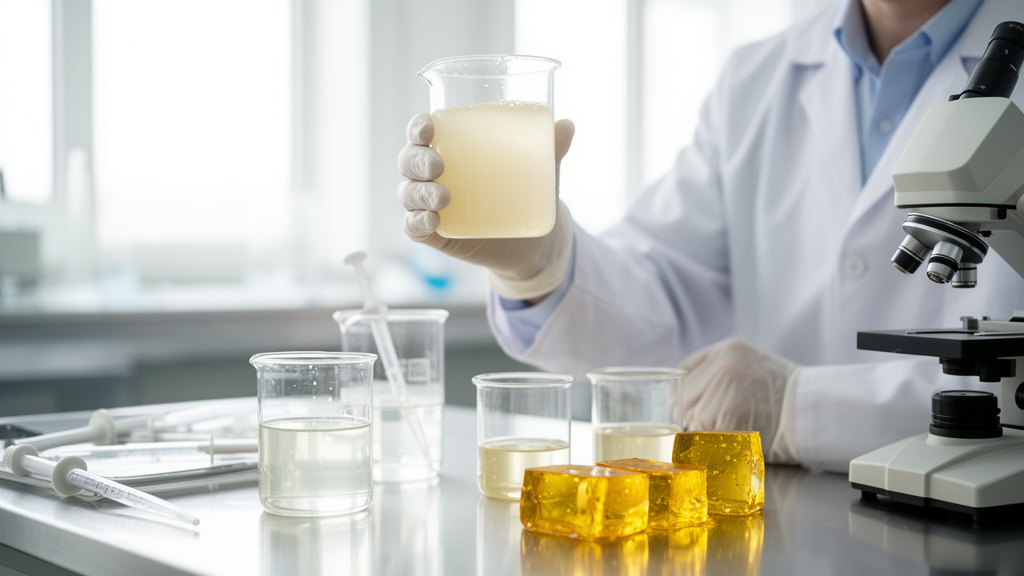
The appeal of oleogels and hydrogels in food science stems from a fundamental problem in modern product development: consumers increasingly demand foods with reduced saturated fat, added functional nutrients, and clean labels, yet the physical roles that traditional ingredients play are difficult to replicate. Solid fats, for example, do far more than carry lipids in a baked product. They trap air during creaming, provide plasticity during dough handling, and set the crumb structure during baking. When formulators simply remove them, the result is often a product with unacceptable texture, poor mouthfeel, and shortened shelf life. Structuring systems such as oleogels offer a way around this dilemma by immobilizing liquid oil within a three-dimensional network built from a small amount of a gelling agent, allowing liquid oils to perform some of the structural functions normally reserved for solid fats.
The gelling agents used to build oleogels are diverse, and each imparts distinct properties to the resulting network. Waxes, including candelilla, beeswax, and sunflower wax, form crystalline networks whose strength and thermal behavior depend on the chain length distribution of their hydrocarbon fractions and on the cooling history of the gel. Organogelators such as ethylcellulose build networks through polymer strand aggregation, while combinations of monoglycerides, phytosterols, and other small molecules can form tubular or fibrillar structures. Because the network architecture determines how oil is trapped, how the gel flows under shear, and how it melts or softens at elevated temperature, the choice of gelling agent is effectively a choice about the final food’s behavior during processing and consumption. This is why studies that systematically link gelator chemistry to functional performance in real foods, rather than in isolated gel systems, carry particular weight for the field.
Hydrogels operate on an analogous principle in the aqueous phase, using polysaccharides and proteins to build networks that hold water, modulate viscosity, and encapsulate hydrophilic compounds. Proteins such as whey, soy, and gelatin can form gels through heat-induced unfolding and aggregation, electrostatic complexation, or enzymatic crosslinking, while polysaccharides such as alginate, pectin, and carrageenan respond to ionic strength, pH, and hydration conditions. The stimulus-responsiveness highlighted in the review literature is especially relevant here: a hydrogel that remains intact in the acidic environment of the stomach but dissociates at intestinal pH can protect a sensitive cargo through gastric transit and release it where absorption is most favorable. Similar logic applies to temperature-triggered systems, which may remain stable during refrigerated storage but soften or release their payload at physiological temperature.
Bigels represent a further step in structural sophistication because they combine two gel phases that would normally be immiscible. In a typical bigel, an oleogel phase and a hydrogel phase are brought together under shear with the help of stabilizers and interfacial design, producing a material in which hydrophilic and lipophilic compounds can be compartmentalized separately. This compartmentalization matters for several reasons. It prevents reactive ingredients from contacting one another until the moment of consumption or digestion. It allows co-encapsulation of compounds with opposing solubility requirements. And it creates release profiles that can be tuned by adjusting which phase is continuous and which is dispersed, since a compound dissolved in the continuous phase will generally diffuse out faster than one sequestered in droplets of the dispersed phase. The phase ratio, droplet size distribution, and interfacial film composition therefore become design variables that food scientists can manipulate to achieve targeted delivery behavior.
The digestive fate of these systems deserves particular attention because the gastrointestinal tract subjects ingested materials to a sequence of environments that few laboratory tests replicate faithfully. In the mouth, shear forces and amylase begin to modify the matrix. In the stomach, acidic pH, pepsin activity, and mechanical churning act on the gel structure over periods ranging from minutes to hours. In the intestine, bile salts emulsify lipids, pancreatic lipase cleaves triglycerides, and the changing pH and ionic conditions continue to remodel whatever structure remains. A gel that appears stable in a beaker may disintegrate rapidly under gastric conditions, releasing its cargo prematurely, or conversely may resist digestion so effectively that its nutrients never become bioaccessible. Static in vitro digestion protocols that sequentially simulate oral, gastric, and intestinal phases have become standard tools for probing these transformations, and more advanced dynamic models that reproduce realistic transit times, pH profiles, and shear regimes are increasingly used to refine predictions.
Scattering and microscopy techniques underpin much of the structural insight in this field. Small-angle X-ray and neutron scattering can resolve features spanning from nanometers to hundreds of nanometers, revealing crystalline packing in wax networks, polymer mesh dimensions in hydrogels, and interfacial film thickness in emulsion gels. Confocal microscopy with selective fluorescent staining can map the spatial arrangement of oil and water phases in bigels, showing whether one phase forms connected channels or isolated domains. Rheology complements these methods by measuring how the network responds to deformation, distinguishing between elastic solids that hold their shape and viscous fluids that flow. When these measurements are collected at multiple stages of digestion rather than only on the freshly prepared gel, they allow researchers to construct a mechanistic narrative connecting formulation choices to structural evolution to nutrient release, which is precisely the framing that the current literature increasingly advocates.
The application of oleogels in baked goods illustrates how laboratory findings must confront the realities of industrial processing. Cookie production involves creaming of fat and sugar, which incorporates air bubbles that later expand during baking and set the final texture. A fat that does not cream properly will yield a dense, hard cookie regardless of its nutritional profile. During baking, the structuring fat must melt or soften at the right rate to allow expansion without collapse. After baking, it contributes to texture during chewing and to the migration of moisture during storage. Replacing conventional solid fat with a wax-based oleogel therefore requires that the gel network survive creaming shear, respond appropriately to oven temperatures, and deliver acceptable sensory properties, all while carrying functional compounds such as vitamin E that may themselves be heat-sensitive. Studies demonstrating complete replacement of solid fat in a real cookie formulation, with measurements of texture, color, and nutrient retention, thus provide evidence at a level of realism that model systems cannot.
High-temperature sterilization presents an even harsher challenge for gel-based systems. Retort processing, which is used to ensure the microbiological safety of shelf-stable meat products, exposes the food to temperatures well above those of normal cooking for extended periods. Proteins denature and aggregate further, polysaccharides may degrade, water held in gel networks can be expelled as the matrix contracts, and textures can shift from desirable to rubbery or mushy. Finding natural ingredients that help gels retain water and texture through such treatment is valuable both for product quality and for reducing the need for synthetic additives. Seaweed-derived ingredients are of particular interest in this context because they bring both water-holding polysaccharides and bioactive compounds, and their use in meat systems also aligns with efforts to reformulate processed meats toward improved nutritional profiles.
Bioaccessibility, the fraction of an ingested nutrient that is released from the matrix and made available for absorption, is the metric that ultimately connects delivery system design to nutritional benefit. A bioactive compound can be chemically intact in a food yet poorly bioaccessible if it remains trapped in an indigestible network or is degraded before release. Conversely, a gel that releases its cargo too early in the digestive tract may expose it to acidic conditions that promote degradation. The design goal is therefore not simply protection or simply release, but a controlled sequence in which the matrix survives processing and storage, resists premature disruption in the stomach, and disassembles at the appropriate point in the intestine. Achieving this requires that formulation studies measure bioaccessibility directly rather than inferring it from encapsulation efficiency alone, and the growing emphasis on digestion-coupled characterization reflects this recognition.
Several methodological themes emerge from the current body of work that will likely shape future research directions. First, the value of testing gels within finished foods under realistic processing conditions is now well established, and studies that bridge the gap between model gels and commercial products will continue to be needed. Second, the combination of structural characterization across length scales with digestion experiments offers a path toward predictive understanding, in which formulation changes can be anticipated to alter release behavior without exhaustive trial and error. Third, the use of plant-derived and food-grade gelators responds to consumer and regulatory pressure, and expanding the palette of such materials, including agricultural byproducts and underexploited seaweed species, broadens the options available to formulators. Fourth, the stability of bioactive compounds during processing, storage, and digestion must be tracked alongside structural performance, since a delivery system that protects structure but not payload fails its purpose.
The broader significance of this research area lies in its potential to reconcile nutritional goals with sensory expectations. Fat reduction, sugar reduction, and nutrient fortification all tend to compromise the textures that consumers enjoy, and the failure of many reformulated products in the marketplace reflects this tension. Gels that can be tuned independently in composition, structure, and responsiveness give formulators additional degrees of freedom, allowing fat to be restructured rather than removed, water to be bound rather than lost, and nutrients to be delivered rather than degraded. As the evidence base grows to encompass more food categories, more gelator combinations, and more complete digestive characterization, these systems will move from promising laboratory concepts toward practical tools for developing foods that are simultaneously healthier, stable, and enjoyable to eat.
Subject of Research: Next-generation oleogel and hydrogel systems for food structuring, digestion, and nutrient delivery
Article Title: Editorial: Next-generation oleogel and hydrogel systems: advances in structuring, digestion, and nutrient delivery in food matrices
Article References: Castelo-Branco, V. N. (2026). Editorial: Next-generation oleogel and hydrogel systems: advances in structuring, digestion, and nutrient delivery in food matrices. Frontiers in Soft Matter, 6, Article 2013976. https://doi.org/10.3389/frsfm.2026.2013976
Image Credits: AI Generated
DOI: 10.3389/frsfm.2026.2013976
Keywords: oleogels, hydrogels, bigels, food science, nutrient delivery, digestion, soft matter, food texture, bioactive compounds, stimuli-responsive materials, Editorial, Next-generation
Cite Scienmag News
Kristina Jarvis. (October 17, 2026). Gel Science Goes Viral: How Oleogels and Hydrogels Are Rewriting the Future of Food. Scienmag. https://scienmag.com/gel-science-goes-viral-how-oleogels-and-hydrogels-are-rewriting-the-future-of-food/
Kristina Jarvis. "Gel Science Goes Viral: How Oleogels and Hydrogels Are Rewriting the Future of Food." Scienmag, 17 October 2026, https://scienmag.com/gel-science-goes-viral-how-oleogels-and-hydrogels-are-rewriting-the-future-of-food/. Accessed 17 October 2026.
Kristina Jarvis. "Gel Science Goes Viral: How Oleogels and Hydrogels Are Rewriting the Future of Food." Scienmag. October 17, 2026. https://scienmag.com/gel-science-goes-viral-how-oleogels-and-hydrogels-are-rewriting-the-future-of-food/


