


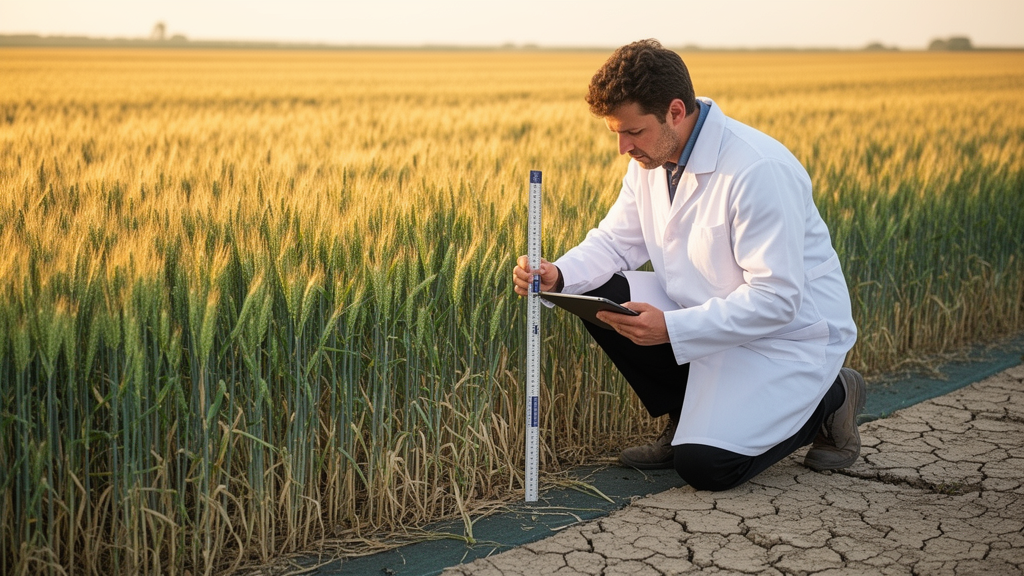
Drought remains one of the most formidable constraints on wheat productivity in semi-arid regions, where erratic rainfall and rising temperatures threaten the stability of harvests that feed millions. A new study published in BMC Plant Biology has taken a systematic approach to this challenge, evaluating 400 spring wheat genotypes from Pakistani germplasm collections through a sequential screening protocol that combined controlled seedling-stage stress with field-stage drought trials. The research, led by Muhammad Zeeshan and colleagues at The Islamia University of Bahawalpur in collaboration with institutions across Türkiye, Azerbaijan, Uzbekistan, and China, demonstrates how multivariate phenotypic profiling can efficiently narrow a large germplasm pool down to a manageable subset of drought-tolerant parental lines suitable for breeding climate-resilient cultivars.
The study was structured in two phases. In Phase 1, all 400 spring wheat genotypes were evaluated at the seedling stage under three moisture regimes: 100%, 70%, and 40% field capacity. A completely randomized design with three replicate pots per genotype-treatment combination was used, and ten morpho-physiological traits were recorded for each line. This seedling-stage screening served as the first filter, allowing researchers to identify genotypes that maintained growth under reduced water availability before committing resources to more expensive and time-consuming field trials.
The results of Phase 1 revealed the physiological toll that drought takes on young wheat plants. Mean seedling length declined from 40.0 cm under full moisture to approximately 29 cm under drought stress, a reduction that was statistically significant at P ≤ 0.01. Perhaps more telling was the response of proline content, an osmoprotectant that plants accumulate under water stress to protect cellular structures. Proline levels increased approximately 5.5-fold under drought conditions, also significant at P ≤ 0.01. Interestingly, no statistically significant difference was observed between the two drought levels for the growth traits, suggesting that once moisture dropped below a certain threshold, additional stress did not further impair seedling growth in a measurable way.
To make sense of the ten measured traits across 400 genotypes and three moisture regimes, the researchers turned to principal component analysis, a multivariate statistical technique that condenses correlated variables into independent axes of variation. The first two principal components jointly explained approximately 40% of the seedling-stage variation across all moisture regimes, while five components were required to explain more than 70%. This relatively even distribution of variance across multiple components indicated that drought adaptation at the seedling stage is not governed by a single dominant trait but rather by a combination of independent morpho-physiological characteristics.
Building on this multivariate framework, the team developed an integrated ranking system that combined standardized trait means, PC1 and PC2 scores, and hierarchical-cluster membership. Rather than relying on any single metric, this approach synthesized information from multiple dimensions of the phenotypic data to produce a holistic assessment of each genotype’s drought performance. From this ranking, 105 lines were advanced to Phase 2 field evaluation, representing roughly a quarter of the original pool. This sequential narrowing strategy exemplifies how controlled-environment screening can serve as an efficient pre-filter for field trials, reducing the logistical burden while preserving phenotypic diversity.
Phase 2 subjected the 105 selected lines to field-stage drought treatments at two critical developmental stages: drought at anthesis and drought at grain development, alongside a full-irrigation control. These stages are particularly vulnerable points in the wheat life cycle, as water stress during flowering can reduce grain set while stress during grain filling can diminish kernel weight and overall yield. The field evaluation provided a real-world test of whether seedling-stage tolerance translates into adult-plant drought resilience, a question that has long challenged plant breeders.
The field-stage results revealed a striking reorganization of the phenotypic structure under stress. Under full irrigation, the first principal component accounted for 60.96% of the phenotypic variation, indicating that a single dominant axis governed growth differences among genotypes in the absence of stress. However, under drought at anthesis, PC1’s contribution dropped to 22.47%, and under drought at grain development it fell to 30.26%. This redistribution of phenotypic variance across a larger number of independent axes under stress suggests that drought adaptation in adult wheat plants involves multiple independent traits rather than a single dominant characteristic, and that the genetic architecture of drought response differs fundamentally between well-watered and stressed conditions.
This stage-specific reorganization of the phenotypic structure carries important implications for breeding programmes. The authors caution against reliance on single-trait or single-stage selection, arguing that the multi-trait, multi-stage nature of drought adaptation demands a more comprehensive approach. A genotype that performs well at the seedling stage may not maintain that advantage under field conditions, and traits that correlate with yield under full irrigation may become decoupled under water stress. The pronounced shift in how phenotypic variance is distributed between seedling and field stages, and between different drought timing treatments in the field, underscores the complexity of drought as a breeding target.
The 105 lines identified through this sequential multivariate profiling represent a phenotypically diverse subset of Pakistani wheat germplasm suitable as parental material for a Line × Tester crossing programme aimed at drought resilience. The Line × Tester mating design is a well-established quantitative genetics approach that allows breeders to estimate combining ability and heterosis, providing insights into which parental combinations are most likely to produce superior drought-tolerant offspring. By ensuring that the selected parents span a range of phenotypic profiles rather than clustering around a single trait optimum, the multivariate approach maximizes the genetic diversity available for recombination in the breeding programme.
The germplasm used in this study was provided by the Pakistan Agricultural Research Council, the Wheat Research Institute in Faisalabad, and the Regional Agricultural Research Institute in Bahawalpur, reflecting a collaborative effort to harness national genetic resources for climate adaptation. The research was supported by the Recep Tayyip Erdoğan University Development Foundation, and the authors acknowledge TÜBITAK for granting a fellowship under the 2221 Sabbatical Scientist Support Programme. As drought intensifies across semi-arid wheat-growing regions from South Asia to the Middle East and beyond, the sequential multivariate profiling strategy demonstrated in this study offers a practical template for other breeding programmes seeking to identify climate-resilient germplasm from large collections. The work highlights that drought tolerance is not a single destination but a journey through multiple developmental stages, each with its own set of adaptive requirements, and that successful breeding for drought resilience must embrace this complexity rather than oversimplify it.
Subject of Research: Drought tolerance screening of bread wheat germplasm using multivariate phenotypic profiling
Article Title: Multivariate phenotypic profiling identifies drought-tolerant bread wheat germplasm through sequential seedling and field-stage screening
Article References: Zeeshan, M., Alam Khan, M., Ahmad, I., Normat Saydullayevich, X., Azhar Nadeem, M., Gou, J.-Y., Shehzad Baloch, F., & Tanveer Altaf, M. (2026). Multivariate phenotypic profiling identifies drought-tolerant bread wheat germplasm through sequential seedling and field-stage screening. BMC Plant Biology. https://doi.org/10.1186/s12870-026-10121-8
Image Credits: AI Generated
DOI: 10.1186/s12870-026-10121-8
Keywords: bread wheat, drought tolerance, germplasm screening, principal component analysis, cluster analysis, phenotypic profiling, plant breeding, climate resilience, Triticum aestivum, proline content, field capacity, semi-arid regions
Cite Scienmag News
Alan Morgan. (October 17, 2026). Multivariate phenotypic profiling identifies drought-tolerant bread wheat germplasm through sequential seedling and field-stage screening. Scienmag. https://scienmag.com/multivariate-phenotypic-profiling-identifies-drought-tolerant-bread-wheat-germplasm-through-sequential-seedling-and-field-stage-screening/
Alan Morgan. "Multivariate phenotypic profiling identifies drought-tolerant bread wheat germplasm through sequential seedling and field-stage screening." Scienmag, 17 October 2026, https://scienmag.com/multivariate-phenotypic-profiling-identifies-drought-tolerant-bread-wheat-germplasm-through-sequential-seedling-and-field-stage-screening/. Accessed 17 October 2026.
Alan Morgan. "Multivariate phenotypic profiling identifies drought-tolerant bread wheat germplasm through sequential seedling and field-stage screening." Scienmag. October 17, 2026. https://scienmag.com/multivariate-phenotypic-profiling-identifies-drought-tolerant-bread-wheat-germplasm-through-sequential-seedling-and-field-stage-screening/

