


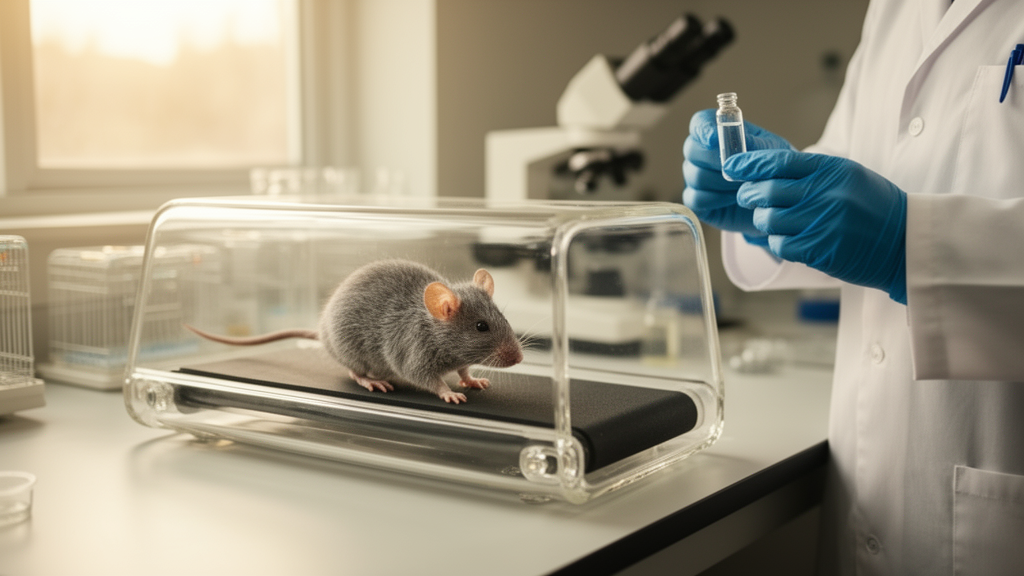
Aging steals physical function one small decline at a time: grip weakens, endurance fades, and balance becomes precarious. Exercise remains the best defense, yet many older adults cannot adhere to training programs, and even lifelong exercisers eventually feel aging blunt their gains. Now, a study in Physiological Reports suggests a way to stack the deck. Researchers report that Tat-Beclin1, a cell-permeable peptide that switches on autophagy, improved grip strength, endurance capacity, and balance and coordination in aged male mice, and that adding the peptide to an endurance training program produced gains comparable to the additive effects of both therapies.
The work, led by Kleiton A. S. Silva of Rowan University with collaborators including Sue C. Bodine and Vitor A. Lira, is, according to the authors, the first to test Tat-Beclin1 alone or combined with endurance training on the physical function of aged mice. The team hypothesized that an alternating-day regimen of the peptide and treadmill running would yield superior benefits compared with either treatment alone, and set out to identify the molecules associated with improvements in physical function.
Tat-Beclin1 is a small peptide derived from Beclin1, a fundamental autophagy-related protein that coordinates autophagosome formation and fusion with lysosomes through its association with the class III phosphatidylinositol 3-kinase complex. Mechanistically, the peptide binds GAPR-1, a negative regulator of autophagy, releasing Beclin1 back into the PtdIns3K complex and triggering autophagy, the primary cellular mechanism for degrading long-lived proteins and organelles. Autophagic activity is thought to decline with aging, and aerobic exercise can rescue it in aged muscles and hearts, making Beclin1 an attractive pharmacological target. Genetic evidence supports the idea: Beclin1 deficiency blunted exercise-induced increases in capillary density and endurance capacity in young mice, while a knock-in mutation that activates autophagy by disrupting the Beclin1/BCL2 interaction preserved myofiber cross-sectional area in 20-month-old animals.
To test the peptide in aging, the researchers purchased 22-month-old male C57BL/6J mice, roughly equivalent to 69-year-old humans, and randomly assigned them to four groups: control, Tat-Beclin1, exercise, and the combination. After baseline testing, the 23-month-old animals completed a four-week intervention on an alternating-day schedule. Exercise groups ran on a motorized treadmill three times per week, Mondays, Wednesdays, and Fridays, for 12 sessions, with warm-up, training at 70% of maximum running speed, and cool-down periods, and a slope that increased from 5% to 10%. Peptide groups received intraperitoneal injections of 15 mg/kg Tat-Beclin1 twice weekly, on Tuesdays and Thursdays, for a total of eight injections. Control animals received phosphate-buffered saline and were brought near the treadmill to account for handling and operational stress.
The functional results were striking. Tat-Beclin1 alone increased four-paw grip strength by 20.43% post-treatment, while the combination group gained 41.74%; control and exercise-only groups showed no significant change. Endurance capacity, measured as time to exhaustion on an incremental treadmill test, improved by 37.41% with the peptide, 53.87% with exercise, and 66.67% with the combination, while the control group trended downward by 21.17%. On the rotarod, an accelerating rod that assesses balance and coordination, the combination group increased latency to fall by 60.28%, whereas the control group declined by 22.41% and the single-treatment groups showed no significant change. Statistical analysis revealed significant main effects of both peptide and exercise across all three functional domains, but no significant interaction, indicating the peptide did not modify the effect of exercise beyond their individual contributions. The absolute gains in the combined group, however, were comparable to the additive effects of both therapies.
Notably, the combination did not blunt exercise adaptation, a persistent problem in geropharmacology. Metformin has been shown to antagonize the benefits of progressive resistance exercise in humans and to attenuate muscle mitochondrial respiration during aerobic exercise adaptation in aged rodents and older adults. Rapamycin opposes muscle hypertrophy adaptations to chronic overload and resistance exercise. By contrast, adding Tat-Beclin1 to endurance training preserved, and appeared to extend, the functional gains of running alone.
To probe the mechanisms, the team performed proteomic analysis of gastrocnemius/plantaris muscle using data-independent acquisition mass spectrometry. Gene set enrichment analysis showed that all three treatments upregulated fatty acid metabolism biological processes compared with controls, including fatty acid catabolic process in the peptide group, regulation of fatty acid catabolic process in the exercise group, and fatty acid beta-oxidation in the combination group. The protein ACACB, also known as ACC2, which regulates fatty acid entry into mitochondria, was the sole protein commonly upregulated in all three comparisons, suggesting remodeling of skeletal muscle lipid metabolism and enhanced capacity for fatty acid flux regulation.
The combination strategy produced a distinctive proteomic signature. Compared with exercise alone, the combined group upregulated proteins involved in mitochondrial bioenergetics, including oxidative phosphorylation, ATP synthesis coupled to the electron transport chain, and cellular respiration, suggesting high aerobic energy production to support muscle function. Unexpectedly, the combined treatment also upregulated proteins involved in stress and acute inflammatory responses. Among the few proteins meeting stringent statistical thresholds, haptoglobin and orosomucoid-1 were upregulated, findings confirmed by western blotting. Haptoglobin has been shown to be required to prevent muscle atrophy: haptoglobin-knockout mice exhibit muscle atrophy, decreased strength after exercise challenge, and impaired physical performance. Orosomucoid-1, meanwhile, improves endurance capacity and muscle glycogen content when administered to young rodents, reportedly by activating AMPK, an energy sensor that also activates autophagy. Inter-alpha-trypsin inhibitor heavy chain H4, involved in tissue repair, was also upregulated.
Surprisingly, given that both peptide and exercise are well-known autophagic agonists, western blotting revealed limited changes in the protein expression of autophagy markers, including Beclin1, the LC3B-II/I ratio, and p62, in the muscles examined. The authors suggest this likely reflects limitations in detecting dynamic autophagic activity at the selected endpoint rather than a true lack of autophagy induction. Autophagic flux assays with lysosomal inhibitors such as chloroquine or colchicine, and food removal prior to euthanasia, since rich nutrient conditions may blunt autophagic activity, should be considered in future studies. Morphological analysis of gastrocnemius/plantaris and tibialis anterior muscles showed no changes in mean myofiber cross-sectional area or fiber-type distribution, although the peptide produced a main effect on the cross-sectional area of type 2a and 2x fibers in the gastrocnemius/plantaris.
The study has limitations the authors acknowledge. Only male mice aged 23 to 24 months were studied, and the team is currently conducting similar studies in females. Future work should include adult animals to compare the impact of the peptide across ages, determine whether long-term treatment elicits further improvements, and focus on the detected acute inflammatory proteins, particularly orosomucoid-1, to assess whether the combination can serve as a standalone therapy for attenuating age-related decline in physical function. Nevertheless, the findings identify Tat-Beclin1 as a promising candidate for countering aging-related physical dysfunction, one that adds to, rather than blocks, the beneficial effects of endurance training, and point toward an underexplored mechanism of muscle protection during aging.
Subject of Research: Combining the autophagy-inducing peptide Tat-Beclin1 with endurance training to improve physical function in aged mice
Article Title: Adding Tat‐Beclin1 to an endurance training program promotes additive improvements in physical function in aged male mice
Article References: Tchen, T. T., Rahman, S., Ghiarone, T., Spruce, L. A., Fazelinia, H., Brown, E. M., Papachristou, C., Bodine, S. C., Lira, V. A., & Silva, K. A. S. (2026). Adding Tat‐Beclin1 to an endurance training program promotes additive improvements in physical function in aged male mice. Physiological Reports, 14(19), Article e71128. https://doi.org/10.14814/phy2.71128
Image Credits: AI Generated
DOI: 10.14814/phy2.71128
Keywords: Tat-Beclin1, autophagy, Beclin1, endurance training, aging, physical function, sarcopenia, skeletal muscle, proteomics, mitochondrial bioenergetics, haptoglobin, orosomucoid-1
Cite Scienmag News
Ophelia Keating. (October 17, 2026). Autophagy-Boosting Peptide Tat-Beclin1 Adds to Endurance Training Gains in Aged Mice. Scienmag. https://scienmag.com/autophagy-boosting-peptide-tat-beclin1-adds-to-endurance-training-gains-in-aged-mice/
Ophelia Keating. "Autophagy-Boosting Peptide Tat-Beclin1 Adds to Endurance Training Gains in Aged Mice." Scienmag, 17 October 2026, https://scienmag.com/autophagy-boosting-peptide-tat-beclin1-adds-to-endurance-training-gains-in-aged-mice/. Accessed 17 October 2026.
Ophelia Keating. "Autophagy-Boosting Peptide Tat-Beclin1 Adds to Endurance Training Gains in Aged Mice." Scienmag. October 17, 2026. https://scienmag.com/autophagy-boosting-peptide-tat-beclin1-adds-to-endurance-training-gains-in-aged-mice/


