


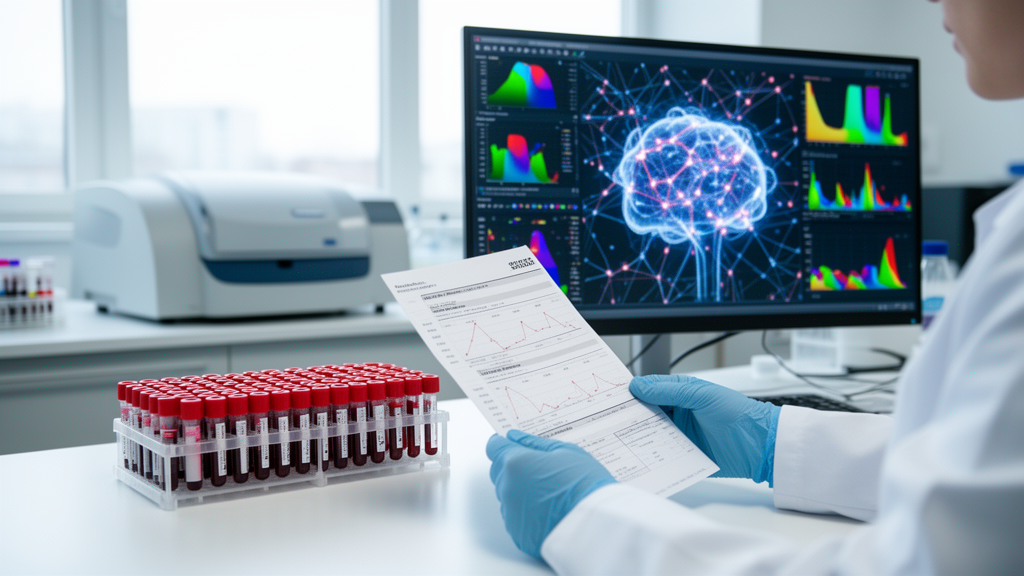
A routine complete blood count is among the cheapest, fastest tests in medicine, costing the equivalent of just a few dollars in many countries. Now, a research team from institutions in Pakistan, Saudi Arabia and Bahrain has shown that these humble reports, scanned straight from hospital paperwork, can feed an artificial intelligence system capable of flagging multiple diseases at once. The study, published in Frontiers in Imaging, describes an end-to-end pipeline that digitizes paper CBC reports with optical character recognition, labels them against expert-defined clinical thresholds, and then predicts probable conditions using tuned machine learning classifiers.
The motivation is straightforward. In developing countries, expensive disease-specific tests are often out of reach for large portions of the population, while the CBC test, ranging from roughly 600 to 1000 Pakistani rupees, is widely affordable. Its twelve standard parameters encode a surprising amount of clinical signal: white blood cell counts point to infection and leukemia, hemoglobin, red blood cell count and hematocrit indicate anemia and polycythemia, platelet counts reveal bleeding and inflammatory disorders, and the differential leukocyte fractions help identify bacterial infection, bone marrow suppression and allergic responses. Yet in most hospitals these reports exist only as paper printouts, unread by any algorithm and difficult to store or analyze at scale.
To build their dataset, the researchers collected nearly 8,000 real CBC reports from 2023 and 2024 at a local hospital, all in PDF form with identical layouts. After applying inclusion and exclusion criteria, 6,500 patient records remained. Crucially, all patient demographics and personal identifiers were removed in compliance with privacy guidelines, and ethical clearance was obtained from the hospital. The team then benchmarked six OCR engines on the scanned pages, including PyMuPDF, OpenCV, PdfMiner, Tesseract, EasyOCR and PaddleOCR, measuring each with the character error rate, the standard metric that counts substitutions, insertions and deletions against a manually verified ground truth.
PaddleOCR emerged as the clear winner, achieving 99 percent accuracy with a character error rate of just 0.01, compared to 93 percent for EasyOCR and 84 percent for PyMuPDF and OpenCV. The winning pipeline involved converting PDFs to images, then applying Gaussian filtering to remove high-frequency noise, median filtering to suppress salt-and-pepper artifacts without blurring character edges, skew correction to align table boundaries, histogram equalization to enhance contrast, and min-max normalization to rescale pixel intensities. A detection model localized the table region and identified rows, columns and value positions, while a CRNN-based recognition model with a structure-preserving module ensured that each extracted value stayed aligned with its correct test name, preventing records from being mixed together.
With the table data digitized, the team faced a labeling problem: the extracted records had no disease annotations. They solved this with a rule-based algorithm built on clinically accepted reference ranges verified by medical experts at the source hospital. Each of the twelve parameters received a dictionary of thresholds with disease associations for values above and below normal. A hemoglobin below 13 g/dL, for example, flags anemia, while a value above 18 g/dL suggests polycythemia; an MCV under 75 fL indicates microcytic anemia, an MCHC above 35 g/dL indicates hyperchromic anemia, platelets below 150 per microliter signal thrombocytopenia, and elevated neutrophils point to acute bacterial infection. The algorithm processed every record against these rules, generating both a binary disease-or-normal label and, importantly, multiple simultaneous disease labels per patient.
The data was then cleaned through exploratory analysis, with outliers detected in the platelet feature capped using a Z-score threshold to preserve clinical relevance, and all features standardized before modeling. For the multi-disease task, the team used multi-label classification, decomposing the single multi-disease output column into seventeen separate binary target columns via a Multi-Label Binarizer, so that each record became a vector of yes-or-no flags for each condition. Five classifiers were trained: logistic regression, decision tree, random forest, gradient boosting and support vector machine, all implemented in scikit-learn on a 16 GB Windows machine running Python 3.12.2.
Hyperparameter tuning proved decisive. Using GridSearchCV integrated with 10-fold cross-validation on an 80:20 train-test split, the team searched parameter grids for each model, setting the decision tree maximum depth to 20 with the Gini criterion, constraining the random forest to a depth of three, six leaf nodes and square-root feature sampling to prevent overfitting, fixing gradient boosting at 100 estimators with a learning rate of 0.1, and configuring the support vector classifier with a regularization parameter C of 3, scaled gamma and a radial basis function kernel. Untuned models peaked at around 74 percent F1-score for binary classification, but after tuning the cross-validated results climbed substantially, with gradient boosting reaching an F1 of 89.4 percent and an ROC-AUC of 0.94.
On the held-out test set, random forest delivered the best binary performance with 91.7 percent precision, 90.9 percent recall and a 0.94 ROC-AUC, narrowly edging out gradient boosting. The multi-label results told a similar story: random forest achieved around 93 percent precision and an F1 of 92.0 percent on cross-validation, with gradient boosting close behind, while logistic regression and the decision tree lagged. The authors noted that misclassified cases tended to involve borderline values only slightly outside normal ranges, highlighting how sensitive threshold-based labeling can be when clinical signals overlap. Across both tasks, the ensemble methods that aggregate many decision trees proved most robust to this ambiguity.
Transparency was addressed with explainable AI. The team applied SHAP, or SHapley Additive Explanations, analysis independently to each disease label, ranking features by their marginal contribution to each prediction. The analysis identified white blood cells, red blood cells, hemoglobin, MCV, platelets, hematocrit, MCH, MCHC and neutrophils as the most influential parameters driving both binary and multi-disease classification. This patient-level interpretability, the researchers argue, is essential for clinician trust in high-stakes healthcare settings, allowing a doctor to see exactly which blood values pushed a given prediction.
The study is the first of its kind, the authors say, to tackle multi-disease prediction from CBC features using a large real-world dataset, and it arrives with clear caveats. The data comes from a single hospital region and only twelve parameters, so results cannot yet be generalized to broader populations, and rule-based labeling may miss complex diagnostic patterns that only appear in richer clinical data. The team is already working to integrate the system into an Android application so patients and doctors can interpret reports interactively, and they suggest that hospitals should maintain online repositories to make digitization easier in the first place. If validated across multi-center data, the approach could turn the world’s most routine blood test into a low-cost early warning system, catching anemia, infections and more serious hematological conditions before expensive, time-consuming confirmatory tests become necessary.
Subject of Research: AI-based multi-disease prediction from digitized complete blood count reports
Article Title: AI-enabled multi-disease diagnosis using low-cost CBC reports
Article References: Bibi, M., Saeed, W. K., Jabeen, S., Shah, S., Ali, G., ELAffendi, M., & Khan, M. (2026). AI-enabled multi-disease diagnosis using low-cost CBC reports. Frontiers in Imaging, 5, Article 1754419. https://doi.org/10.3389/fimag.2026.1754419
Image Credits: AI Generated
DOI: 10.3389/fimag.2026.1754419
Keywords: complete blood count, artificial intelligence, machine learning, OCR, PaddleOCR, multi-label classification, disease diagnosis, medical imaging, healthcare, anemia, random forest, gradient boosting
Cite Scienmag News
Blake Davidson. (October 17, 2026). AI turns routine blood count reports into a low-cost multi-disease screening tool. Scienmag. https://scienmag.com/ai-turns-routine-blood-count-reports-into-a-low-cost-multi-disease-screening-tool/
Blake Davidson. "AI turns routine blood count reports into a low-cost multi-disease screening tool." Scienmag, 17 October 2026, https://scienmag.com/ai-turns-routine-blood-count-reports-into-a-low-cost-multi-disease-screening-tool/. Accessed 17 October 2026.
Blake Davidson. "AI turns routine blood count reports into a low-cost multi-disease screening tool." Scienmag. October 17, 2026. https://scienmag.com/ai-turns-routine-blood-count-reports-into-a-low-cost-multi-disease-screening-tool/


