


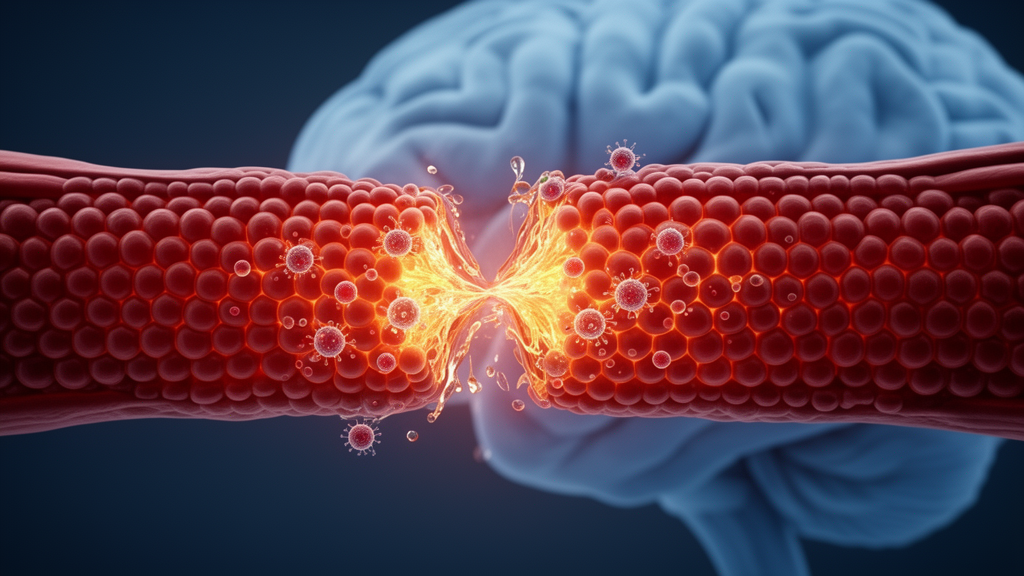
When a stroke cuts off blood flow to part of the brain, the damage does not stop with the neurons starved of oxygen. One of the most consequential secondary events is the failure of the blood-brain barrier, the tightly sealed lining of blood vessels that normally keeps the brain separated from the circulating blood. Once that barrier breaks down, fluid, immune cells and blood-borne toxins flood into neural tissue, amplifying swelling and cell death. A new study published in Translational Psychiatry points to a specific molecular culprit in this process: GPR84, an inflammatory receptor on the surface of blood vessel cells, which appears to actively dismantle the barrier’s structural seals from within.
The research, led by Haipeng Lu, Mingqiao Ying and Chuanchen Hu of the Department of Neurology at Affiliated Jinhua Hospital, Zhejiang University School of Medicine, set out to identify which inflammatory mediators drive barrier breakdown after ischemic stroke. Their attention settled on GPR84, a G protein-coupled receptor long associated with immune activation but poorly understood in the context of cerebral blood vessels. The team hypothesized that this receptor, when switched on during the inflammatory aftermath of ischemia, might not merely accompany barrier failure but actively cause it.
To test the idea, the researchers first looked at what happens to GPR84 in the injured brain. In a mouse model of experimental cerebral ischemia, they found a marked increase in GPR84 expression in the cortex, the outer layer of the brain where stroke damage is often most severe. The pattern was not limited to animals. When the team exposed human cerebral microvascular endothelial cells, the specialized cells that form the inner wall of brain capillaries, to oxygen-glucose deprivation followed by reoxygenation, a laboratory procedure that mimics the metabolic stress of stroke and reperfusion, those cells also ramped up GPR84 production. The receptor, in other words, is switched on by ischemic stress in both living brains and in the human vessel cells that build the barrier itself.
The decisive experiment came from genetics. The researchers studied mice engineered to lack a functional Gpr84 gene entirely. When these animals were subjected to ischemic insult, the difference was striking. Compared with normal mice, the GPR84-deficient animals developed smaller areas of tissue infarction, meaning less brain tissue died outright. Their brains swelled less, a critical measure because edema inside the rigid skull drives much of the acute damage after stroke. On standardized neurological assessments, which test motor coordination, reflexes and overall function, the knockout mice performed significantly better. Most importantly for the barrier hypothesis, vascular leakage, the pathological escape of blood components into brain tissue, was significantly reduced.
Underlying these functional improvements, the team observed preservation of the barrier’s molecular architecture. Two structural proteins, Claudin-5 and ZO-1, are essential components of tight junctions, the zipper-like seals that knit adjacent endothelial cells together and make the blood-brain barrier impermeable. In normal mice after stroke, these proteins degrade and disappear from the junctions, opening gaps in the wall. In the GPR84-deficient mice, Claudin-5 and ZO-1 remained intact at the neurovascular unit, the anatomical complex of vessel cells, supporting cells and neural tissue that together maintain the barrier. The genetic deletion had effectively protected the physical seals of the brain’s vascular lining.
To confirm that GPR84 acts directly on endothelial cells rather than through some indirect immune mechanism, the researchers turned to cell culture. They applied selective GPR84 agonists, molecules that artificially activate the receptor, to monolayers of endothelial cells grown in the laboratory. The result was a recapitulation of barrier failure: the cell layers, which normally form tight, impermeable sheets, became leaky. This experiment demonstrated that switching on GPR84 is sufficient by itself to break down endothelial barrier function, without any contribution from immune cells or other brain cell types.
The team then probed the signaling pathway downstream of the receptor, and this is where the study delivers its most mechanistically interesting finding. GPR84 activation disrupted the cAMP pathway, a ubiquitous intracellular signaling system in which the messenger molecule cyclic AMP regulates countless cellular processes. When the researchers co-administered a cell-permeable cAMP analogue, a synthetic version of the messenger that can enter cells and restore signaling, the barrier failure caused by GPR84 activation was abrogated. The protective effect of restoring cAMP signaling pointed to a specific cascade: GPR84 suppresses cAMP, and the loss of cAMP drives the breakdown of tight junctions.
Further experiments refined the pathway. When the researchers silenced GPR84 expression in endothelial cells, the cells became resistant to barrier dysfunction under ischemic stress. Critically, this resistance was linked to maintained phosphorylation of CREB, a transcription factor that acts downstream of cAMP and regulates the expression of numerous genes, including those involved in maintaining tight junctions. In cells with active GPR84, CREB phosphorylation drops, and the transcriptional programs that keep tight junction proteins in place presumably falter. In cells where GPR84 is silenced, CREB phosphorylation is preserved, and the structural integrity of the barrier holds. The authors describe this as a cell-autonomous GPR84-cAMP-CREB signaling cascade that directly impairs brain endothelial barrier function, meaning the entire pathway operates within the endothelial cell itself rather than requiring signals from neighboring cells.
The authors are careful to note an important limitation. While the cell culture experiments establish that GPR84 on endothelial cells is sufficient to cause barrier failure, the integrated contributions of GPR84 expressed on immune cells within the neurovascular unit in vivo remain to be defined. In the living brain, GPR84 is also present on microglia, macrophages and other immune cells that swarm into the injured area after stroke, and these cells may contribute to barrier disruption through additional mechanisms that the current study does not fully disentangle. The endothelial-autonomous pathway is clearly established, but the full in vivo picture likely involves multiple cell types acting in concert.
Nevertheless, the findings position GPR84 as a candidate mechanistic target for barrier preservation strategies after ischemic stroke. Current stroke therapies remain limited, with thrombolysis and mechanical thrombectomy addressing the clot but doing little to prevent the secondary inflammatory damage that unfolds over hours and days. If pharmacological inhibition of GPR84, or interventions that restore cAMP-CREB signaling in endothelial cells, can be developed into viable treatments, they could offer a way to keep the blood-brain barrier intact during the critical window after reperfusion, potentially reducing edema, limiting hemorrhagic transformation and improving neurological outcomes. The study, supported by Affiliated Jinhua Hospital, Zhejiang University School of Medicine, and published open access, provides a detailed molecular map of one pathway by which stroke damages the brain’s most important protective boundary, and a clear starting point for therapeutic exploration.
Subject of Research: The role of the inflammatory receptor GPR84 in blood-brain barrier disruption after ischemic stroke
Article Title: GPR84 exacerbates blood-brain barrier disruption after ischemic stroke via cAMP/CREB-dependent tight junction suppression
Article References: Lu, H., Ying, M., & Hu, C. (2026). GPR84 exacerbates blood-brain barrier disruption after ischemic stroke via cAMP/CREB-dependent tight junction suppression. Translational Psychiatry. https://doi.org/10.1038/s41398-026-04378-8
Image Credits: AI Generated
DOI: 10.1038/s41398-026-04378-8
Keywords: GPR84, blood-brain barrier, ischemic stroke, tight junctions, Claudin-5, ZO-1, cAMP, CREB, endothelial cells, cerebral ischemia, neurovascular unit, Translational Psychiatry
Cite Scienmag News
Cassandra Pierce. (October 17, 2026). Inflammatory receptor GPR84 weakens the blood-brain barrier after stroke, study finds. Scienmag. https://scienmag.com/inflammatory-receptor-gpr84-weakens-the-blood-brain-barrier-after-stroke-study-finds/
Cassandra Pierce. "Inflammatory receptor GPR84 weakens the blood-brain barrier after stroke, study finds." Scienmag, 17 October 2026, https://scienmag.com/inflammatory-receptor-gpr84-weakens-the-blood-brain-barrier-after-stroke-study-finds/. Accessed 17 October 2026.
Cassandra Pierce. "Inflammatory receptor GPR84 weakens the blood-brain barrier after stroke, study finds." Scienmag. October 17, 2026. https://scienmag.com/inflammatory-receptor-gpr84-weakens-the-blood-brain-barrier-after-stroke-study-finds/


