


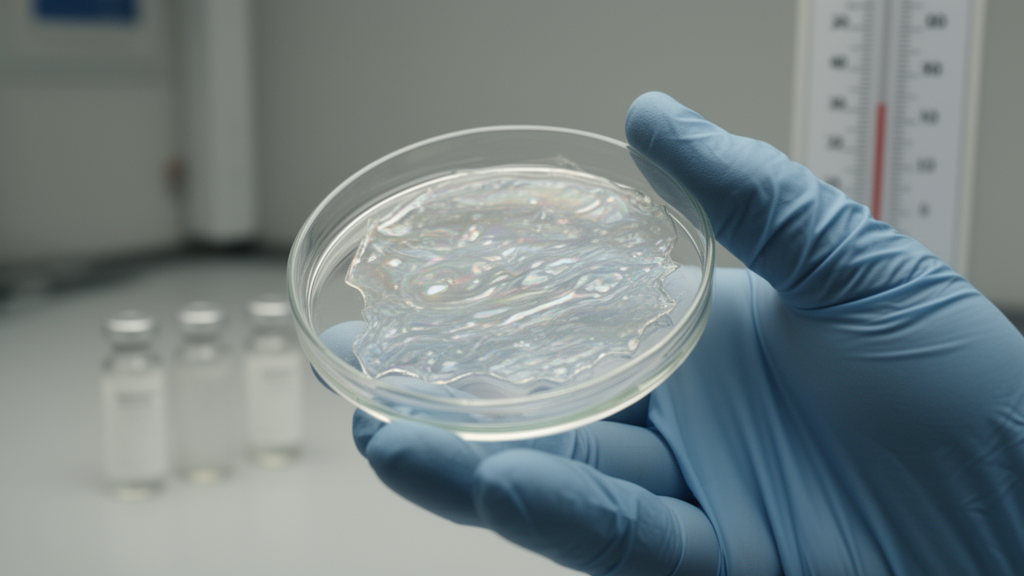
Vaccines that must stay frozen are a persistent bottleneck for global health, and a new biomaterials study suggests a way around the problem for one promising class of nanovaccines. Researchers at Union College have shown that bacterial outer membrane vesicles, spherical lipid bilayers studded with protein antigens, can be dried into thin polymer films and remain structurally intact for up to eight weeks at room temperature. The work, published in Frontiers in Biomaterials Science, is the first investigation of outer membrane vesicles in a thin film format and points toward a buccally administered vaccine platform that would not depend on cold-chain infrastructure.
Outer membrane vesicles, or OMVs, are roughly 50 to 150 nanometers in diameter, cannot replicate, and carry multiple pathogen-associated molecular patterns that make them potent adjuvants. They have already been engineered to display influenza antigens, including the Matrix two protein extracellular domain, and recombinant OMV vaccines have protected mice against lethal influenza A challenge. Their weakness is thermal: OMVs are unstable above 37 degrees Celsius and are normally stored frozen or freeze-dried long term. The authors report their own observations that OMVs precipitate from solution within hours at room temperature and overnight at 4 degrees Celsius, underscoring how fragile these vesicles are in liquid form.
The team, led by Stephanie M. Curley in the Electrical, Computer, and Biomedical Engineering Department, generated OMVs from engineered ClearColi cells displaying four heterologous M2e epitope sequences fused to the bacterial protein ClyA with a C-terminal histidine tag. Vesicles were purified by vacuum filtration and ultracentrifugation, quantified by total protein content, and characterized by dynamic light scattering to confirm particle size distribution and concentration. Films were then prepared by drop casting 750 microliters of formulation into 12-well plates and drying for at least 24 hours at room temperature.
Formulation engineering was a central part of the study. The researchers screened solvents including water, phosphate-buffered saline, sodium chloride, and Tris buffers, finding that 20 millimolar Tris at pH 8.8 produced the most consistent film formation across excipients. Two molecular weights of hydroxypropyl methylcellulose, or HPMC, were tested, but only the 10 kilodalton version dissolved fully at the concentrations needed; the 86 kilodalton polymer failed to dissolve, and 1 percent HPMC yielded thin, brittle films while 5 percent and above proved unwieldy. The final films used 2.5 percent HPMC, combined with poly(vinyl) alcohol, poly(ethylene) glycol, sorbitol, glycerol, or the amphiphilic compound PMAL, and OMVs were loaded to a reconstituted total protein concentration of 0.03 milligrams per milliliter.
Physical characterization revealed how the vesicles integrate into the film matrix. Fourier transform infrared spectroscopy showed broader and more intense peaks in the approximately 3500 per centimeter region, which the authors attribute to enhanced hydrogen bonding between hydroxyl groups of the HPMC matrix and functional groups on OMV surface proteins and lipopolysaccharides. Hydrophilic, hydroxyl-dense additives such as PVA, sorbitol, and glycerol further strengthened these interactions. Scanning electron microscopy showed spherical protrusions on the surface of OMV-containing films that were absent from control films, and cross-sectional imaging established a film thickness of approximately 50 to 100 micrometers, thin enough for rapid dissolution.
Long-term stability testing produced the study’s most consequential findings. Four film types were stored at room temperature for up to eight weeks, then reconstituted in phosphate-buffered saline and assessed by particle count and protein analysis. Films containing PMAL, an amphiphilic compound often used to stabilize biomolecules, degraded the OMV structure completely within four weeks, an outcome the authors link to its detergent-like nature, since surfactants are routinely used to degrade OMVs in laboratory assays. In contrast, films containing PVA with sorbitol or PVA with glycerol maintained consistent particle counts over the full eight weeks, with only a slight reduction in the PEG-containing film at the final time point.
Protein stability told a more nuanced story. Dot blots probing the histidine-tagged ClyA-M2e antigen on intact vesicles showed that PMAL-containing films lost detectable antigen by two weeks, earlier than the four-week point at which particle degradation became apparent, suggesting that surface proteins interact directly with film components and degrade before the vesicle structure collapses. SDS-PAGE analysis indicated protein degradation in PMAL films as early as one week after film formation, although the low antigen concentration of approximately 0.03 milligrams per milliliter limited the resolution of the expected 50 kilodalton ClyA-M2e band. Western blotting, which captures antigen both within and on the surface of vesicles, showed that ClyA-M2e content remained relatively consistent across eight weeks in sorbitol-containing films and, to a large extent, in PEG-containing films, with PEG formulations providing the most protein stability overall and some reduction visible in glycerol-containing films at eight weeks.
Dissolution testing addressed the platform’s intended route of administration. Because only the first two formulations, HPMC-PVA-sorbitol and HPMC-PVA-glycerol, were mechanically stable enough to be removed intact from the casting molds, these films were tested in solutions mimicking the salivary environment, containing alpha-amylase, lipase, and lysozyme alone and in combination in cell culture medium at 37 degrees Celsius. All dissolution times fell below roughly 400 seconds, with most films dissolving in under five minutes, and alpha-amylase produced the fastest dissolution of the three single enzymes. The authors note this is unexpected, since cellulose compounds inhibit alpha-amylase activity, and suggest instead that amylase binding to the cellulose surface may physically disrupt the film structure and accelerate dissolution.
The implications reach beyond the laboratory bench. Lower respiratory infections are currently the fourth leading cause of death worldwide, and influenza alone causes an estimated 389,000 deaths annually. Systemic injection often fails to promote immunity at the oral and nasal mucosa, the primary site of infection for respiratory pathogens, whereas mucosal vaccines can induce both local and systemic responses and eliminate needles entirely. Prior modeling work cited in the study predicts that improving the thermostability of a single pentavalent vaccine would make it available in almost every part of developing countries, and thin film platforms have previously achieved up to 100 percent recovery of infectious and immunogenic agents while preserving active and inactive viruses, bacteria, and proteins without refrigeration.
The authors are candid about limitations. Background scattering from reconstituted HPMC particles complicated dynamic light scattering analysis, and they suggest nanoparticle tracking analysis with an instrument such as the NanoSight300, which counts individual particles, may be better suited to future work. Formulations three and four frequently tore during removal from the casting molds, and the team is investigating silicone molds, which have provided a greater success rate in film removal and could yield films with fewer defects and more uniformity. The next step is animal testing to determine whether OMV immunogenicity remains consistent after long-term room temperature storage. If it does, a thin film that dissolves on the cheek within minutes and survives eight weeks on a shelf could bring mucosal nanovaccines to populations that ultra-cold freezers have left behind.
Subject of Research: Biomaterials Science
Article Title: Outer membrane vesicle loaded thin films as a stable room temperature vaccine platform
Article References: Randall, N. M., Squissato, J., Numanoglu, C., Dubois, W., Lee, H., & Curley, S. M. (2026). Outer membrane vesicle loaded thin films as a stable room temperature vaccine platform. Frontiers in Biomaterials Science, 5, Article 1913356. https://doi.org/10.3389/fbiom.2026.1913356
Image Credits: AI Generated
DOI: 10.3389/fbiom.2026.1913356
Keywords: outer membrane vesicles, thin films, vaccine thermostability, cold chain, mucosal vaccination, biomaterials, Outer, membrane, vesicle, loaded, thin, films
Cite Scienmag News
Kristina Jarvis. (October 17, 2026). Bacterial vesicle thin films survive eight weeks at room temperature. Scienmag. https://scienmag.com/bacterial-vesicle-thin-films-survive-eight-weeks-at-room-temperature/
Kristina Jarvis. "Bacterial vesicle thin films survive eight weeks at room temperature." Scienmag, 17 October 2026, https://scienmag.com/bacterial-vesicle-thin-films-survive-eight-weeks-at-room-temperature/. Accessed 17 October 2026.
Kristina Jarvis. "Bacterial vesicle thin films survive eight weeks at room temperature." Scienmag. October 17, 2026. https://scienmag.com/bacterial-vesicle-thin-films-survive-eight-weeks-at-room-temperature/


