


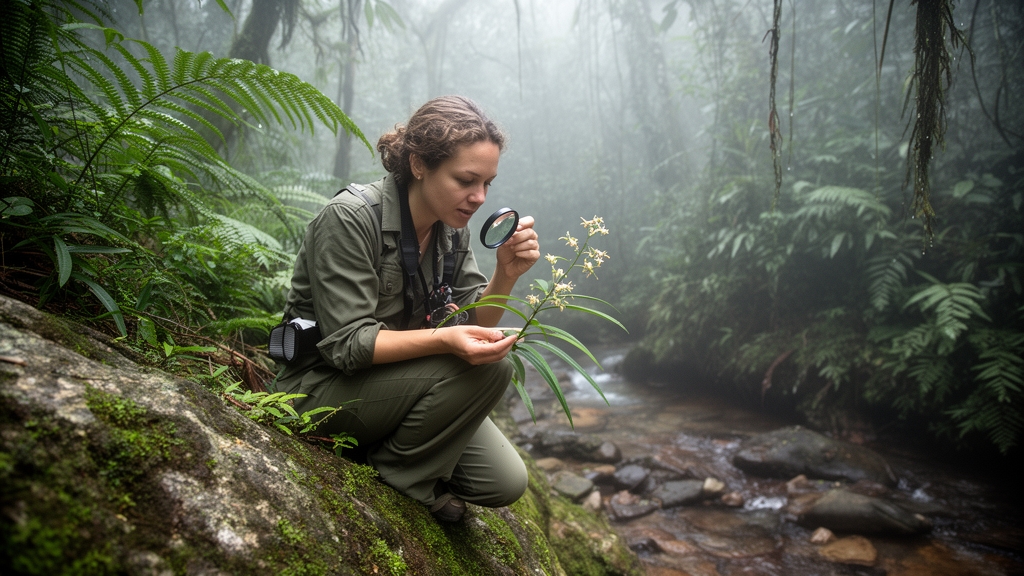
Deep in the evergreen broad-leaved forests of Vietnam’s Central Highlands, botanists have identified a flowering plant that no one had ever formally documented. The species, now named Staurogyne konchurangensis, was collected in Kon Chu Rang Nature Reserve in Gia Lai Province and is described as new to science in the journal PhytoKeys. Alongside it, the researchers present the first comprehensive account of Staurogyne purpurea, a striking purple-flowered herb from northern Vietnam whose diagnostic features and geographical distribution had remained only sketchily known since its original brief description in 2020.
Staurogyne is the largest genus of the subfamily Nelsonioideae within the Acanthaceae, the family that includes Acanthus, Ruellia and Thunbergia. Nelsonioideae comprises six genera and roughly 175 species, characterized by the absence of cystoliths in epidermal cells, descending cochlear aestivation of the corolla lobes, more than four ovules per ovary, and albuminous seeds that lack funiculi. Staurogyne itself contains around 166 species scattered across tropical and subtropical regions of America, Africa and Asia. The genus is defined by bracteoles attached to the pedicel rather than adnate to the receptacle or calyx tube, subequal or unequal calyx lobes, corollas usually less than three centimeters long, two stamens or four didynamous stamens per flower, and capsules lacking retinacula that contain numerous minute seeds. In Vietnam, 27 species of Staurogyne have been recorded so far, and the new paper raises that tally while sharpening the picture of another.
The discovery of S. konchurangensis resulted from fieldwork spanning several years. Teams led by D.V. Hai collected specimens in Kon Chu Rang Nature Reserve in July and September 2017, while a team led by M.S. Nuraliev gathered material in May 2016 and November 2022. The type specimen, designated as the holotype, was collected on 19 September 2017 at an elevation of 986 meters in Son Lang Commune. Voucher specimens were prepared following standard herbarium protocols and are deposited in the herbaria HN, LE and MW. The researchers also examined relevant specimens from Vietnam and neighboring countries through high-resolution digital images available via JSTOR Global Plants and the Global Biodiversity Information Facility, allowing careful comparison with material held in collections worldwide.
Staurogyne konchurangensis is a small herb, growing to about twenty centimeters tall, with stout, terete, pubescent stems that are distinctly brown-purple in color. Its leaves are oblanceolate, three to 9.5 centimeters long and 0.7 to two centimeters wide, dark green and glabrous above with dark green cystoliths, and whitish green below with sparse pubescence along the veins. The inflorescence is a lax raceme six to thirteen centimeters long, bearing four to fourteen flowers. The flowers are weakly zygomorphic, with a five-lobed calyx split nearly to the base, a white corolla approximately 1.5 to two centimeters long that sometimes carries a slight purple tint, and four didynamous stamens with glandular hairy filaments. The ovary contains 26 to 28 ovules per locule, and the capsule is oblong, eight to nine millimeters long and 2.5 to three millimeters wide, holding 52 to 56 seeds.
What sets the new species apart from its closest relatives is a combination of measurements rather than any single dramatic feature. It is similar in habit to S. concinnula and S. debilis, two congeners that also form lax racemes and white corollas on herbs ten to twenty centimeters tall. But S. konchurangensis has bracts five to eight millimeters long, compared with two to four millimeters in S. concinnula and about two millimeters in S. debilis. Its calyx measures ten to thirteen millimeters, versus five to seven and five to six millimeters respectively. Its corolla is roughly 1.5 to two centimeters long, about twice the length of the corollas of both allied species, and its capsules are larger as well. The stamens are also longer, with the anterior pair seven to nine millimeters and the posterior pair six to seven millimeters, and the style reaches eleven to fourteen millimeters. The stigma is unequally two-lobed, with the adaxial lobe apically divided into two small serrate lobules, a shape that differs from the subulate stigma of S. concinnula.
The new species grows under the shade of primary and secondary evergreen broad-leaved forest on fertile soil along streams, at elevations of 900 to 1000 meters. It is currently known only from Kon Chu Rang Nature Reserve, a legally protected territory in Gia Lai Province. The researchers note that the plant occurs at undisturbed sites where only a slight anthropogenic threat has been detected, but that no data exist on its population size and structure. They therefore preliminarily assess its conservation status as Data Deficient under the IUCN Red List Categories and Criteria, a designation that reflects how much remains unknown rather than how secure the species may be. Flowering and fruiting occur from May to November, and the species is named after its type locality, Kon Chu Rang Nature Reserve, with the proposed Vietnamese vernacular name Nhụy thập kon chư răng.
One curious feature of the new species is the orientation of its flowers, which often appear inverted or oblique. The authors suggest that this phenomenon may result from resupination, a condition known in some members of Acanthaceae, such as many Strobilanthinae, but resupination has never been documented in Staurogyne. Alternatively, the unusual orientation could result from bending of the inflorescence rachis or the pedicel. Determining the cause will require further study, including examination of living material in the field, since dried herbarium specimens cannot easily reveal the developmental processes behind such floral reorientation.
The second part of the paper concerns Staurogyne purpurea, a much taller herb reaching up to 1.2 meters, described originally in 2020 from steep rocky slopes of stream valleys in what was then Ha Giang Province in northern Vietnam. The species was collected during fieldwork by the team of B.H. Quang in Tuyen Quang Province, in Tung Vai Commune in April 2024 and in Minh Tan Commune in April 2025 and June 2026, the latter locality having previously been included in Ha Giang Province. The new collections allowed the researchers to present a full description for the first time, including detailed morphological data and analytical illustrations of the flower, fruit and seed.
S. purpurea is a robust, usually branched plant with elliptic leaves twelve to eighteen centimeters long and five to eight centimeters wide, densely pubescent below especially along the midvein and secondary veins. Its dense racemes bear many flowers with a corolla approximately three centimeters long, bright purple on both surfaces except for a whitish proximal portion of the tube, and marked with about twenty dark longitudinal lines on the tube. The calyx lobes are fourteen to sixteen millimeters long, the stamens are didynamous with glandular hairy anther thecae connected in pairs, and the style reaches 2.5 to 2.8 centimeters. The capsule holds 56 to 60 seeds. The species is most similar to S. caobangensis, endemic to northern Vietnam, and S. vicina, known from Yunnan in China and northern Vietnam, but differs from both by its longer leaf blades, its lanceolate to ovate bracts, its narrowly oblanceolate to linear bracteoles, and above all by its bright purple corolla, whereas both allied species have pure white flowers.
S. purpurea is currently known from two localities in Tuyen Quang Province, within the legally protected Bat Dai Son Nature Reserve and Phong Quang Nature Reserve. It grows under the shade of very humid primary evergreen broad-leaved forests and on steep rocky slopes of stream valleys composed of stratified, highly eroded limestone, at elevations of 800 to 1200 meters. The researchers note that the plant occurs at undisturbed sites with no detected anthropogenic threat, but that field population assessment has never been performed. They predict that limestone mountains with similar habitat conditions in Tuyen Quang, Cao Bang and Lang Son provinces probably harbor additional populations. Accordingly, they also preliminarily assess S. purpurea as Data Deficient under the IUCN criteria. Flowering occurs in April and fruiting in June and July, and the proposed Vietnamese vernacular name is Nhụy thập hồng.
Subject of Research: Taxonomic description of a new Vietnamese Staurogyne species and an amended description of S. purpurea
Article Title: Novelties in Vietnamese Staurogyne ( Acanthaceae ): S. konchurangensis , a new species, and amended description of S. purpurea
Article References: Han, L. N., Quang, B. H., Nguyen, K. S., Nuraliev, M. S., Choudhary, R. K., Hoan, D. T., & Hai, D. V. (2026). Novelties in Vietnamese Staurogyne (Acanthaceae): S. konchurangensis, a new species, and amended description of S. purpurea. PhytoKeys, 279, 69-83. https://doi.org/10.3897/phytokeys.279.210807
Image Credits: AI Generated
DOI: 10.3897/phytokeys.279.210807
Keywords: Staurogyne, Acanthaceae, Vietnam, new species, taxonomy, Kon Chu Rang Nature Reserve, Gia Lai Province, Tuyen Quang Province, Nelsonioideae, plant conservation, biodiversity, botany
Cite Scienmag News
Margaret Porter. (October 17, 2026). New Species of Staurogyne Discovered in Vietnam’s Kon Chu Rang Nature Reserve. Scienmag. https://scienmag.com/new-species-of-staurogyne-discovered-in-vietnams-kon-chu-rang-nature-reserve/
Margaret Porter. "New Species of Staurogyne Discovered in Vietnam’s Kon Chu Rang Nature Reserve." Scienmag, 17 October 2026, https://scienmag.com/new-species-of-staurogyne-discovered-in-vietnams-kon-chu-rang-nature-reserve/. Accessed 17 October 2026.
Margaret Porter. "New Species of Staurogyne Discovered in Vietnam’s Kon Chu Rang Nature Reserve." Scienmag. October 17, 2026. https://scienmag.com/new-species-of-staurogyne-discovered-in-vietnams-kon-chu-rang-nature-reserve/


