


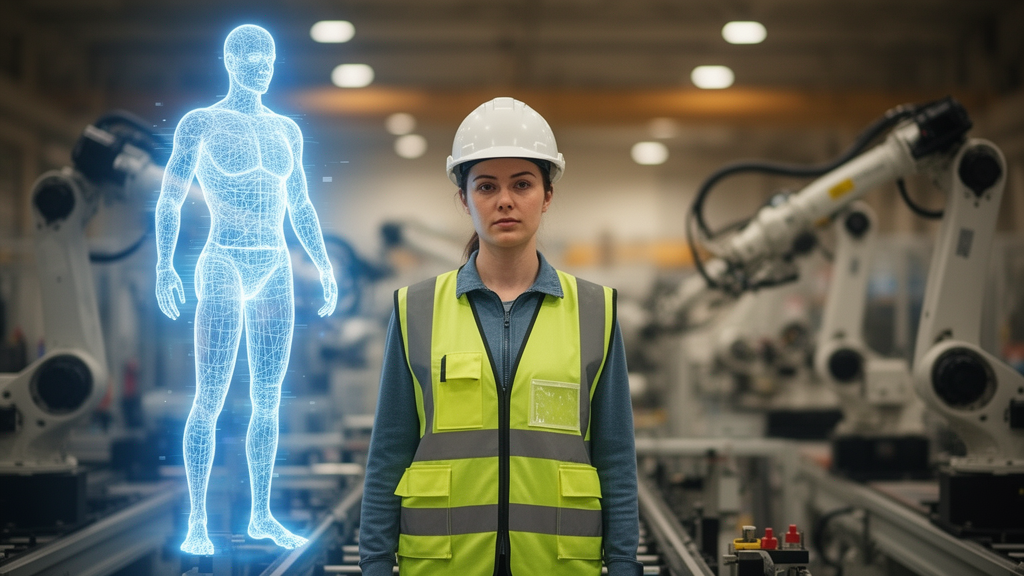
A digital replica of a factory worker that updates in real time, predicts fatigue before it becomes dangerous, and slows a collaborative robot before a collision can occur may sound like science fiction, but researchers say it is the defining engineering challenge of Industry 5.0. A new review published in Frontiers in Robotics and AI argues that so-called human-centric digital twins, or HCDTs, could transform manufacturing by fusing worker data with robots, machines, tasks and entire production environments. Yet the authors, led by Sagheer Khan of the SDAIA-KFUPM Joint Research Center for Artificial Intelligence in Saudi Arabia, also issue a stark warning: most systems currently labelled human-centric are anything but, because they monitor workers to squeeze out productivity rather than deliver measurable benefits to the people wearing the sensors.
Industry 5.0 emerged as a response to the shortcomings of Industry 4.0, the era of cyber-physical systems, artificial intelligence and the Internet of Things that digitised factories worldwide. While Industry 4.0 dramatically improved productivity, flexibility and real-time decision-making, critics noted it paid insufficient attention to workers, societal value, environmental sustainability and industrial resilience. Industry 5.0 retains those technological foundations but reorients them around three interconnected pillars: human-centricity, sustainability and resilience. The European Commission formalised this vision, positioning workers as active participants whose creativity, intuition and judgment are augmented by intelligent machines rather than replaced by them. The review argues that Industry 5.0 is best understood not as a separate industrial revolution but as an incremental, socio-technical evolution of Industry 4.0, one that changes the purpose for which advanced technologies are applied.
The core technical contribution of the review is a set of operational criteria that distinguish a genuine HCDT from related but weaker concepts. A conventional human model might represent posture, anthropometry or muscular load, but it is often generic, static and used offline. A human digital twin goes further, maintaining a personalised, continuously updated representation of a specific worker’s physiological, cognitive, behavioural and emotional state. Human-robot collaboration, meanwhile, describes the physical or cognitive interaction between workers and robots sharing a workspace. An HCDT integrates all of these: it connects human data with information from robots, machines, tasks, processes and the environment, then closes the loop by feeding decisions back into the physical system. Crucially, the authors insist that adaptation alone is not enough. A system that uses physiological data purely to accelerate output may contain a human digital twin but remains production-centred, not human-centric.
To qualify as a true HCDT under the review’s framework, a system must satisfy six criteria simultaneously. It must maintain a worker-specific digital representation updated at a frequency appropriate to the decisions it supports. It must integrate human information with robot, machine, task and environmental data rather than analysing it in isolation. It must link human and operational information to a recommendation, decision or physical adaptation, with effects returned through feedback. It must define and evaluate at least one worker-centred outcome, whether safety, ergonomics, wellbeing, autonomy, accessibility or skill development. It must preserve human authority, allowing workers to understand, correct, question, reject or override consequential decisions. And it must operate trustworthily, communicating uncertainty and degrading safely when sensing, communication or model confidence fails.
The enabling technologies behind such systems are as diverse as they are interdependent. Human-focused sensing spans optical motion capture, markerless RGB-D cameras, wearable inertial measurement units and physiological sensors measuring everything from electromyography to heart-rate variability and skin temperature. Researchers have demonstrated that just six inertial sensors, combined with deep neural networks, can reconstruct three-dimensional human posture and translation in real time. Brain-computer interfaces, in which operators issue commands to robots via EEG signals, remain promising but constrained by signal noise, lengthy calibration and limited classification accuracy. Environmental sensors measuring temperature, humidity, noise, vibration and hazardous gases provide the context without which human measurements are ambiguous; an elevated heart rate could signal exertion, stress, thermal exposure or ordinary movement, and only multi-modal fusion can tell the difference.
Artificial intelligence forms the analytical bridge between sensing and action. Convolutional neural networks estimate worker posture and robot configuration from camera data, while recurrent architectures such as long short-term memory networks and spiking neural networks predict human motion and intention, allowing robots to adjust speed or trajectory before a worker enters a hazardous zone. Reinforcement learning policies can be trained and evaluated inside digital twin environments before deployment, reducing the cost and risk of physical experimentation. But the review stresses that reward functions must include worker-oriented criteria such as collision avoidance, separation distance and ergonomic exposure; a policy optimised solely for cycle time may achieve high productivity while imposing excessive physical and cognitive demands. Optimisation techniques, from genetic algorithms to ant-colony methods, must likewise treat worker safety and wellbeing as objectives or constraints rather than afterthoughts.
Simulation and modelling constitute the analytical core of any HCDT. Finite-element analysis can estimate joint loading, muscular demand and the biomechanical consequences of human-robot contact without exposing people to hazardous experiments. Because high-fidelity models are computationally expensive, reduced-order and surrogate models approximate their behaviour for real-time operation, trading speed against accuracy within clearly defined validity ranges. Robot simulators such as ROS2, Gazebo and NVIDIA Isaac Sim allow collaborative behaviour to be tested virtually, while game engines like Unity and Unreal Engine create immersive training environments and synthetic training data. The authors caution, however, that graphical realism must never be confused with physical validity: a photorealistic virtual robot may still carry inaccurate mass, friction or contact parameters, and safety-critical predictions demand experimental verification.
Collaborative robots provide the physical mechanism through which HCDT decisions become reality. Adaptive systems can modify robot speed, trajectory, force, separation distance, assistance level and task allocation according to a worker’s position, experience, workload and fatigue. Shared control regimes, such as robust variable-admittance control for co-manipulation of objects with unknown loads, blend human intent with robotic precision. Yet the review warns that certified safety functions, including speed and separation monitoring and power and force limiting, must remain independent of any AI component. If the digital twin, the network or the model fails, the robot must transition to a predefined safe state. Human-automation conflict is another hazard: a worker and an HCDT may interpret the same situation differently, so workers need accessible mechanisms to stop robots, reject recommendations and escalate disputes, with intervention treated as valuable information rather than system failure.
Connectivity and computing architecture complete the picture. The Industrial Internet of Things links wearables, cameras, robots and machines, while edge computing performs millisecond-critical processing such as worker detection and collision prediction close to the source, preserving privacy by analysing raw video locally and transmitting only skeletal coordinates or posture scores. Fog layers coordinate multiple production cells, and cloud platforms handle long-term storage, high-fidelity simulation and AI training. Time synchronisation is critical: combining a current robot position with an outdated worker location could produce an unsafe recommendation, so every measurement must carry a timestamp and a maximum acceptable data age. Cybersecurity threads through the entire architecture, because an HCDT’s attack surface spans sensors, networks, models and actuators, and a compromised but authenticated sensor could report a false worker position with dangerous consequences.
Ultimately, the review proposes a six-stage closed-loop framework connecting sensing, communication, modelling, AI-based analysis, decision-making and human feedback, all protected by privacy and data governance. The authors are candid that the framework is a literature-derived synthesis, not a validated industrial standard, and that longitudinal studies under realistic conditions are urgently needed. They recommend standardised evaluation using established instruments, from RULA and REBA ergonomic assessments to the NASA-TLX workload index, alongside measures of autonomy, trust and skill development. The message is unambiguous: the success of human-centric digital twins will be judged not by their technical sophistication but by whether they deliver sustained, measurable improvements in worker safety, wellbeing and autonomy without sliding into surveillance, cognitive burden or new risks. In the factory of the future, the most important question may not be what the machines can do, but what they do for the people working alongside them.
Subject of Research: Human-centric digital twins and their enabling technologies in Industry 5.0 manufacturing
Article Title: Human-centric digital twins in industry 5.0: technologies, applications, and future directions
Article References: Khan, S., Tumrani, S., Van Nam, N., Ahmed, M., Khan, A., & Khan, M. (2026). Human-centric digital twins in industry 5.0: technologies, applications, and future directions. Frontiers in Robotics and AI, 13, Article 1983733. https://doi.org/10.3389/frobt.2026.1983733
Image Credits: AI Generated
DOI: 10.3389/frobt.2026.1983733
Keywords: human-centric digital twins, Industry 5.0, human-robot collaboration, digital twin, artificial intelligence, worker safety, ergonomics, collaborative robots, reinforcement learning, augmented reality, cybersecurity, edge computing
Cite Scienmag News
Denise Maddox. (October 17, 2026). Human-Centric Digital Twins Aim to Put Factory Workers First in Industry 5.0. Scienmag. https://scienmag.com/human-centric-digital-twins-aim-to-put-factory-workers-first-in-industry-5-0/
Denise Maddox. "Human-Centric Digital Twins Aim to Put Factory Workers First in Industry 5.0." Scienmag, 17 October 2026, https://scienmag.com/human-centric-digital-twins-aim-to-put-factory-workers-first-in-industry-5-0/. Accessed 17 October 2026.
Denise Maddox. "Human-Centric Digital Twins Aim to Put Factory Workers First in Industry 5.0." Scienmag. October 17, 2026. https://scienmag.com/human-centric-digital-twins-aim-to-put-factory-workers-first-in-industry-5-0/


