


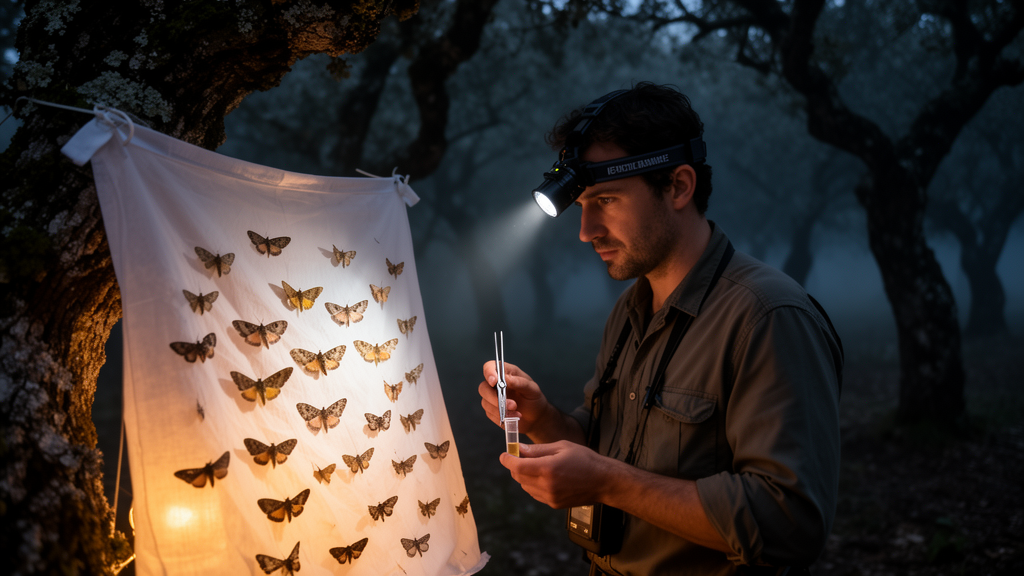
Deep in the mountain forests of Calabria, the southernmost tip of peninsular Italy, a family of small moths has been quietly evading scientific attention. Now a team of researchers has shone a molecular spotlight on these elusive insects, and the results are striking: DNA barcoding of 85 tineid moth specimens has revealed a species new to Italy, several species new to the country’s south, and two genetically distinct lineages that may represent species entirely unknown to science. The study, published in Nota Lepidopterologica, represents the largest investigation ever carried out on South Italian Tineidae, integrating molecular and morphological techniques to overcome a long-standing taxonomic impediment.
Tineidae, a family of small moths belonging to the superfamily Tineoidea, includes roughly 119 species in Italy and approximately 285 in Europe. Many people know these insects from their less glamorous side: the larvae of some species are notorious pests of stored food, clothing, and cultural heritage. But beyond their economic significance lies a fascinating ecological role. Most tineid larvae feed on fungi, lichens, bird nests, deadwood, and decaying organic matter, displaying strong functional relationships with the microhabitats that forest ecologists use as indicators of forest management quality. This makes them potentially excellent bioindicators of forested habitats, yet their small size and the similar appearance of many species have severely limited their use in this capacity.
The research focused on well-preserved mountainous forest habitats and highly fragmented plain forests across Calabria. The specimens were collected during standardized surveys using UV LED light traps, primarily targeting macromoths, with tineid voucher specimens preserved as by-catches for future study. Additional specimens were opportunistically gathered from other light sources or during daytime observations. The habitats sampled spanned an impressive range: retrodunal areas, olive groves with remnants of Mediterranean shrubs, riparian forests, fragmented thermophilous oak woodlands, chestnut woodlots, maple forests, mixed deciduous-conifer forests, pine forests, mixed beech-pine forests, and beech forests.
At the Centre for Biodiversity Genomics in Canada, the specimens underwent DNA barcoding using SMRT Sequencing on a PacBio Sequel platform with SPRI DNA extraction. Of the 85 specimens analyzed, 74 yielded successful barcode sequences ranging from 648 to 672 base pairs in length. These sequences, along with images and collection data, are now publicly available in the dataset DS-TINEITS on the Barcode of Life Data System (BOLD). The sequences clustered into 27 Barcode Index Numbers, or BINs, an algorithmic framework that typically corresponds to species. Three of these BINs were entirely new to BOLD, belonging to Haplotinea insectella, Monopis obviella, and Reisserita relicinella, directly improving the molecular reference library for this poorly studied family.
The molecular analysis assigned 66 specimens to 24 species, and the faunistic revelations were remarkable. Sixty-seven percent of the identified species represent new records for parts of Italy or for the entire country. The most notable discovery concerns Pelecystola fraudulentella, a moth described from Slovenia in 1852 that is now recorded for the first time in Italy. This species is so rarely encountered in Europe that its second record, after about 150 years, came from Sweden, with subsequent finds in Slovakia, Czech Republic, Hungary, Bulgaria, and Corsica. The Italian specimen was found in a mountain beech forest in the Pollino Massif, a habitat strikingly similar to those where the species has been recorded in Central Europe, supporting earlier expectations that further investigations would clarify its distribution.
Five additional species are new records for South Italy: Haplotinea insectella, Reisserita relicinella, Stenoptinea cyaneimarmorella, Monopis neglecta, and Triaxomera fulvimitrella. Ten further species are newly recorded for the Calabria region. Monopis neglecta, recently described from Central European countries with only a single specimen known from Italy near Lake Como, was found in three different locations within the southern mountains, two in the Pollino Massif and one in the Sila Mountains, suggesting the species is relatively common there. Triaxomera fulvimitrella, primarily known from Central and northern Europe with only a single record from northern Italy, was collected in a beech forest in the Sila Mountains, marking a very disjunct record and the southernmost known presence of this species in Europe.
The most intriguing cases concern eight specimens belonging to the genera Nemapogon and Neurothaumasia that could not be confidently assigned to any known species. These specimens showed genetic distances of 3.74 percent and 6.73 percent, respectively, from their nearest neighbors in the BOLD database, and dissection of their genitalia could not help assign them to known species either. The coverage of these genera in BOLD is relatively good: for Nemapogon, 39 species are described from Europe, 25 of which are available in BOLD, corresponding to 64.1 percent coverage, while for Neurothaumasia, five of six known European species are represented, or 83.3 percent. Given this relatively good representation, the researchers argue that these specimens may represent undescribed taxa. The recent description of Neurothaumasia cretica from Crete provides compelling evidence that the Calabrian Neurothaumasia should be an undescribed species, and further taxonomic studies are now needed to ascertain the status of both lineages.
The study also revealed unexpectedly high intraspecific genetic variability within Tineidae. Thirty percent of the identified species showed more than one BIN each, a figure far exceeding the 2.5 percent of Erebidae species with multiple BINs in the Iberian Peninsula and the 6.7 percent of Geometridae in Austria. Seven named species each carried two BINs, attributed to the same species by dissection of genitalia. With mean interspecific divergence measuring 6.64 percent for the family in this study, the presence of several BINs under the same name could indicate cryptic diversity, cases that the researchers say need further investigation using morphometrics and nuclear markers.
The findings underscore how much biodiversity remains hidden in European forests, even among well-known insect groups. Most specimens were collected from broadleaved forests, likely because these habitats are rich in polypore fungi, one of the preferred larval foods of Tineidae, which grow predominantly in this forest type compared to conifer forests. However, the researchers caution that the available samples were randomly collected and cannot rigorously confirm this apparent preference. The implementation of DNA barcoding libraries can also help identify preimaginal stages, most of which remain undescribed within the Tineidae, filling gaps in biological knowledge and paving the way for new bioindicators of forest ecosystem diversity.
As by-catches of surveys aimed at describing macromoth communities, the tineid records presented here come with limitations: the habitus of some specimens was not always perfectly preserved, non-phototactic species were not sampled, and quantitative data are lacking. Yet the discoveries speak for themselves. Large areas of Calabria remain unsampled and deserve future investigation, and the researchers hope that improving the taxonomy of this group will ultimately pave the way for using Tineidae as forest bioindicators. For now, the forests of southern Italy have proven once again that even the smallest moths can carry the biggest surprises, and two potentially new species await the taxonomists who will name them.
Subject of Research: DNA barcoding of tineid moths in South Italian forests reveals faunistic novelties and potentially undescribed species
Article Title: DNA barcoding of Tineidae from South Italian forests reveals faunistic novelties and potentially undescribed species ( Lepidoptera , Tineoidea )
Article References: La Cava, S., Zucco, G., Bonacci, T., & Scalercio, S. (2025). DNA barcoding of Tineidae from South Italian forests reveals faunistic novelties and potentially undescribed species (Lepidoptera, Tineoidea). Nota Lepidopterologica, 48, 203-214. https://doi.org/10.3897/nl.48.149560
Image Credits: AI Generated
DOI: 10.3897/nl.48.149560
Keywords: DNA barcoding, Tineidae, Lepidoptera, Calabria, forest biodiversity, undescribed species, BOLD, bioindicators, barcoding, South, Italian, forests
Cite Scienmag News
Gavin Prescott. (October 17, 2026). DNA Barcodes Expose Hidden Moth Diversity in South Italian Forests. Scienmag. https://scienmag.com/dna-barcodes-expose-hidden-moth-diversity-in-south-italian-forests/
Gavin Prescott. "DNA Barcodes Expose Hidden Moth Diversity in South Italian Forests." Scienmag, 17 October 2026, https://scienmag.com/dna-barcodes-expose-hidden-moth-diversity-in-south-italian-forests/. Accessed 17 October 2026.
Gavin Prescott. "DNA Barcodes Expose Hidden Moth Diversity in South Italian Forests." Scienmag. October 17, 2026. https://scienmag.com/dna-barcodes-expose-hidden-moth-diversity-in-south-italian-forests/


