


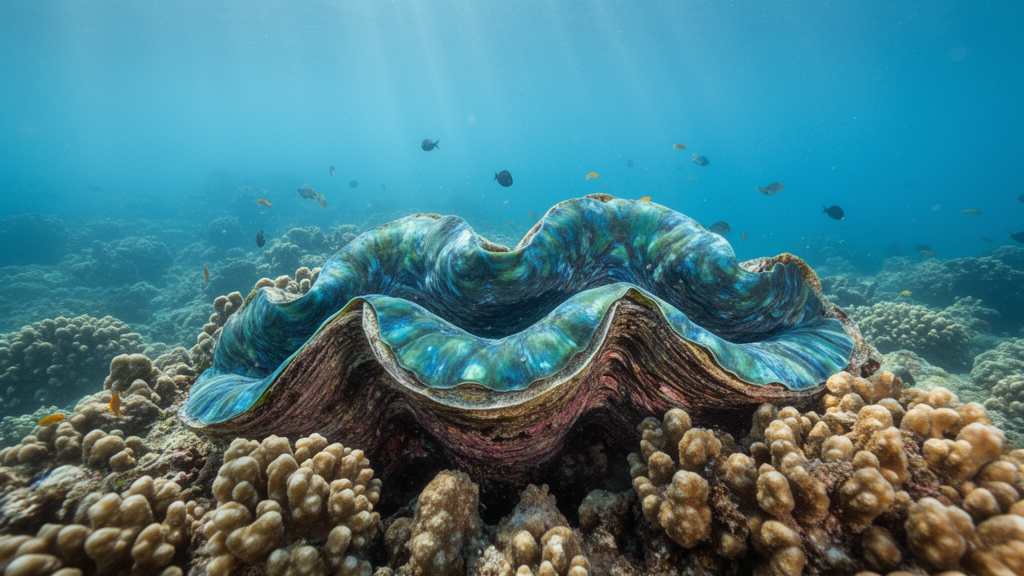
Giant clams are the largest living bivalves on Earth, and they owe much of their success to microscopic partners. Like reef-building corals, these mollusks host photosynthetic dinoflagellates from the family Symbiodiniaceae, single-celled algae that live inside specialized tubules running through the clam’s mantle. The algae supply up to roughly 97 percent of the host’s energy needs in the form of glucose, amino acids, glycerol, and sterols, while the clam provides nutrients that fuel photosynthesis and a tissue environment that shields the symbionts from damaging ultraviolet light. Understanding which algae associate with which clams, and why, has now become a central question for conservationists trying to rebuild populations of these endangered animals across the tropical Pacific.
A new study published in Ecology and Evolution offers the most detailed picture yet of this partnership in the Philippines, an archipelago that harbors eight of the twelve recognized giant clam species. Researchers sampled 165 individual clams representing all eight Philippine species, including Tridacna gigas, T. derasa, T. maxima, T. squamosa, T. noae, T. crocea, Hippopus hippopus, and H. porcellanus. The collections spanned 11 reef sites distributed across five marine biogeographic regions, from the North and South Philippine Seas to the Visayan Sea, the Sulu Sea, and the West Philippine Sea. Sampling took place between 2018 and 2020, with SCUBA divers removing small, non-lethal clips of mantle tissue from each animal for genetic analysis.
The team verified the identity of every clam using DNA barcoding of the mitochondrial COI gene, then profiled the algal communities by sequencing the ITS2 marker region on an Illumina MiSeq platform. After quality filtering, more than 15 million sequences remained, which the researchers processed through the SymPortal analytical framework. This approach groups sequences into defining intragenomic variants and then into ITS2 type profiles, which serve as proxies for distinct algal genotypes and avoid inflating diversity estimates through the natural variation within a single algal genome.
The results revealed a rich but structured community of symbionts. Philippine giant clams hosted algae from three main genera: Cladocopium dominated at nearly 62 percent of total abundance, followed by Durusdinium at about 25 percent and Symbiodinium at roughly 13 percent, with trace amounts of Gerakladium. Across all samples, the sequences resolved into 33 distinct ITS2 type profiles, including 17 Cladocopium profiles, 11 Durusdinium profiles, and five Symbiodinium profiles. The most abundant individual variants were C93a, C1, C66, and C1c among Cladocopium; D5, D4, D9b, and D1 among Durusdinium; and A3 and A6b among Symbiodinium. Four of these variants, C93a, D5, D4, and A3, appeared in around 60 percent of all clams sampled.
When the researchers asked what factors best explained the composition of these algal communities, the answer was unambiguous: the host species itself. Statistical tests comparing community structure across host species, sampling sites, biogeographic regions, and thermal regimes showed that species identity explained the largest share of variation, followed by site, region, and thermal regime. Each clam species carried a characteristic suite of algae. Tridacna gigas, T. derasa, T. maxima, and T. crocea were predominantly associated with Cladocopium, while T. noae and T. squamosa tended to be dominated by Durusdinium. Hippopus hippopus stood out for its prevalence of Symbiodinium, particularly the A3 variant, which is affiliated with Symbiodinium tridacnidorum, a species first isolated from this very host.
Yet the environment left its mark as well. Algal communities differed significantly among most sampling sites, biogeographic regions, and thermal regimes, which the researchers characterized by clustering four decades of sea surface temperature data into three regimes with distinct patterns of thermal stress exposure. Sites in the two warmest regimes experienced bleaching-level thermal stress, and several reached mortality-level stress during El Niño years. Interestingly, the algae associated with the warmest regime were not the thermotolerant Durusdinium types often linked to heat resistance in corals. Instead, Symbiodinium variants A6b and A3g were prevalent there, alongside A3 and Cladocopium C66. This unexpected pattern suggests that temperature alone cannot explain symbiont distributions, and that local adaptation, dispersal limitation, and the composition of surrounding reef communities all shape which algae are available for clams to acquire.
One of the most striking findings came from a natural experiment spanning four decades. Most Tridacna gigas individuals on Philippine reefs today are descendants of hatchery-reared clams restocked from the Silaqui ocean nursery in Bolinao since the 1980s, after overfishing drove the species to local extinction across most of the archipelago. When the researchers compared the algal communities of these translocated clams with those still living at the source site, they found that the restocked animals had largely retained the same Cladocopium-dominated communities, with C66 and C93a as the dominant variants, even after twenty years in new environments. This remarkable stability suggests that symbionts established early in development persist through adulthood, possibly explaining why T. gigas shows the lowest symbiont diversity of any species sampled, with 84 percent of individuals hosting only a single ITS2 type profile.
Exceptions to this pattern proved informative. Tridacna gigas individuals from Palawan, which carried distinct COI haplotypes, hosted different Cladocopium symbionts from the restocked majority, hinting at either different culture lineages or natural recruits that acquired algae from local waters. Juvenile natural recruits in Camiguin similarly hosted C1-dominated communities unlike those of translocated adults, supporting the idea that early symbiont uptake is strongly influenced by whatever algae happen to be available in the surrounding environment. As clam larvae develop, they appear to winnow this initial community through mechanisms that may involve host receptor selectivity, physiological filtering within the mantle microenvironment, or competition among the algae themselves, ultimately allowing the best-adapted strains to proliferate while others persist at background levels as potential reserves.
The study also uncovered subtle evolutionary signatures in these partnerships. Although giant clams acquire their algae exclusively from the environment rather than inheriting them, the researchers detected a weak but statistically significant phylosymbiotic signal, meaning that more closely related clam species tended to host more similar algal communities. A cophylogenetic analysis further revealed that only Cladocopium showed a significant congruence with the clam phylogeny, with the strongest associations linking T. maxima to C1 lineages and T. derasa to C93a lineages. This pattern likely reflects repeated post-acquisition filtering, in which host physiology, recognition mechanisms, and metabolic compatibility consistently favor certain partnerships over evolutionary time, even without vertical transmission.
The implications for conservation are considerable. Species with broader symbiont flexibility, such as H. hippopus, T. maxima, and T. crocea, may be better positioned to tolerate a wider range of environmental conditions, while specialists like T. gigas, already critically endangered according to the IUCN Red List, could be more vulnerable to perturbations that disrupt their narrow partnerships. The authors suggest that introducing suitable algal communities early in mariculture could enhance growth and survival of hatchery-reared clams, potentially improving the outcomes of restocking programs. As coral reefs face escalating thermal stress from climate change, understanding which partnerships confer resilience, and how flexible they remain under pressure, will be essential for safeguarding these iconic giants and the reef ecosystems they support.
Subject of Research: Symbiodiniaceae diversity and community structuring in giant clams across Philippine reefs
Article Title: Host and Environment Shape the Giant Clam‐Associated Photosymbiont Community
Article References: Quijano, J. B., Tayaban, K. M., Baquiran, J. I. P., Maala, G. J., Requilme, J. N. C., Sayco, S. L. G., Dolorosa, R. G., Cabaitan, P. C., & Conaco, C. (2026). Host and Environment Shape the Giant Clam‐Associated Photosymbiont Community. Ecology and Evolution, 16(10), Article e74492. https://doi.org/10.1002/ece3.74492
Image Credits: AI Generated
DOI: 10.1002/ece3.74492
Keywords: giant clams, Symbiodiniaceae, symbiosis, coral reefs, Philippines, Tridacna gigas, Cladocopium, Durusdinium, Symbiodinium, metabarcoding, conservation, phylosymbiosis
Cite Scienmag News
Margaret Porter. (October 17, 2026). Giant Clams Keep Their Algal Partners Close Even When Moved Across Philippine Reefs. Scienmag. https://scienmag.com/giant-clams-keep-their-algal-partners-close-even-when-moved-across-philippine-reefs/
Margaret Porter. "Giant Clams Keep Their Algal Partners Close Even When Moved Across Philippine Reefs." Scienmag, 17 October 2026, https://scienmag.com/giant-clams-keep-their-algal-partners-close-even-when-moved-across-philippine-reefs/. Accessed 17 October 2026.
Margaret Porter. "Giant Clams Keep Their Algal Partners Close Even When Moved Across Philippine Reefs." Scienmag. October 17, 2026. https://scienmag.com/giant-clams-keep-their-algal-partners-close-even-when-moved-across-philippine-reefs/


