


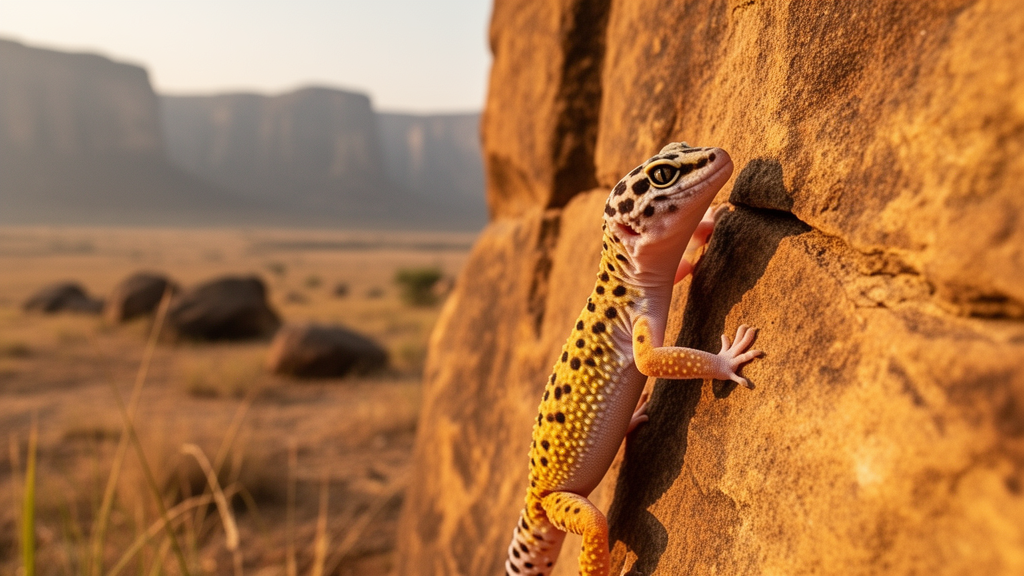
A striking new species of leopard gecko has been discovered hiding in plain sight on the Kaimur Plateau of Bihar, India, and its very existence is rewriting what scientists thought they knew about the region’s reptile diversity. The newly described species, named Eublepharis jhuma after Dr. Dhriti Banerjee, the first woman Director of the Zoological Survey of India, represents not only a remarkable addition to the genus but also the first documented occurrence of leopard geckos in the state of Bihar altogether. The discovery, published in the journal Herpetozoa, is the result of a herpetofaunal survey conducted in 2021 near Parari, on the outskirts of the Kaimur Wildlife Sanctuary, where three specimens were collected and later deposited in the Reptilia section of the Zoological Survey of India in Kolkata.
Leopard geckos of the genus Eublepharis are among the most recognizable reptiles in Asia, famous worldwide as popular pets, yet their wild relatives remain surprisingly poorly studied. The genus currently comprises eight recognized species distributed across South, Southwest, and Central Asia, and India harbors the highest diversity of any single country, with six species now known following this latest addition. Until the end of the twentieth century, only three species were reported from India, but advances in molecular phylogenetics and detailed morphological analysis have dramatically expanded this number in recent years. The family Eublepharidae, commonly known as eyelid geckos because they possess movable eyelids unlike most other geckos, comprises six genera and 49 described species across Eurasia, Africa, and North America.
The new species was identified based on a combination of distinctive morphological features that set it apart from all its congeners. Eublepharis jhuma is a medium-sized gecko reaching a snout-vent length of 123 to 142 millimeters, with large, flat, tubercle-like, moderately keeled scales across the dorsum whose interspaces are much larger than the tubercles themselves. It bears two pale bands between the nuchal loop and the caudal constriction, tuberculate subdigital lamellae beneath the toes, flat and rectangular dorsal scales on the regenerated tail, 22 to 25 subdigital lamellae on the fourth toe, and 12 to 13 precloacal pores arranged in an angulate series without any poreless scales interspersed among them. These characters collectively distinguish it from relatives such as Eublepharis macularius, Eublepharis fuscus, Eublepharis hardwickii, Eublepharis pictus, Eublepharis madarensis, and Eublepharis satpuraensis.
Genetic analysis provided compelling evidence for the species’ distinctiveness. Researchers extracted genomic DNA from ethanol-preserved liver tissue of two individuals and sequenced a 1041-nucleotide fragment of the complete mitochondrial NADH dehydrogenase subunit 2 gene, a standard molecular marker for reptile phylogenetics. Bayesian inference and maximum likelihood analyses both recovered the new species as a strongly supported monophyletic clade, with a Bayesian posterior probability of 1.0. The new species shows uncorrected pairwise sequence divergences of 6.9 to 7.8 percent from its closest sister species, Eublepharis satpuraensis, and even greater divergences from all other congeners, while intraspecific genetic distance within the new lineage was only 1.5 percent. Branch lengths in the resulting phylogenetic tree confirmed measurable sequence divergence between the new lineage and its nearest relatives.
Morphometric comparisons further reinforced the case for species status. Principal component analysis of 16 morphometric variables, adjusted for size-related allometric effects using group-structure methods, revealed clear separation between the new species and Eublepharis satpuraensis in multivariate morphospace. The first two principal components together accounted for 90.45 percent of the total observed variance. The new species exhibits a greater maximum body width, head height, head width, and orbital diameter than its sister species, along with a higher number of lamellae on the fourth toe. Notably, the study also corrected a previous mischaracterization: contrary to an earlier report, Eublepharis satpuraensis does not possess smooth subdigital lamellae but rather feebly tuberculate ones, closely resembling those of the new species.
The geographic context of the discovery is perhaps the most scientifically fascinating aspect of the story. The Kaimur Plateau, forming the eastern margin of the Vindhyan escarpment in the Son Valley, is dominated by Mesoproterozoic Kaimur Sandstone of the Vindhyan Supergroup, the largest Proterozoic sedimentary basin in the Indian subcontinent. This ancient geological formation preserves nearly 4,000 meters of largely unmetamorphosed sediments recording Earth history spanning approximately 1800 to 900 million years ago. The region has gained global significance through discoveries of Cambrian-like small shelly fossils and paleomagnetic evidence related to the breakup of the supercontinent Rodinia and the movement of the Indian continental block. The researchers suggest that the allopatric speciation of the new species from its sister species Eublepharis satpuraensis was shaped by these deep-time geological processes, with the Kaimur Plateau functioning as a refugium for unique and possibly endemic fauna.
The type locality itself is a fragmented tropical dry deciduous forest in the Kaimur range, isolated from the main body of the sanctuary by agricultural fields. At the site, the new gecko was found alongside a rich sympatric reptile community including agamid lizards such as Calotes versicolor and Sitana cf. sivalensis, multiple Hemidactylus gecko species, the skink Eutropis macularia, the sand boa Eryx conicus, and numerous colubrid snakes including Boiga trigonata, Dendrelaphis tristis, Lycodon aulicus, and Oligodon russelius. The habitat fragmentation underscores the vulnerability of this isolated population, particularly given ongoing pressures from agricultural expansion, mining, and industrial development in the region.
The discovery carries significant conservation implications. All Indian leopard gecko species are protected under Schedule I of the Wild Life (Protection) Amendment Act, 2022, India’s highest legal protection category. However, the animals face threats from forest fires, habitat loss, pollution, roadkill incidents, and persecution. The genus has been in the international pet trade since the 1960s, with Eublepharis macularius being the most traded species, and although many captive-bred individuals exist with various color morphs, wild individuals still enter the trade illegally. The researchers emphasize that public awareness and law enforcement actions are essential to reduce these pressures on wild populations.
The new species description also highlights substantial remaining taxonomic uncertainty within the genus. The validity of Eublepharis madarensis, resurrected in 2024, remains unresolved because its type specimen is currently untraceable, and a distinct population in Himachal Pradesh, currently the only known population of Eublepharis macularius in India, requires further taxonomic evaluation. Detailed morphological and phylogenetic analyses based on freshly collected specimens from respective type localities would be essential to clarify these ambiguities.
Perhaps most importantly, the finding underscores how much remains to be discovered in understudied landscapes. The northern Chota Nagpur Plateau, where the Kaimur Plateau sits at the intersection of multiple biogeographic zones, remains poorly surveyed for reptile diversity. A previous study of the Kaimur Wildlife Sanctuary reported 22 reptile species but did not record any member of the family Eublepharidae, suggesting that the new gecko was overlooked or that its range extends into unsurveyed areas. The researchers call for urgent systematic herpetofaunal surveys across the northern Chota Nagpur Plateau, arguing that increased sampling could reveal additional undescribed taxa and that incorporating this region into future biodiversity assessments and conservation planning should be a priority given the ongoing habitat degradation and anthropogenic pressures threatening its unique evolutionary heritage.
Subject of Research: Description of a morphologically distinct and phylogenetically divergent new species of the leopard gecko in the genus Eublepharis Gray, 1827 ( Reptilia , Eublepharidae ) from India
Article Title: Description of a morphologically distinct and phylogenetically divergent new species of the leopard gecko in the genus Eublepharis Gray, 1827 ( Reptilia , Eublepharidae ) from India
Article References: Mohapatra, P. P., Ray, S., Das, A. K., Satrusallya, R., Jena, S. K., Bhupathi, B., Das, R., & Mahapatra, A. K. (2026). Description of a morphologically distinct and phylogenetically divergent new species of the leopard gecko in the genus Eublepharis Gray, 1827 (Reptilia, Eublepharidae) from India. Herpetozoa, 39, 161-176. https://doi.org/10.3897/herpetozoa.39.e183441
Image Credits: AI Generated
DOI: 10.3897/herpetozoa.39.e183441
Keywords: Description, morphologically, distinct, phylogenetically, divergent, species, leopard, gecko, genus, Eublepharis, Gray, Reptilia
Cite Scienmag News
Margaret Porter. (October 17, 2026). New leopard gecko species discovered on India’s ancient Kaimur Plateau. Scienmag. https://scienmag.com/new-leopard-gecko-species-discovered-on-indias-ancient-kaimur-plateau/
Margaret Porter. "New leopard gecko species discovered on India’s ancient Kaimur Plateau." Scienmag, 17 October 2026, https://scienmag.com/new-leopard-gecko-species-discovered-on-indias-ancient-kaimur-plateau/. Accessed 17 October 2026.
Margaret Porter. "New leopard gecko species discovered on India’s ancient Kaimur Plateau." Scienmag. October 17, 2026. https://scienmag.com/new-leopard-gecko-species-discovered-on-indias-ancient-kaimur-plateau/


