


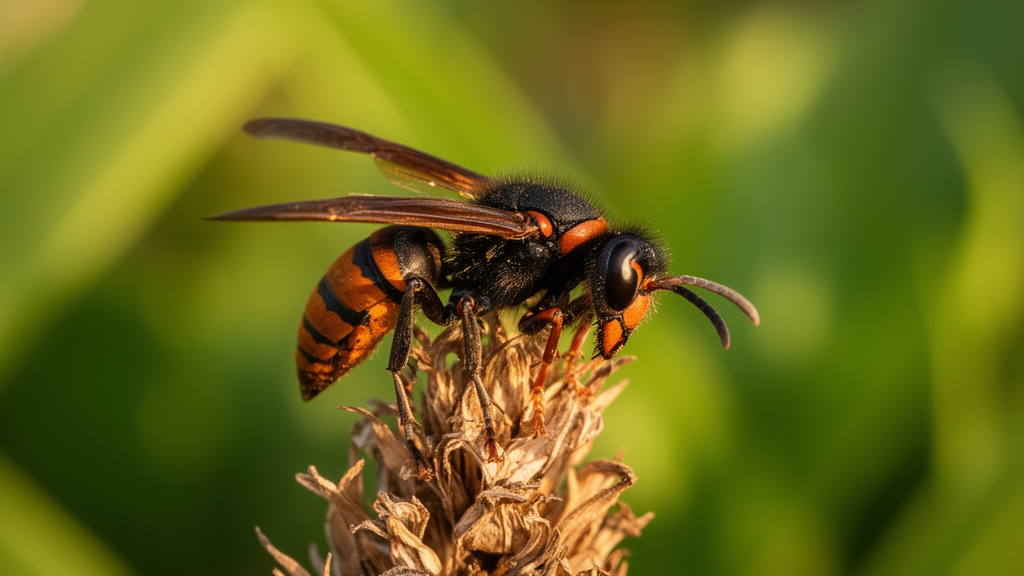
Deep in museum drawers and field collections across Mexico and Panama, two species of large, dark wasps have been hiding in plain sight, mistaken for more familiar relatives for decades. A new taxonomic study published in Neotropical Biology and Conservation describes them formally for the first time: Scolia bartletti from Mexico and Scolia albumtenebris from Panama. The discovery, led by researcher Ramírez-Guillén and colleagues, ends a remarkable drought. No species of the tribe Scoliini had been described from the Americas since 1912, when the entomologist Oscar C. Bartlett published his landmark treatment of North American scoliid wasps. More than a century later, the genus Scolia has finally gained new members, raising the count of New World Scolia species from twelve to fourteen.
Scoliid wasps are anything but obscure in the ecosystems they inhabit. These robust, often black-and-yellow insects are parasitoids in their larval stage, with females hunting beetle grubs, including scarab larvae that rank among the most destructive agricultural and garden pests in the Americas. Adult females dig into soil to reach their prey, paralyze it with a sting, and lay an egg on it, leaving the developing wasp larva to consume the grub from the outside in. That behavior makes scoliids natural allies in pest suppression, and it makes accurate species identification more than an academic exercise. If pest-control programs or ecological surveys misidentify the wasps they are counting, the biological picture they build is built on sand.
The path to the new species began with a nagging inconsistency. During an exhaustive review of Mexican Scoliidae, the researchers noticed that some male specimens identified as Scolia guttata, a widespread and variable species, were conspicuously smaller than typical members of that species. Size alone would not settle anything, but when the team dissected and examined the male genitalia, the differences became impossible to ignore. The genital structures of the small males did not match S. guttata at all. Stranger still, the genitalia illustrated in a 2020 study by Añino and colleagues appeared closer to Scolia mexicana than to S. guttata, deepening the suspicion that more than one species had been lumped under a single familiar name.
That suspicion proved correct twice over. The smaller Mexican males, collected across Chiapas, Guanajuato, Guerrero, Michoacán, and Oaxaca, represent a species new to science, now named Scolia bartletti in honor of Bartlett’s foundational contribution to the study of Scoliini in America. The species measures just 13 to 16 millimeters in length, notably smaller than the 14.5 to 36.3 millimeter range documented for S. guttata females and males. Its integument is black, marked with a yellow spot on each side of the second and third metasomal segments, and its dark brown wings carry violaceous reflections. The most decisive diagnostic feature lies in the genitalia: the paramere is elongated, tilting slightly inward from the middle and tapering toward the cuspis volsellaris, and the lamina volsellaris bears long setae. In S. guttata, the paramere is not elongated and the lamina volsellaris carries only short setae.
Only male specimens of S. bartletti are currently known, making it one of just two Scolia species in the region, alongside S. fuscipennis, whose females remain undiscovered. Both species appear to be endemic to Mexico. The variation among the available specimens is itself informative: one individual from Oaxaca lacks the yellow spots on the second tergum entirely, while another from Guanajuato carries yellow markings on the first through third terga, with those on the third noticeably smaller. Such variation underscores how deceptive external appearance can be in this group, and why the researchers leaned so heavily on internal anatomy rather than color pattern alone.
The second new species tells a different story. Scolia albumtenebris, known from Panama’s Darién, Panamá, and Panamá Oeste provinces, including specimens from the famous Barro Colorado Island, is named for its striking pelage. The species name combines the Latin words for white and darkness, a nod to the distinctive mixture of black and whitish-yellowish setae that covers the body. Females, measuring 16 to 17 millimeters, bear black setae overall with a blend of black and pale setae across the metasoma and mesosoma. Males, slightly larger at 16 to 19 millimeters, carry black setae on the head and tergites, except on the yellow spots, while the rest of the body is clothed in whitish-yellow setae. The male paramere is strongly truncated, forming nearly a right angle inward, a shape that immediately separates it from the smooth, elongated paramere of S. bartletti and from the non-angled paramere of S. mexicana.
What makes S. albumtenebris particularly interesting is how long it evaded recognition. Specimens used in the description had already been mentioned in the 2020 study by Añino and colleagues, but at the time they were not recognized as distinct. The researchers caution that specimens cited in that earlier work, and in a 2022 study by Ramírez-Guillén and colleagues, still need to be re-examined to confirm whether they belong to the new species or to S. guttata. The problem is not trivial. Scolia guttata has been recorded from the United States, Mexico, Guatemala, Costa Rica, Panama, Colombia, Venezuela, and Trinidad and Tobago, but the authors warn that its distribution may be inflated by misidentification. Four species, S. guttata, S. bartletti, S. albumtenebris, and S. mexicana, share a very similar color pattern and can only be reliably separated by examining the genitalia, the punctation of the propodeum, and the presence or absence of a median tubercle on the metasternal plate, features that are often difficult to observe without dissection.
To bring order to this confusion, the study provides a complete taxonomic key to the Scolia species of North and Central America, allowing researchers to work through the fourteen known species step by step. The key relies on characters such as the presence of a tubercle on the metasternal plate, the arrangement of yellow spots or bands on the terga, the punctation of the posterior face of the propodeum, and the shape of the male paramere. For S. albumtenebris, the combination of a sparsely punctate posterior propodeal face, predominantly white setae in males, and a paramere forming a ninety-degree inward angle distinguishes it cleanly from S. mexicana, which has a densely punctate posterior face, black setae, and no such angle.
The work draws on specimens held in six collections across Mexico and Panama, including the entomological collection of El Colegio de la Frontera Sur in San Cristóbal, the Universidad de Guanajuato, the Universidad Michoacana de San Nicolás de Hidalgo, the Instituto de Biología at the Universidad Nacional Autónoma de México, and the Museo de Invertebrados G. B. Fairchild at the Universidad de Panamá. Genitalia were extracted after softening specimens in humid chambers for four days, then photographed with a Leica MC170HD camera mounted on a Leica M250C stereoscope. Distribution maps were constructed in ArcGIS 10.3, and the type specimens are deposited at El Colegio de la Frontera Sur.
The broader implications reach beyond two new names on a list. With this contribution, the known Scoliidae fauna of the Americas rises to 71 species across 14 genera, and Scolia now ties with Pygodasis as the genus with the highest species count in the region. The authors argue that a complete revision of Scolia is overdue. Scolia bicincta, for instance, may need to be split into two separate species, though the differences separating them remain unclear. The identities of several South American and Cuban species, including S. rufiventris, S. jucunda, S. binominata, S. scutata, and S. cubensis, also require validation. In a group where a single color pattern can mask multiple species and where the decisive characters sit inside the male genital capsule, the discovery of S. bartletti and S. albumtenebris is a reminder that biodiversity in well-studied regions is still being uncovered, one dissection at a time.
Subject of Research: Taxonomic description of two new Scolia wasp species from Mexico and Panama
Article Title: Two new species of Scolia ( Hymenoptera , Scoliidae ) from Mexico and Panama
Article References: Ramírez-Guillén, L. D., León-Cortés, J. L., & Falcon-Brindis, A. (2025). Two new species of Scolia (Hymenoptera, Scoliidae) from Mexico and Panama. Neotropical Biology and Conservation, 20(4), 295-308. https://doi.org/10.3897/neotropical.20.e166466
Image Credits: AI Generated
DOI: 10.3897/neotropical.20.e166466
Keywords: Scolia, Scoliidae, new species, Mexico, Panama, taxonomy, Hymenoptera, male genitalia, Neotropical, wasp diversity, Scoliini, Barro Colorado Island
Cite Scienmag News
Drew Townsend. (October 17, 2026). Two New Scolia Wasp Species Discovered in Mexico and Panama After a Century of Silence. Scienmag. https://scienmag.com/two-new-scolia-wasp-species-discovered-in-mexico-and-panama-after-a-century-of-silence/
Drew Townsend. "Two New Scolia Wasp Species Discovered in Mexico and Panama After a Century of Silence." Scienmag, 17 October 2026, https://scienmag.com/two-new-scolia-wasp-species-discovered-in-mexico-and-panama-after-a-century-of-silence/. Accessed 17 October 2026.
Drew Townsend. "Two New Scolia Wasp Species Discovered in Mexico and Panama After a Century of Silence." Scienmag. October 17, 2026. https://scienmag.com/two-new-scolia-wasp-species-discovered-in-mexico-and-panama-after-a-century-of-silence/


