

When a Brazilian performance artist stages her own body as an archive of memory in the United Kingdom, or when an Argentine artist in Mexico replaces street confrontation with intimate, accessible performance, something more than personal expression is taking place. According to an editorial published on 15 October 2026 in the Migration and Society section of Frontiers in Sociology, these practices belong to a broader phenomenon that researchers Paula Guerra, Júlia Almeida de Mello and Sofia Sousa have gathered under the banner of artivism: the fusion of art and activism through which migrant, racialised, gendered and dissident bodies claim voice precisely where formal political channels remain closed to them.
The editorial introduces a Research Topic of five studies that converge on a single analytical question: how the body, placed in plural situations of displacement, gender or dissidence, becomes a political instrument for claiming voice and for individual and collective self-assertion in the public sphere. The coordinators contend that research remains scarce on the connections between dynamics of social disorder and the everyday practices of art and life at the threshold of borders, whether physical, symbolic or institutional. The five contributions respond to this gap from distinct disciplinary perspectives, drawing variously on postcolonial literary studies, visual sociology and art history.
The theoretical program underpinning the collection is explicitly decolonial and intersectional. Following scholars such as Quijano, Lugones, Maldonado-Torres and Crenshaw, the editors understand the body as a site where race, gender, class and territory are co-constituted, and where the afterlives of coloniality continue to determine who is granted mobility and who remains confined. Diaspora and displacement, in this reading, are never merely descriptive categories: they name an unfinished process of attachment and re-attachment through which bodies inscribe, resist and reconfigure the traces of dispossession, converting vulnerability into a resource for creation, memory and voice. The body, in short, is a privileged site of political negotiation, particularly where it intersects with gender, migration and artistic creation.
The first study, by Nila and Mukherjee, analyses Sujata Massey’s historical crime novel A Murder on Malabar Hill through the concepts of hybridity and the third space. Its protagonist, Perveen Mistry, is a Parsi lawyer, a woman and a figure embedded in a colonial context, and the authors show how postcolonial detective fiction shifts the rational European detective toward a figure of cultural mediation, situated between British law and indigenous legal systems. Mobilising classical urban sociology, including Lefebvre’s production of space and Soja’s thirdspace, as well as Haraway’s notion of situated knowledges, the article interprets the city of Bombay as a third space in which justice becomes a kind of situated negotiation rather than a universal verdict handed down from above.
The second contribution, by Guerra, focuses on Rubiane Maia, a Brazilian artist based in the United Kingdom. Combining a biographical approach with categorical and content analysis of a semi-structured interview and of two performances, Book-Performance and Speirein, the study demonstrates how Maia transforms the biographical rupture brought about by migration and motherhood into a corporeal archive of memory. The article brings together theoretical frameworks on coloniality, decolonial intersectionality and diaspora studies, showing how the vulnerability of the Black migrant woman’s body is converted into a creative force that enters into a wider critical dialogue with collective memory. The performances themselves become the analytical evidence: the body in motion functions as an archive that no state institution could confiscate.
In the third article, Mello traces a genealogy between the bodies exhibited in nineteenth-century freak shows and the queer bodies in the artistic productions of Fernanda Magalhães and Laura Aguilar. Drawing on the Bakhtinian grotesque, Goffman’s notion of stigma and Foucauldian biopolitics, the author argues that bodily difference, more specifically fatness, continues to function as a border that defines normality. The artistic appropriation of the grotesque, in this framework, constitutes a political strategy of resistance and visibility: what nineteenth-century spectacle framed as deviant, contemporary art reframes as affirming, queer and politically charged. The border between the normal and the grotesque, the study suggests, is drawn and redrawn through cultural practice, and artists can move that line.
The fourth study, by Sousa, proposes the concept of soft artivism, developed from the work of the Argentine artist Tuty Moreno Campos, currently resident in Mexico. Drawing on Warner’s work on soft activism and on the tradition of feminist aesthetics, the author argues that Campos’s artivism, visible in the performances Vaciarce from 2019 and Árido from 2020, shifts the focus away from the public confrontation typically associated with traditional activist practice toward a field of intimate and sensitive transformation. The register is one of informality, experimentation and accessibility that engages in dialogue with performativity and with the legacy of feminist movements. Soft artivism, in this account, does not abandon politics; it relocates the political from the barricade to the threshold, from the crowd to the singular body in transformation.
The final article, by Alwulaii, offers a critical framework that runs transversally across the four preceding investigations. Drawing on Bourdieu, Shilling and Foucault, the study identifies four structural gaps in the sociology of the body: the over-representation of the white female body, the subalternisation of other races and ethnicities, the geographical concentration on Western societies, and the reduction of fatness to a medical problem to the detriment of its reading as a social phenomenon. The article thereby reinforces the relevance of investigations such as those brought together in this Research Topic, insofar as they shift the gaze toward the Global South and toward bodies that have been historically marginalized by dominant academic and scientific literature.
Read together, the five contributions substantively confirm that the migrant, female, racialized, queer, artist body constitutes a terrain of symbolic and political contestation. From colonial detective fiction to contemporary performance, from grotesque imagery to soft artivism, the studies demonstrate that art effectively functions as a device for translation between competing systems of knowledge, and that artivism, as practice, way of life and mode of assertion, remains a fundamental instrument for the negotiation of borders, identities and social inequalities. The coordinators also situate the collection beyond migration strictly defined: elsewhere, in examining the trajectory of the band Fulô do Sertão and the emergence of Feminejo in Northeast Brazil, Guerra has shown how the rural female body becomes a vehicle of contestation against patriarchal traditionalism, reconfiguring gender, territory and voice through a do-it-yourself ethos of artivism. Situated in the Global South and largely absent from Anglo-American scholarship on popular music and the arts, such cases corroborate the wider argument that artistic practice, whether performative, literary, musical or visual, offers marginalized bodies a means of claiming voice where formal political channels remain closed.
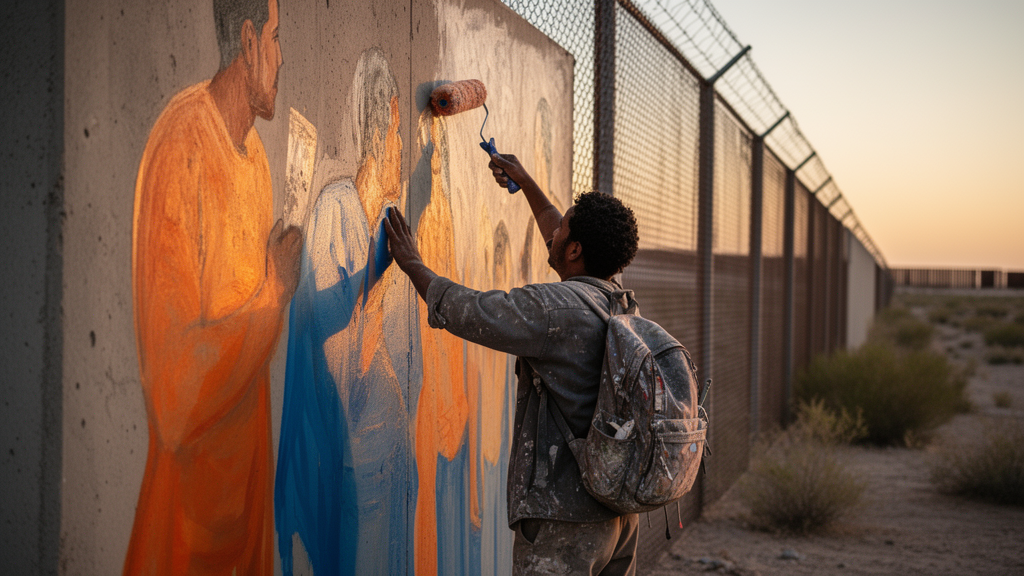
A challenge nonetheless remains for future research. The editors call for deepening intercultural and transnational comparisons that would allow scholars to understand how these dynamics of body, gender and migration are articulated beyond the contexts studied here, an invitation that the Research Topic leaves open to the scientific community. For now, the collection stands as evidence that borders are not only negotiated in courtrooms, checkpoints and parliaments, but also on stages, in novels, in photographs and in performances: wherever a body in displacement converts its vulnerability into voice.
Subject of Research: Editorial: Negotiating borders: body politics and artivism in migration
Article Title: Editorial: Negotiating borders: body politics and artivism in migration
Article References: Guerra, P., Almeida de Mello, J., & Sousa, S. (2026). Editorial: Negotiating borders: body politics and artivism in migration. Frontiers in Sociology, 11, Article 1984093. https://doi.org/10.3389/fsoc.2026.1984093
Image Credits: AI Generated
DOI: 10.3389/fsoc.2026.1984093
Keywords: artivism, migration, body politics, Global South, decolonial, Editorial, Negotiating, borders, body, politics, scientific research
Cite Scienmag News
Eleanor Graham. (October 17, 2026). How Migrant Bodies Turn Art Into Political Resistance at the Borders. Scienmag. https://scienmag.com/how-migrant-bodies-turn-art-into-political-resistance-at-the-borders/
Eleanor Graham. "How Migrant Bodies Turn Art Into Political Resistance at the Borders." Scienmag, 17 October 2026, https://scienmag.com/how-migrant-bodies-turn-art-into-political-resistance-at-the-borders/. Accessed 17 October 2026.
Eleanor Graham. "How Migrant Bodies Turn Art Into Political Resistance at the Borders." Scienmag. October 17, 2026. https://scienmag.com/how-migrant-bodies-turn-art-into-political-resistance-at-the-borders/


