


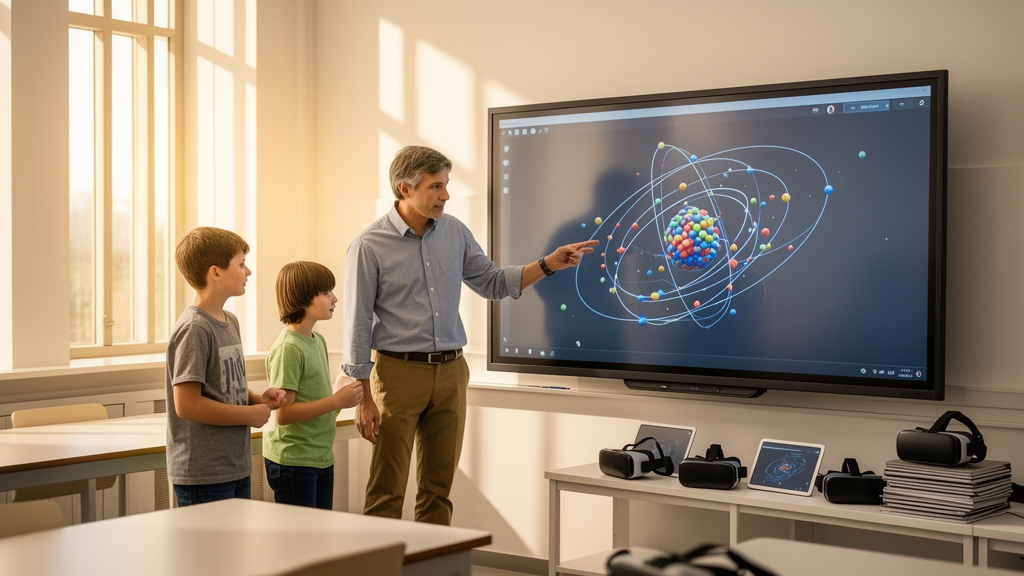
Physics has always been the hardest sell in the classroom: invisible fields, abstract quantum states, and mathematical models that students cannot touch or see. Now a sweeping systematic review argues that the gadgets of the Industry 4.0 era can finally make those abstractions tangible, but only if something far less glamorous is in place first. The review, published in Discover Education by Nurazmi Nurazmi and Hartono Bancong of Universitas Muhammadiyah Makassar in Indonesia, synthesized seventy peer-reviewed studies published between 2011 and 2025 and reached a conclusion that should unsettle anyone who believes technology alone transforms learning: the decisive variable is not the headset or the simulation software, but the digital competence of the teacher wielding them.
The authors searched the Scopus database following the PRISMA 2020 reporting guidelines, screening ninety-seven records down to seventy studies that met strict eligibility criteria: peer-reviewed journal articles or conference papers in English, focused on digital competence or technology integration in physics teaching across secondary education, teacher education, and higher education. Methodological quality was appraised with design-specific tools, including the Critical Appraisal Skills Programme checklist for qualitative work and the Mixed Methods Appraisal Tool for quantitative and mixed-methods studies. From this corpus, five major themes crystallized: augmented and virtual reality in physics learning, teacher digital competence development, digital simulations and virtual laboratories, contextual and implementation barriers, and the assessment of digital competence itself.
The most visually striking findings concern immersive technologies. Augmented reality and virtual reality offer three recurring affordances in physics classrooms: visualization of phenomena that are difficult or impossible to observe directly, interactive manipulation of scientific representations, and inquiry-oriented learning. The review cites studies showing that AR-enhanced inquiry sequences improved students’ conceptual understanding of electromagnetic induction, that game-based virtual reality environments boosted motivation and collaborative problem-solving, and that AR-supported digital escape rooms encouraged teamwork and creativity. Recent empirical work on VR-based experiments, including a study of the hydrogen emission spectrum, demonstrates that immersive visualization can support conceptual understanding of abstract phenomena when integrated with meaningful learning activities.
Yet the review is emphatic that these positive outcomes are context-dependent rather than uniform. Studies reporting stronger learning experiences generally incorporated pedagogical scaffolding, inquiry-based activities, teacher facilitation, and alignment between digital tools and physics learning objectives. Recurring challenges included hardware accessibility, design complexity, cognitive overload, and uneven teacher readiness. From the perspective of the Technological Pedagogical Content Knowledge framework, or TPACK, the effectiveness of AR and VR reflects the interaction among technological knowledge, pedagogical knowledge, and physics content knowledge, rather than the effect of the technology alone. A teacher who understands both the physics and the pedagogy can decide when a virtual representation serves learning and when it merely dazzles.
Digital simulations and virtual laboratories emerge as the workhorses of technology-enhanced physics education. The review documents their use to address limited equipment, visualize difficult phenomena, support inquiry-based experimentation, and extend laboratory access through virtual and remote environments. Studies combining virtual laboratories with structured pedagogy provide the strongest explanations of how these environments support learning: one used a Predict-Observe-Explain model for Ohm’s law and direct-current circuits, reporting a moderate conceptual learning gain alongside positive science-process-skill performance. Low-cost approaches, such as 3D-printed optical cubes for wave-optics experiments and Arduino-based measurement projects, illustrate how programmable, affordable systems can support authentic data collection while drawing on digital sensing and analysis.
Crucially, the review concludes that virtual and simulation-supported laboratories are most defensible as complementary resources rather than universal replacements for physical experimentation. Their value depends on pedagogical scaffolding, alignment with physics concepts, opportunities for authentic inquiry and data interpretation, teacher preparation, and equitable access. The authors point to evidence that virtual demonstrations are most effective when complemented with hands-on experimental experiences, and to research from Germany identifying increased workload and reduced feedback quality during digitally mediated teaching, leading researchers to advocate blended learning environments that balance digital innovation with established laboratory practices.
Teacher professional development forms the review’s second pillar, and here the findings are sobering. Digital competence among educators is increasingly conceptualized as a multidimensional capability extending beyond technical skills: effective integration requires teachers to make informed decisions about when, why, and how specific technologies support physics concepts and scientific practices. Frameworks such as TPACK and the European DigCompEdu framework, which encompasses professional engagement, digital resource management, technology-supported teaching, assessment practices, and learner empowerment, provide complementary analytical lenses. Professional-development initiatives informed by these frameworks can strengthen teachers’ confidence and willingness to integrate technology, but motivational improvement does not automatically translate into sustained instructional practice.
The review identifies a persistent gap between teachers’ perceived digital readiness and their ability to implement technology effectively in classrooms. Pre-service teachers in one study acquired a large share of their digital skills through self-organized learning yet still wanted more structured curricular guidance and collaboration. Nationwide and cross-disciplinary studies show that teacher digital competence varies substantially across disciplines, institutions, and professional-learning conditions, with discipline-related differences in DigCompEdu profiles. The authors argue that professional development should move beyond short-term technology training toward sustained mentoring, collaborative learning communities, and discipline-specific digital pedagogy, supported by institutional resources and opportunities to apply digital technologies in authentic physics learning situations.
Barriers to integration are systemic rather than isolated technical problems. The review documents infrastructure constraints, digital divides, age-related factors, mismatches between available devices and pedagogical models, limited institutional support, and difficulties aligning digital tools with curriculum and assessment practices. Studies from Indonesia, Russia, Slovakia, and other regions emphasize that access to technology alone does not guarantee meaningful competence development; sustainable integration requires institutional ecosystems providing devices, connectivity, technical support, professional learning opportunities, and continuous implementation guidance. In Slovakia, researchers reported substantial infrastructure and professional-development gaps relative to European Union digital competency benchmarks, calling for governmental funding and structured teacher upskilling programs.
Assessment of digital competence remains a developing frontier. The review catalogs performance tasks, self-report instruments, expert-validation procedures, and correlational approaches, but notes that definitions and measurement approaches varied considerably, with uneven evidence concerning validity and reliability. One study combining surveys with laboratory tasks using video-analysis software reported satisfactory internal consistency, while another used expert agreement indices to validate a smartphone-assisted e-module integrating scientific literacy and ICT competence. The authors conclude that no single assessment approach suffices to represent the complexity of digital competence, and that physics-specific assessment should account for digital modelling, simulation use, experimental data interpretation, and scientific communication. Their overarching message is that digital competence should be viewed not merely as the ability to use technology but as a strategic capability enabling teachers and learners to critically engage with digital tools, construct scientific understanding, and participate in future-ready physics learning environments, with future research prioritizing longitudinal, comparative, and context-sensitive investigations.
Subject of Research: Physics Education
Article Title: A systematic review of digital competence in physics education in the era of industry 4.0
Article References: Nurazmi, N., & Bancong, H. (2026). A systematic review of digital competence in physics education in the era of industry 4.0. Discover Education, 5(1), Article 1187. https://doi.org/10.1007/s44217-026-02294-z
Image Credits: AI Generated
DOI: 10.1007/s44217-026-02294-z
Keywords: digital competence, physics education, augmented reality, virtual reality, virtual laboratories, TPACK, teacher professional development, Industry 4.0, educational technology, systematic review, systematic, review
Cite Scienmag News
Courtney Benton. (October 17, 2026). Why Digital Competence, Not Gadgets, Decides Whether Physics Education’s High-Tech Future Pays Off. Scienmag. https://scienmag.com/why-digital-competence-not-gadgets-decides-whether-physics-educations-high-tech-future-pays-off/
Courtney Benton. "Why Digital Competence, Not Gadgets, Decides Whether Physics Education’s High-Tech Future Pays Off." Scienmag, 17 October 2026, https://scienmag.com/why-digital-competence-not-gadgets-decides-whether-physics-educations-high-tech-future-pays-off/. Accessed 17 October 2026.
Courtney Benton. "Why Digital Competence, Not Gadgets, Decides Whether Physics Education’s High-Tech Future Pays Off." Scienmag. October 17, 2026. https://scienmag.com/why-digital-competence-not-gadgets-decides-whether-physics-educations-high-tech-future-pays-off/


