


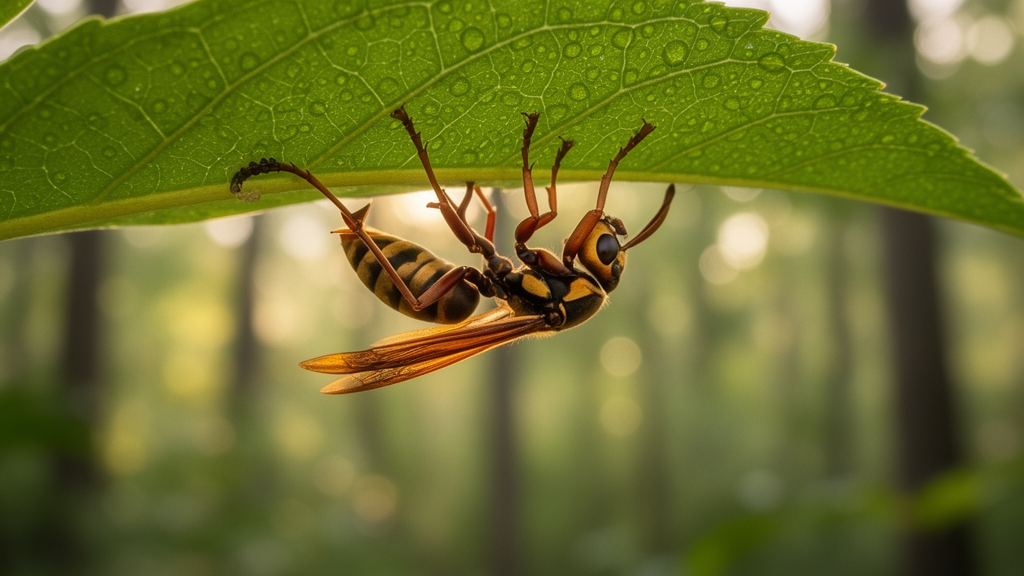
In the autumn of 2007, two students in a Tufts University biology lab set out to answer a deceptively simple question: what does it cost a paper wasp to fight off a parasite? They implanted sterile nylon monofilaments into the abdomens of Polistes dominula workers, mimicking the physical presence of the twisted-wing parasite Xenos vesparum, and measured the metabolic consequences of mounting an immune response. The researchers expected carbon dioxide production to rise as the insects invested energy in encapsulating the foreign object. Instead, the implanted wasps did something unexpected. They tended to dial their energy use down, and in a field enclosure they were also more likely to abandon their nests entirely. The team had not set out to study parasitic manipulation, but they had stumbled onto the edge of it.
That accidental finding sits at the center of a provocative new Perspective published in Frontiers in Parasitology by Philip T. Starks of Tufts University, who argues that the popular zombie narrative surrounding Xenos vesparum may be outrunning the actual evidence. Parasitized P. dominula workers famously become sluggish, desert their colonies, aggregate at pre-hibernation sites, overwinter, and emerge the following spring to join established nests, a sequence that conveniently serves the parasite’s mating and transmission needs. Popular coverage has gleefully described the wasps as outsider zombie queens, hijacked by a puppet-master parasite. But Starks contends that parasite-benefiting behavior alone is not sufficient evidence of parasite-designed control, and that the field needs to take a simpler explanation seriously before crediting Xenos with mind control.
The distinction at stake is between what behavioral parasitologists call active and passive manipulation. Active manipulation implies that a parasite produces a specific signal, whether neurochemical, endocrine, immune, or genomic, that directs host behavior in ways that serve parasite transmission. Passive manipulation implies something far less elaborate: the physical act of infection itself is enough to elicit host behaviors that, by circumstance, also benefit the parasite. Under this view, the host is not being steered like a puppet; it is responding to being compromised in ways the parasite can exploit. Starks argues that passive manipulation should be treated as a useful null model and a plausible evolutionary starting point for the Xenos system, not as a weak afterthought. If the host already possesses the behavioral architecture, the parasite may not need to build it. It may only need to activate it.
The philosophical foundation for this argument comes from C. Lloyd Morgan, the nineteenth-century psychologist whose famous Canon holds that an animal’s action should not be interpreted as the product of a higher faculty when a lower one suffices. Starks applies the same caution to mechanism. Before attributing post-infection behavior to a specialized parasite signal that reprograms the host nervous system, researchers should ask whether a simpler host-response mechanism could produce the same result. This is not an argument against adaptation, he stresses. A wasp may desert its nest because it is injured, immunologically challenged, or physiologically compromised, and if that response happens to move the host into a context that favors parasite mating or transmission, the parasite benefits. But benefit, he insists, is not mechanism.
What makes the passive hypothesis genuinely compelling in this system is that the behavioral components of the Xenos-associated phenotype are not unique to parasitized wasps. Early-emerging females in social wasp colonies can naturally leave their natal nests, aggregate, overwinter, and reappear as potential reproductives the following spring. In P. dominula, some spring females never initiate nests at all; instead, they adopt or usurp nests founded by others, behaviors long interpreted as alternative reproductive tactics rather than parasite-induced pathologies. Starks, who described a sit-and-wait reproductive strategy in these wasps decades ago, points out that Xenos vesparum does not need to invent a novel behavioral sequence if the necessary components already exist in the host repertoire. Under that interpretation, the infected wasp’s behavior is not alien. It is contextually misplaced, a normal program expressed at the wrong time and place.
Recent science has actually moved toward this subtler picture. Transcriptomic analyses have shown that stylopized workers, those carrying Xenos infections, exhibit gyne-shifted brain expression patterns, suggesting the parasite exploits phenotypic plasticity related to social caste rather than rewriting the host from scratch. Long-term field observations on trumpet creeper vines have placed the system in an ecological context where altered spatial and feeding behavior can benefit both host survival and parasite transmission, pointing toward co-evolved or shared phenotypes rather than simple takeover. Neuroanatomical work has further shown that caste, sex, and parasitism interact in shaping brain-region allocation, again tying the parasite-associated phenotype to pre-existing axes of wasp plasticity. The field, in other words, has drifted from mind control toward plasticity. The open question is whether the parasite controls that plasticity or merely benefits from releasing it.
The archived pilot experiment from the Tufts lab offers a striking illustration of what a passive trigger could look like. Workers received sterile nylon monofilaments two millimeters in length, inserted between the second and third abdominal sternites to approximate the physical presence of a protruding female strepsipteran. Sham-handled controls were anesthetized, weighed, prodded, and returned to their nests without implantation. Resting metabolic rate was measured before and after manipulation using differential open-flow respirometry, while nest desertion was monitored in a field enclosure with thirteen paired nests, each contributing one implanted and one sham-handled worker. The encapsulation response was estimated from melanin deposited on the retrieved monofilaments. Three patterns emerged. Implanted wasps showed lower relative carbon dioxide production after manipulation than controls. They were also more likely to desert their nests in the enclosure, a count supported by the surviving activity dataset. And crucially, the magnitude of the encapsulation response did not predict the change in carbon dioxide production, suggesting the metabolic shift was not simply a graded energetic cost of melanizing the implant.
These observations come with important caveats that Starks is careful to acknowledge. The archive is uneven: the field-activity spreadsheet survives intact, but the respirometry and encapsulation results are preserved as archived figures and analysis notes rather than full raw data tables, so the pilot should be read as hypothesis-generating rather than definitive. More fundamentally, a sterile implant is not Xenos vesparum. It does not reproduce, feed, secrete parasite-specific compounds, or persist through the host’s seasonal transition. The experiment therefore cannot show that true infection lacks active components; it can only show that active parasite signaling is not necessary to produce two early features of the infected phenotype, reduced energy use and nest desertion. A second complication is that the pseudo-parasite may have induced a generalized sickness response, the conserved suite of lethargy, anorexia, and social withdrawal documented across invertebrates facing injury, immune challenge, or infection. Yet Starks argues this objection strengthens rather than weakens his case: if a broad, conserved response to physical insult is sufficient to produce behavior useful to the parasite, then the parasite may be exploiting a pre-existing host response rather than issuing specialized instructions.
Turning the hypothesis into a testable research agenda, Starks outlines experiments designed around mechanism rather than mere outcome. The most direct test would vary the site of implantation: if desertion and energy conservation depend on a specific anatomical interface, the location where a female Xenos actually protrudes between the host’s tergites, the response is at least consistent with a site-specific trigger, whereas identical behavioral changes following insult anywhere on the abdomen would favor a generalized injury response. A complementary approach would separate wound response from the persistent presence of a foreign body by comparing puncture wounds alone against retained implants. Parasite extracts or candidate secretions applied without implantation would test whether a non-mechanical chemical signal is sufficient, necessary, or irrelevant, an experiment made newly tractable by transcriptomic work identifying candidate genes whose expression shifts in stylopized hosts. The most powerful version would compare truly parasitized wasps, pseudo-parasitized wasps, sham controls, and naturally dispersing unparasitized females at the level of neural gene expression, asking whether the infected state resembles a state the host can reach on its own. Natural variation in infection intensity offers yet another accessible test: passive manipulation predicts a threshold-like response where additional parasite load adds little once the trigger is crossed, while active manipulation often predicts a graded dose-response relationship.
However the mechanism ultimately resolves, the Xenos–Polistes system will remain a compelling example of parasite-associated behavioral change, and parasitized wasps undeniably behave in ways that benefit their parasite. But the deeper lesson extends well beyond one wasp-parasite association. The zombie metaphor is vivid, Starks concludes, but it can smuggle mechanism into description, transforming an observed correlation into an assumed puppeteer. The parasite may benefit not by inventing a new wasp but by activating an old one in the wrong context, a possibility that deserves treatment as a genuine hypothesis rather than a caveat. Before science invokes puppeteers, he argues, it should first test the strings, because parasite-benefiting outcomes are not, by themselves, evidence of parasite-designed control.
Subject of Research: The passive manipulation hypothesis in the Xenos vesparum and Polistes dominula host-parasite system
Article Title: Zombies without puppeteers: Morgan’s Canon and the passive manipulation hypothesis in Xenos vesparum/Polistes dominula
Article References: Starks, P. T. (2026). Zombies without puppeteers: Morgan’s Canon and the passive manipulation hypothesis in Xenos vesparum/Polistes dominula. Frontiers in Parasitology, 5, Article 1907843. https://doi.org/10.3389/fpara.2026.1907843
Image Credits: AI Generated
DOI: 10.3389/fpara.2026.1907843
Keywords: Xenos vesparum, Polistes dominula, parasitic manipulation, passive manipulation, behavioral parasitology, host behavior, zombie parasites, strepsiptera, social wasps, caste plasticity, Morgan's Canon, sickness behavior
Cite Scienmag News
Kristina Jarvis. (October 17, 2026). Zombie wasps may be running on their own ancient programs, new study suggests. Scienmag. https://scienmag.com/zombie-wasps-may-be-running-on-their-own-ancient-programs-new-study-suggests/
Kristina Jarvis. "Zombie wasps may be running on their own ancient programs, new study suggests." Scienmag, 17 October 2026, https://scienmag.com/zombie-wasps-may-be-running-on-their-own-ancient-programs-new-study-suggests/. Accessed 17 October 2026.
Kristina Jarvis. "Zombie wasps may be running on their own ancient programs, new study suggests." Scienmag. October 17, 2026. https://scienmag.com/zombie-wasps-may-be-running-on-their-own-ancient-programs-new-study-suggests/


