


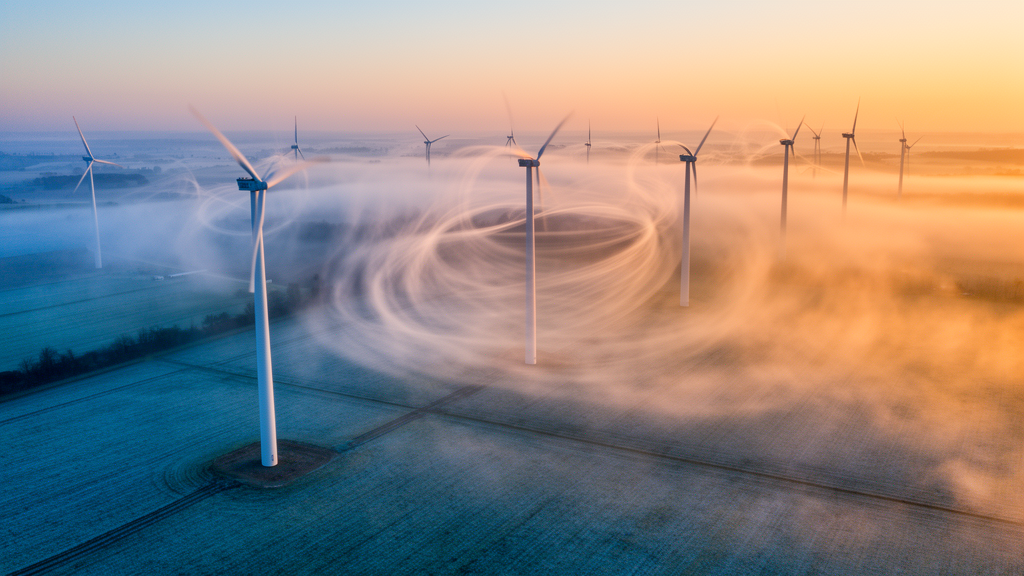
Every sunrise sets off an invisible revolution above the Great Plains. The cold, stratified air that settles over wind farms at night is gradually stirred into a churning, well-mixed atmosphere as the sun heats the ground, and a new study shows that this daily metamorphosis fundamentally rewrites the physics of the turbulent wake trailing behind every wind turbine. Using computer simulations anchored to real measurements from an Oklahoma wind farm, researchers tracked how turbine wakes morph from orderly, swaying structures into chaotic, multi-mode turbulence within just a few hours of the morning transition — with measurable consequences for power output.
The research, published as a preprint under review in the journal Wind Energy Science by Dachuan Feng, Wen Zhang, Minping Wan, and Simon J. Watson, reconstructs the atmospheric boundary layer evolution observed on 26 September 2023 at the King Plains wind farm during the American WAKE experimeNt, or AWAKEN, field campaign. Rather than treating the atmosphere as a static backdrop, the team employed measurement-assimilated large-eddy simulation, a computational technique that resolves the largest turbulent eddies in the flow while forcing the simulation to follow the actual conditions recorded in the field. This allowed them to capture the boundary layer during a genuinely non-equilibrium period — the fleeting hours when the atmosphere is neither fully stable nor fully unstable.
The atmospheric boundary layer is the lowest kilometer or so of the atmosphere, the region where the land and the free air above exchange momentum, heat, and moisture. At night, under clear skies, the ground cools faster than the air, producing a stable stratification in which layers of denser air sit beneath lighter air. Turbulence is suppressed, winds are smooth, and the wake behind a turbine behaves like a coherent, quasi-deterministic structure. After sunrise, solar heating flips the temperature gradient, buoyancy begins to drive vigorous vertical mixing, and the boundary layer transforms into a turbulent, well-stirred engine. Wind turbines living through this transition experience an inflow that changes faster than most engineering models assume.
To dissect the wake dynamics, the researchers identified three regimes across the morning transition: stable, transitional, and unstable. In each regime, they averaged the simulated wake flow over time and then applied a mathematical tool known as resolvent analysis. Resolvent analysis examines how the linearized Navier–Stokes equations, perturbed around the time-averaged flow, amplify forcing into coherent structures. In practical terms, it reveals the dominant shapes and frequencies with which the wake naturally oscillates — the hidden skeleton of the turbulence.
The results are striking. Under stable night-time stratification, the wake’s dominant mechanism is a single, low-rank, shear-driven coherent structure — essentially one regular swaying motion, generated by the velocity difference between the slowed wake and the faster ambient flow. As the boundary layer grows increasingly unstable, the picture changes completely: the dominant mechanism becomes higher-rank and buoyancy-driven, meaning many irregular modes compete simultaneously, each shaped by rising thermal plumes rather than by simple shear alone. The transitional regime, sandwiched between the two, exhibits hybrid behavior, carrying signatures of both shear-driven order and buoyancy-driven disorder.
The statistics of the inflow shift just as dramatically. As the boundary layer becomes increasingly unstable, the hub-height turbulence intensity increases by roughly an order of magnitude compared with stable night-time conditions. Meanwhile, the characteristic length scale of atmospheric motion grows from a few rotor diameters — eddies comparable in size to the turbine rotor itself — to the full depth of the boundary layer, structures spanning hundreds of meters to more than a kilometer. A turbine that spent the night bathed in small, gentle eddies is, by mid-morning, immersed in vast, energetic sweeps of air that engulf entire rows of machines.
These changes are not merely academic. The study shows that array-averaged power production, its variability, and its spectral content — the distribution of power fluctuations across frequencies — all change significantly over a period of just a few hours. Wake dynamics govern how much energy downstream turbines extract from the wind: a wake that meanders coherently may sweep across neighboring machines in predictable pulses, while a wake shredded into many irregular modes diffuses differently, altering both the losses and the fatigue loads experienced by the array. The finding that these quantities shift on timescales of hours means that control strategies and power forecasts calibrated to one stability regime can be badly miscalibrated a few hours later.
Perhaps the most consequential conclusion is a negative one: steady-state stability classifications do not adequately represent the dynamics of the diurnal cycle. Much of wind-farm engineering — wake models, layout optimization, power forecasting — implicitly assumes that the atmosphere sits in one equilibrium state at a time, and that a stable or unstable label fully characterizes the flow. The morning transition violates that assumption. During the non-equilibrium period, the wake is not in balance with its inflow, and the coherent structures identified by resolvent analysis evolve continuously between the stable and unstable archetypes. For grid operators, this means the hours around sunrise may be precisely when forecasts are least reliable unless the transition itself is modeled.
The work also demonstrates the power of measurement-assimilated simulation as a bridge between field campaigns and theory. The AWAKEN campaign, one of the most extensive efforts to instrument a working wind farm with lidars, met masts, and other sensors, provides the ground truth; large-eddy simulation provides the full three-dimensional, time-resolved flow field that no field campaign can measure everywhere at once. Assimilating the measurements into the simulation ensures the modeled boundary layer follows the real atmosphere’s trajectory through the morning, allowing the researchers to isolate cause and effect in a way that neither observations nor idealized simulations could achieve alone.
As wind power becomes a dominant pillar of electricity systems worldwide, the margins of performance increasingly lie in details like these. A wake that changes character within hours, shifting from one regular swaying motion to many irregular ones, is not a curiosity — it is a daily, predictable, and currently under-modeled feature of every wind farm on Earth. The authors argue that power forecasts and turbine controls should reflect these shifts, and the present study offers both the evidence and the analytical machinery, from resolvent analysis to regime classification, to begin doing so. The next sunrise over the plains will, once again, rewrite the wake — but now, at least, the transformation is on the record.
Subject of Research: How the diurnal atmospheric stability transition reshapes wind-turbine wake dynamics and power production
Article Title: Effect of atmospheric stability transition on wind-turbine wake dynamics
Article References: Feng, D., Zhang, W., Wan, M., & Watson, S. J. (2026). Effect of atmospheric stability transition on wind-turbine wake dynamics. https://doi.org/10.5194/wes-2026-184
Image Credits: AI Generated
DOI: 10.5194/wes-2026-184
Keywords: wind energy, atmospheric boundary layer, wake dynamics, atmospheric stability, large-eddy simulation, resolvent analysis, turbulence, AWAKEN field campaign, diurnal cycle, power forecasting, wind farm control, buoyancy-driven turbulence
Cite Scienmag News
Faith Mcneil. (October 17, 2026). Morning Turbulence: How Dawn Air Transforms Wind-Turbine Wakes Within Hours. Scienmag. https://scienmag.com/morning-turbulence-how-dawn-air-transforms-wind-turbine-wakes-within-hours/
Faith Mcneil. "Morning Turbulence: How Dawn Air Transforms Wind-Turbine Wakes Within Hours." Scienmag, 17 October 2026, https://scienmag.com/morning-turbulence-how-dawn-air-transforms-wind-turbine-wakes-within-hours/. Accessed 17 October 2026.
Faith Mcneil. "Morning Turbulence: How Dawn Air Transforms Wind-Turbine Wakes Within Hours." Scienmag. October 17, 2026. https://scienmag.com/morning-turbulence-how-dawn-air-transforms-wind-turbine-wakes-within-hours/


