


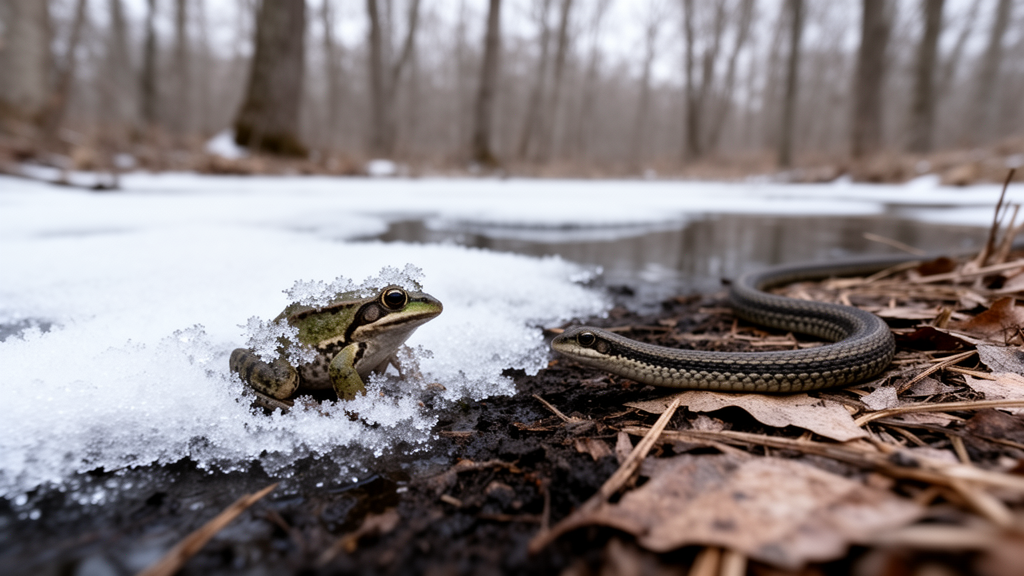
A new study has revealed that the loss of snowpack, combined with rising winter temperatures, is a primary driver of local extirpation among amphibians and reptiles across the Midwestern United States. Using a deep learning framework paired with interpretable artificial intelligence, researchers have quantified how compound winter stressors—rather than summer heat or drought—may be the dominant climatic force behind the disappearance of some of North America’s most climate-sensitive herpetofauna. The findings, published in Frontiers in Amphibian and Reptile Science, challenge the long-standing assumption that biodiversity loss under climate change is primarily a warm-season phenomenon.
The research, led by Wisam Bukaita of Lawrence Technological University, compiled a multi-decadal, species-integrated dataset combining population dynamics, survival metrics, and climate variables for four focal taxa: Blanchard’s cricket frog (Acris blanchardi), the eastern massasauga (Sistrurus catenatus), Kirtland’s snake (Clonophis kirtlandii), and the queen snake (Regina septemvittata). These species were selected because they occupy wetland, prairie, and streamside habitats that depend on stable winter thermal regimes. The dataset drew on long-term monitoring programs from the U.S. Geological Survey, the Michigan Natural Features Inventory, state conservation databases, and peer-reviewed ecological studies spanning the 1980s through 2025.
At the heart of the study is a fully connected neural network designed to predict population persistence, survival probability, and extirpation risk from three winter climate inputs: snow depth, temperature anomalies, and winter precipitation. The architecture comprised three hidden layers with 128, 64, and 32 neurons, using ReLU activation and a dropout rate of 0.2 to reduce overfitting. Training employed mean squared error for continuous outputs and binary cross-entropy for classification, optimized with the Adam algorithm at a learning rate of 0.001 over 500 epochs with early stopping. Model performance was validated using an 80/20 train–test split and 5-fold cross-validation, achieving root mean square error values of 0.08 to 0.15 and R² values between 0.71 and 0.87 for continuous predictions, alongside AUC-ROC scores of 0.84 to 0.93 and F1-scores of 0.79 to 0.88 for extirpation classification.
What sets this study apart from previous correlative climate–biodiversity analyses is its use of SHapley Additive exPlanations (SHAP), a game-theoretic interpretability framework that decomposes model predictions into individual feature contributions. SHAP attribution revealed that snowpack variables—depth and duration—were the dominant predictors, contributing 42 to 57 percent of total model importance. Temperature anomalies accounted for 28 to 39 percent, while winter precipitation contributed 12 to 21 percent. Snowpack emerged as roughly 1.3 times more influential than temperature and up to 2.1 times more influential than precipitation alone, underscoring that the loss of subnivean insulation—the insulating layer beneath snow—is the single most powerful climatic signal of population collapse in these systems.
Perhaps the most striking finding concerns the interaction between snowpack loss and temperature anomalies. When both stressors occurred simultaneously, extirpation risk increased by 35 to 62 percent beyond what would be expected from additive effects alone, with interaction terms contributing an additional 18 to 26 percent to model output. The model identified clear nonlinear thresholds: extirpation probability rose sharply when snowpack declined below 30 to 40 percent of historical norms and when temperature anomalies exceeded +2 °C. Under these compound conditions, risk accelerated two to three times faster than linear model expectations, suggesting the presence of ecological tipping points where small additional changes in winter climate trigger disproportionately large biological responses.
Species-specific analyses revealed differentiated vulnerability shaped by ecological traits. Kirtland’s snake, a prairie-wetland specialist already constrained by fragmented populations and extremely low detection rates, exhibited the highest sensitivity, with extirpation probability increasing by up to 68 percent under combined stress conditions. Blanchard’s cricket frog showed a 6 to 11 percent increase in mortality probability for every 10 percent reduction in snow depth, consistent with the loss of thermal buffering exposing dormant individuals to lethal soil temperature fluctuations. The eastern massasauga, a wetland-dependent rattlesnake, demonstrated 22 to 38 percent higher mortality risk under elevated winter temperature variability exceeding a standard deviation of 3 °C. The queen snake, a streamside specialist, was most sensitive to the interaction of reduced snowpack and increased winter rainfall, with persistence declining by 30 to 47 percent under combined hydrological stress.
The physiological mechanisms underlying these patterns are well grounded in ectotherm biology. Amphibians and reptiles depend on stable thermal and hydric conditions during dormancy or brumation, and snowpack serves as a critical insulating blanket that stabilizes soil and near-surface temperatures. When snow cover diminishes, overwintering organisms are exposed to repeated freeze–thaw cycles that can induce cellular damage, disrupt osmotic balance, and impair energy regulation. Simultaneously, warmer winter temperatures accelerate metabolic rates in dormant individuals, prematurely depleting lipid reserves—a phenomenon known as metabolic exhaustion. Shifts from snow-dominated to rain-dominated precipitation further alter wetland hydroperiods and stream flow dynamics, destabilizing hibernacula and disrupting breeding habitat availability and prey phenology.
Across all four taxa, the integrated dataset documented long-term population declines ranging from 35 to 65 percent, accompanied by a 40 to 70 percent reduction in occupied habitat patches and a 20 to 35 percent increase in interannual variability after 2000. These trends align with broader evidence that climate-driven extinction risk is often shaped by synergistic interactions among multiple stressors rather than single drivers. The study also notes that winter climate stress can amplify non-climatic pressures such as habitat fragmentation, contaminant exposure, and disease, functioning as a stress multiplier that intensifies the impact of co-occurring environmental pressures beyond what climate-only predictions would suggest.
The deep learning framework outperformed traditional statistical baselines including generalized linear models, generalized additive models, random forests, and XGBoost across all evaluation metrics, with statistically significant improvements confirmed by paired tests. The authors acknowledge limitations, including the challenge of distinguishing statistical attribution from biological causation, potential multicollinearity among climatic variables, and the absence of benchmarking against emerging transformer or graph-based architectures. Nevertheless, the framework represents a pragmatic balance between predictive performance, data availability, and ecological interpretability, moving beyond correlation toward mechanistic understanding of climate-driven extirpation.
The conservation implications are significant. Current climate adaptation frameworks that emphasize growing-season conditions may substantially underestimate species vulnerability by neglecting winter processes. The study recommends prioritizing the protection and restoration of microhabitats that buffer winter thermal variability—including deep soil substrates, wetlands, forested cover, and landscape features that promote snow accumulation and retention—and maintaining at least 30 to 40 percent of historical snowpack buffering capacity. It further advocates integrating winter-specific predictors such as snow water equivalent, snow cover duration, freeze–thaw frequency, and winter temperature variability into species distribution models and monitoring programs. As winter temperatures continue to rise faster than annual averages across temperate regions, the findings make clear that winter climate change is not a secondary component of global warming but a primary, quantifiable driver of ecological instability and species loss.
Subject of Research: Deep learning attribution of winter climate drivers of amphibian and reptile extirpation
Article Title: Winter warming and snowpack loss synergistically drive amphibian and reptile extirpation: a deep learning attribution study of climatic mechanisms
Article References: Bukaita, W. (2026). Winter warming and snowpack loss synergistically drive amphibian and reptile extirpation: a deep learning attribution study of climatic mechanisms. Frontiers in Amphibian and Reptile Science, 4, Article 1841535. https://doi.org/10.3389/famrs.2026.1841535
Image Credits: AI Generated
DOI: 10.3389/famrs.2026.1841535
Keywords: snowpack loss, winter warming, amphibian decline, reptile extirpation, deep learning, SHAP, climate change, biodiversity loss, subnivean insulation, freeze-thaw cycles, Midwestern United States, ecological thresholds
Cite Scienmag News
Margaret Porter. (October 17, 2026). Snowpack Loss and Winter Warming Drive Amphibian and Reptile Extinctions. Scienmag. https://scienmag.com/snowpack-loss-and-winter-warming-drive-amphibian-and-reptile-extinctions/
Margaret Porter. "Snowpack Loss and Winter Warming Drive Amphibian and Reptile Extinctions." Scienmag, 17 October 2026, https://scienmag.com/snowpack-loss-and-winter-warming-drive-amphibian-and-reptile-extinctions/. Accessed 17 October 2026.
Margaret Porter. "Snowpack Loss and Winter Warming Drive Amphibian and Reptile Extinctions." Scienmag. October 17, 2026. https://scienmag.com/snowpack-loss-and-winter-warming-drive-amphibian-and-reptile-extinctions/


