


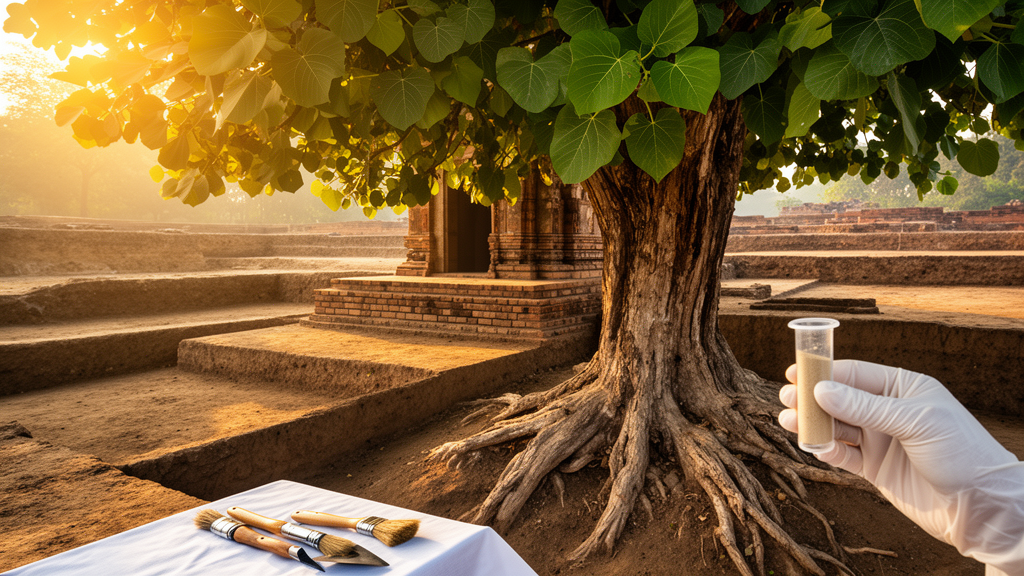
At Lumbini in Nepal, the site revered as the birthplace of the Buddha, archaeologists have long known that an ancient tree shrine once stood within the Mayadevi Temple. Excavations revealed a sequence of structures built around a central open space, beginning with wooden postholes in the sixth century BCE and culminating in a brick platform dated to between 400 and 200 BCE. What remained stubbornly unknown was the identity of the tree itself. Now a team of organic geochemists and archaeologists has answered that question using an unlikely witness: the waxy molecules preserved in the soil beneath the shrine. Their verdict points to Ficus religiosa, the sacred fig, the very species under which the Buddha is traditionally said to have attained enlightenment.
The study, published in Frontiers in Geochemistry, harnessed leaf wax biomarkers, the tough, water-repellent lipid molecules that coat the surfaces of plant leaves. When leaves fall and decompose, these hydrophobic compounds resist degradation and leaching, embedding themselves in soils where they can survive for millennia. Because each plant species produces a characteristic suite of waxes, the chemical fingerprint of a long-vanished tree can persist in the ground long after its trunk, roots and leaves have rotted away. The researchers exploited this property to probe soils collected during the 2012 excavations at Lumbini, targeting contexts dated by radiocarbon and optically stimulated luminescence measurements.
Before touching the archaeological material, the team first built a chemical reference library. They collected fresh leaves from the three tree species most closely associated with the life of the Buddha: Saraca asoca, the asoka tree traditionally linked to his birth; Ficus religiosa, the peepal or bodhi tree of his enlightenment; and Shorea robusta, the sal tree under which he is said to have died. Leaves from mature specimens growing in the Lumbini Development Trust garden were dried, extracted with solvents and analysed by gas chromatography coupled to high-resolution mass spectrometry, a technique that separates complex lipid mixtures and identifies individual molecules by their mass spectra.
The decisive breakthrough came from a class of compounds called triterpenoid wax esters, in which pentacyclic triterpenoid alcohols such as beta-amyrin, alpha-amyrin and lupeol are bonded to fatty acids of varying chain lengths. Ficus religiosa leaves proved remarkably distinctive, yielding 24 different triterpenoid esters, including abundant beta-amyrin palmitate and alpha-amyrin palmitate, along with a series of esters pairing the same triterpenoids with linoleic, oleic, stearic, eicosadienoic, eicosanoic and behenic acids. Shorea robusta, by contrast, carried a single diagnostic compound, taraxeryl linoleate, while Saraca asoca produced no unique triterpenoid signature at all. Because no commercial standards exist for many of these esters, the team confirmed their identities by base hydrolysis, chemically cleaving the esters to release their constituent alcohols and fatty acids for independent verification.
When the researchers turned to the archaeological soils, the generic lipid classes told a familiar but frustrating story. The n-alkanes, n-alkanols and simple wax esters in every sample confirmed that vegetation had been present across the site, but their distributions were overprinted by contributions from countless non-sacred plants, making species-level identification impossible. It was only the triterpenoid esters that cut through this background noise. In the soils of the temple’s central open space, the team found beta-amyrin palmitate and alpha-amyrin palmitate, compounds detected exclusively in Ficus religiosa among the three reference species, together with beta-amyrin stearate and beta-amyrin eicosadienoate, two further esters unique to the sacred fig.
The chronological control made the finding extraordinary. The highest concentrations of the Ficus-specific esters appeared in a tree root channel fill dating to the mid-sixth to mid-third century BCE, precisely the period of the earliest shrine phases. Even the raised surface associated with the sixth-century BCE wooden posthole structure, the oldest known phase of the shrine, yielded the same diagnostic pair. The ratio of beta-amyrin palmitate to alpha-amyrin palmitate in the temple soils, averaging 0.57, matched the ratio of 0.59 measured in the modern reference leaves with striking precision. In short, a Ficus religiosa tree stood in the central open space throughout the roughly 300-year structural evolution of the shrine, from its humble timber origins to its brick-clad maturity.
The biomarker evidence also painted a vivid picture of the wider sacred landscape. Sediments from a palaeo-channel beside the temple contained abundant Ficus-specific esters, indicating that a grove of sacred figs grew along this slow-moving watercourse at the time the shrine was founded, their leaf litter washing into the anoxic channel sediments where preservation was exceptional. This aligns with the known ecology of Ficus religiosa, which favours the deep alluvial soils typical of such channels. Intriguingly, soils from beneath the shrine phases, associated with evidence of agricultural cultivation, also contained the diagnostic esters, suggesting that a grove of sacred figs predated the shrine itself, meaning the earliest Buddhist structure may have been deliberately built within an already venerated stand of trees.
Beyond the temple and the channel, the picture changed. In the village mound and monastic area, Ficus-specific esters appeared only at trace levels, indicating the sacred fig was rare in the broader historic landscape. Two exceptions stood out: a mid-seventh-century BCE foundation pit in the village, filled with ash and ceramics, showed enhanced triterpenoid esters, hinting that Ficus material may have been deliberately deposited as part of pre-Buddhist ritual practice; and an early first-century CE occupation surface in the monastery yielded a distribution comparable to the palaeo-channel, suggesting monks continued to bring sacred fig leaves to their living quarters as the faith matured. Crucially, taraxeryl linoleate, the diagnostic ester of Shorea robusta, was entirely absent from all archaeological soils, undermining earlier suggestions, based on charcoal fragments, that the sal tree occupied the shrine. No biomarker evidence for Saraca asoca could be obtained either way.
The findings carry profound implications for understanding early Buddhist practice. Buddhist texts describe Queen Mayadevi grasping a tree as she gave birth, and tree shrines, or bodhigaras, remain central features of temples across South Asia today. The new evidence demonstrates that the sacred fig, a species venerated since the Indus Civilisation of the third millennium BCE, made the transition into Buddhist religious culture at its very inception, standing at the heart of the shrine from the mid-sixth century BCE onward. The continuity of the tree through successive rebuilding phases suggests an unbroken chain of veneration linking the earliest worshippers at Lumbini to the traditions that survive today.
Methodologically, the study opens a new window onto archaeology across South Asia, where the region’s hot, monsoonal climates rapidly destroy wood, pollen and other conventional botanical evidence. Leaf wax biomarkers, by contrast, endure. The team argues that triterpenoid ester analysis could now be applied to other temples, shrines and ritual sites throughout the subcontinent, revealing where sacred trees once stood even when every trace of their wood has vanished. For a discipline that has long relied on architectural reliefs and textual descriptions to infer the role of trees in early religion, the ability to read a species signature directly from the soil represents a genuinely transformative tool, one that turns the humblest molecules into custodians of sacred history.
Subject of Research: Biomarker identification of the sacred fig tree in the earliest Buddhist shrine at Lumbini
Article Title: Triterpenoid wax esters confirm Ficus religiosa in archaeological sequences within the Mayadevi temple shrine, Lumbini – the birthplace of Buddha
Article References: Reay, M. K., Simpson, I. A., Zhao, W., Coningham, R. A. E., Davis, C., Acharya, K. P., Manuel, M., Strickland, K., Gilliland, K., Kinnaird, T. C., & Bull, I. D. (2025). Triterpenoid wax esters confirm Ficus religiosa in archaeological sequences within the Mayadevi temple shrine, Lumbini – the birthplace of Buddha. Frontiers in Geochemistry, 3, Article 1507366. https://doi.org/10.3389/fgeoc.2025.1507366
Image Credits: AI Generated
DOI: 10.3389/fgeoc.2025.1507366
Keywords: Lumbini, Mayadevi Temple, Ficus religiosa, leaf wax biomarkers, triterpenoid esters, Buddhist archaeology, sacred trees, organic geochemistry, Nepal, tree shrine, biomarker archaeology, early Buddhism
Cite Scienmag News
Courtney Benton. (October 17, 2026). Ancient Leaf Waxes Reveal the Sacred Fig Tree Stood at Buddhism’s Earliest Shrine. Scienmag. https://scienmag.com/ancient-leaf-waxes-reveal-the-sacred-fig-tree-stood-at-buddhisms-earliest-shrine/
Courtney Benton. "Ancient Leaf Waxes Reveal the Sacred Fig Tree Stood at Buddhism’s Earliest Shrine." Scienmag, 17 October 2026, https://scienmag.com/ancient-leaf-waxes-reveal-the-sacred-fig-tree-stood-at-buddhisms-earliest-shrine/. Accessed 17 October 2026.
Courtney Benton. "Ancient Leaf Waxes Reveal the Sacred Fig Tree Stood at Buddhism’s Earliest Shrine." Scienmag. October 17, 2026. https://scienmag.com/ancient-leaf-waxes-reveal-the-sacred-fig-tree-stood-at-buddhisms-earliest-shrine/


