


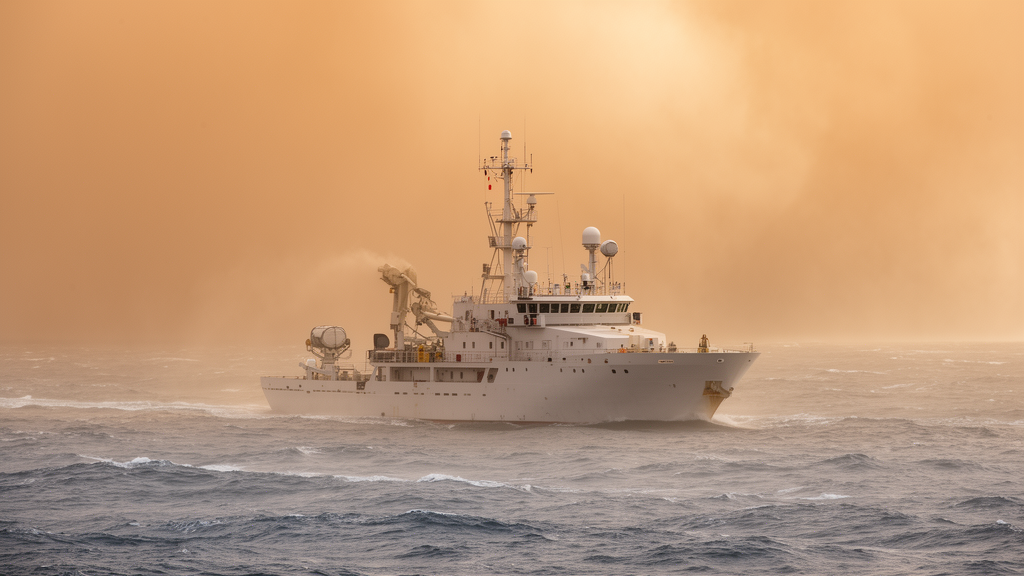
Every winter, vast plumes of mineral dust lift off the deserts of North Africa and ride the trade winds westward across the tropical Atlantic, sometimes traveling thousands of kilometers before settling over the Amazon basin, the Caribbean, or the open ocean. Despite being one of the most abundant aerosol types in Earth’s atmosphere, this trans-Atlantic dust highway remains surprisingly under-observed, particularly during the boreal winter months when in-situ measurements over the tropical mid-ocean are scarce. A new dataset, described in a preprint under review for the journal Earth System Science Data, now offers one of the most comprehensive ship-based portraits of this phenomenon to date, compiled from two research expeditions aboard the German research vessel R/V METEOR between January and March 2025.
The measurement campaign, known as EXPORT — short for EXperiments with the Portable Observatory for aeRosol Transport — was led by Andebo Waza, Konrad Kandler, Franz Kanngießer, Stephanie Fiedler, and colleagues from institutions including the GEOMAR Helmholtz Center for Ocean Research Kiel and Technische Universität Darmstadt. Expedition M207 departed Belém, Brazil, on January 3, 2025, and concluded in Mindelo, Cabo Verde, on February 11, 2025, tracing a northbound course directly through the dust corridor. Expedition M208 then began and ended in Mindelo, running from February 15 to March 17, 2025, keeping the ship and its instruments close to the African continent where dust outbreaks are most intense. Together, the two cruises captured continuous aerosol and meteorological observations across three distinct, multi-day Saharan dust events: the first over the tropical mid-Atlantic, and the latter two nearer the African coast.
What makes the EXPORT dataset unusual is its combination of ground-based in-situ sampling and remote sensing of lofted dust layers, all from a moving platform in a region where such measurements are rare. At the heart of the in-situ package was an optical particle counter, or OPC, which measured particulate matter concentrations and particle size distributions for diameters up to roughly 35 micrometers — a size range that includes the coarse dust grains responsible for much of the atmospheric dust mass burden. Complementing the optical counts, the team deployed a flat plate sampler to collect deposited particles, which were then analyzed using scanning electron microscopy coupled with energy-dispersive X-ray analysis, or SEM-EDX. This technique allowed the researchers to determine particle size, morphology, and elemental composition, from which they derived deposition rates — a key quantity for estimating how much dust, and the nutrients it carries, actually reaches the ocean surface.
Above the ship, a battery of remote sensing instruments probed the vertical structure of the atmosphere. CALITOO and MICROTOPS sun photometers measured aerosol optical depth at several wavelengths, providing a column-integrated measure of how much sunlight the dust attenuated. A Vaisala CL61 ceilometer recorded fine-scale layering of aerosol plumes, including depolarization measurements that help distinguish irregularly shaped mineral dust particles from spherical marine aerosols such as sea spray. A wind lidar profiled wind speeds aloft, an optical disdrometer characterized precipitation, and a broadband radiation sensor tracked the radiative effects of the dust. Nearly 90 radiosonde launches — balloon-borne instrument packages that profile temperature, humidity, and winds — stitched these observations into a three-dimensional picture of the dust-laden atmosphere.
The scientific stakes are considerable. Saharan dust influences climate in multiple, competing ways: it scatters and absorbs solar radiation, alters cloud formation by serving as ice-nucleating particles, and fertilizes ocean ecosystems with iron and other micronutrients. Yet climate and weather models still struggle to represent dust transport accurately, in part because ground-truth observations over the remote tropical Atlantic are so sparse. Most long-term dust records come from land-based stations in Africa or from satellite retrievals, which infer column properties but cannot resolve the vertical distribution, particle microphysics, or surface deposition directly. Ship-based campaigns like EXPORT fill precisely this gap, offering calibration points for satellites and validation data for reanalysis products and forecast models.
Indeed, the EXPORT team documented their measurements with a first comparison against reanalysis datasets and the METEOR’s own meteorological sensors, an early sanity check that will help future users judge how well existing models capture the observed dust events. The three dust outbreaks sampled during the cruises serve as illustrative case studies: one plume encountered far from any landmass in the tropical mid-Atlantic, and two others observed closer to West Africa, where fresh outbreaks loft dense dust into the Saharan Air Layer — the hot, dry, elevated air current that carries dust across the basin. Comparing in-situ size distributions and concentrations against model output during these events can reveal where models overestimate or underestimate coarse-particle transport, a persistent problem because large dust grains settle out faster than many models assume.
The winter timing of the campaign is itself scientifically meaningful. Between December and March, the Saharan dust belt shifts southward, and dust transport toward the Amazon becomes most pronounced. This seasonal dust delivery is thought to supply phosphorus and other nutrients that sustain the rainforest’s productivity, compensating for losses from leaching and runoff. Capturing this season with direct measurements — rather than extrapolating from other times of year — matters for quantifying the ocean and land fertilization budgets, for understanding how dust radiative forcing modulates the tropical Atlantic energy balance, and for constraining how dust may respond to changing land use and climate in North Africa.
All of the EXPORT datasets are now publicly available through the PANGAEA data repository, spanning optical particle counter measurements, flat plate sampler collections, sun photometer retrievals, Maritime Aerosol Network observations, radiation and ceilometer profiles, radiosonde soundings, wind lidar data, and disdrometer records for both cruises. The ship’s own meteorological data are archived separately through the dship.o2a-data.de portal operated by Universität Hamburg. This open release means that atmospheric modelers, satellite validation teams, and aerosol researchers worldwide can immediately begin mining the data — comparing it against dust reanalyses, testing transport schemes, or refining retrieval algorithms for spaceborne lidars and imagers.
For a field that has long relied on sparse island stations and satellite proxies, a two-month, instrument-dense transect through the heart of the winter dust corridor is a rare and valuable resource. As the preprint moves through peer review at Earth System Science Data, the EXPORT measurements stand ready to sharpen estimates of how much African dust crosses the Atlantic, at what heights, in what particle sizes, and with what consequences for climate, clouds, and ecosystems on both sides of the ocean.
Subject of Research: Trans-Atlantic transport of Saharan mineral dust measured from a research vessel during two 2025 expeditions
Article Title: Trans-Atlantic aerosol transport from January to March 2025 – measurements from two expeditions on a research vessel
Article References: Waza, A., Kandler, K., Kanngießer, F., Gottschall, J., Leuzinger, A., Speith, S., Sudarchikova, N., Wahl, S., Hepert, W., & Fiedler, S. (2026). Trans-Atlantic aerosol transport from January to March 2025 – measurements from two expeditions on a research vessel. https://doi.org/10.5194/essd-2026-733
Image Credits: AI Generated
Keywords: Saharan dust, mineral dust, aerosol transport, tropical Atlantic, R/V METEOR, research expedition, aerosol optical depth, ceilometer, radiosondes, SEM-EDX, dust deposition, Earth System Science Data
Cite Scienmag News
Russell Cooper. (October 16, 2026). Saharan Dust Crossing the Atlantic: Research Vessel Captures Rare Winter Aerosol Data. Scienmag. https://scienmag.com/saharan-dust-crossing-the-atlantic-research-vessel-captures-rare-winter-aerosol-data/
Russell Cooper. "Saharan Dust Crossing the Atlantic: Research Vessel Captures Rare Winter Aerosol Data." Scienmag, 16 October 2026, https://scienmag.com/saharan-dust-crossing-the-atlantic-research-vessel-captures-rare-winter-aerosol-data/. Accessed 16 October 2026.
Russell Cooper. "Saharan Dust Crossing the Atlantic: Research Vessel Captures Rare Winter Aerosol Data." Scienmag. October 16, 2026. https://scienmag.com/saharan-dust-crossing-the-atlantic-research-vessel-captures-rare-winter-aerosol-data/


