


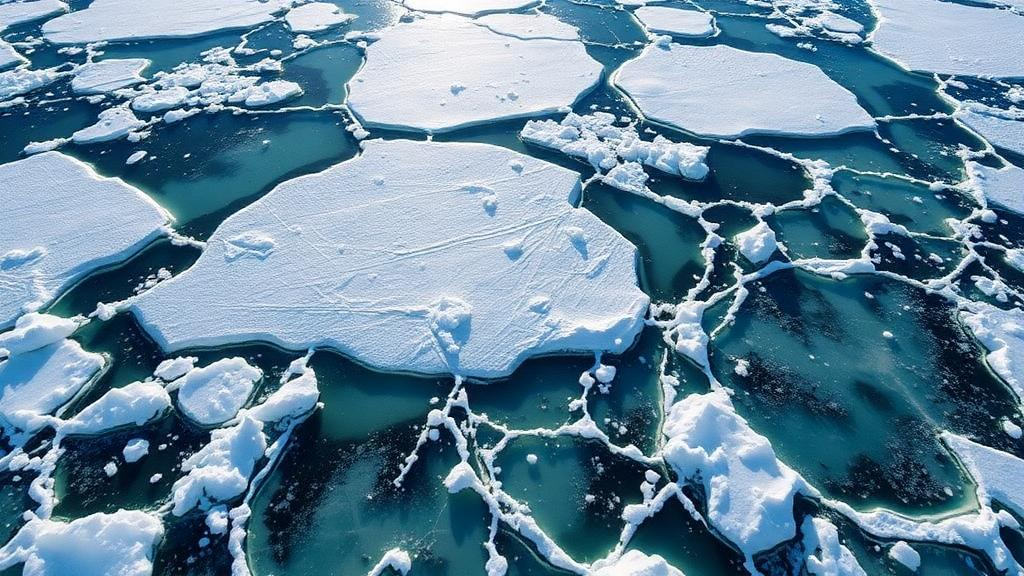
The Arctic’s winter sea ice, the vast frozen lid that forms over the ocean each year and then largely vanishes in summer, is on track to shrink by roughly one million square kilometres more than current climate models suggest, according to new research published in the journal Nature Geoscience. The finding comes not from satellite observations or supercomputer simulations alone, but from a surprising archive: the chemical fingerprints of algae that lived in Arctic sea ice some 6,000 years ago, during a warm stretch of Earth’s history known as the mid-Holocene.
While the dramatic retreat of summer sea ice has dominated headlines for years, the loss of winter ice has attracted far less scientific scrutiny, even though climate models disagree with one another most sharply during the winter months. That gap matters enormously. Winter ice cover acts as an insulating barrier, regulating how much heat and moisture escape from the relatively warm ocean into the cold polar atmosphere. When that barrier weakens or disappears, the consequences ripple far beyond the polar circle, and have been linked to colder winters and heavier snowfall across the United Kingdom, northern Europe and North America. The urgency of the question was underlined in March 2025, when the Arctic recorded its lowest maximum winter sea ice extent since modern measurements began, a record that was tied again this year.
To tackle the problem, researchers from the University of Cambridge and the Centro de Investigación en Matemáticas in Mexico, known as CIMAT, compiled the largest-ever database of a key biomarker produced by algae living within sea ice. The team extracted samples from ocean sediment cores laid down during the mid-Holocene, an epoch when subtle shifts in Earth’s orbit produced warmer conditions and reduced sea ice cover across the Arctic. Because the same physical laws govern sea ice behaviour regardless of why the climate is warming, this ancient warm period offers a natural test case for how the region responds to rising temperatures.
The biomarker at the heart of the study, called IP25, is a highly branched isoprenoid lipid produced by certain diatoms that thrive in the brine channels of sea ice. When these algae die, the molecules settle to the seafloor and become preserved in layered sediments, creating a year-by-year archive of ice conditions stretching back millennia. By measuring IP25 concentrations alongside complementary biomarkers from organisms that live only in open water, the researchers could reconstruct how much of the Arctic Ocean was covered by ice during the mid-Holocene, effectively generating a ground-truth map of past winter sea ice that no model can simply assume.
The team then compared these ancient measurements with simulations of the same period produced by 27 different climate models. Rather than treating every model equally, the researchers applied a statistical technique known as Bayesian weighting, assigning greater influence to models that reproduced the reconstructed sea ice conditions accurately and less to those that missed the mark. Because the same physical processes govern sea ice across different climates, these weights could then be transferred to simulations of the recent past and of the decades ahead, effectively letting the Arctic’s own history referee the models’ future forecasts.
The verdict was unambiguous: taken together, the models had been over-predicting how much winter sea ice the Arctic should hold. “When we apply the model weights to historical simulations, we completely eliminated the positive bias,” said lead author Crystal Fu of Cambridge’s Scott Polar Research Institute. “The future projections similarly end up being lower than previous estimates, by about a million square kilometres.” In practical terms, an area of winter ice larger than Egypt and Turkey combined may vanish from winter projections that had previously looked comparatively secure.
Bridging past and future in this way is far from straightforward. “The scientific community has amassed lots of palaeoclimate records over recent decades, but it’s remained a challenge to directly link these records to future projections, since there is uncertainty at both ends,” Fu explained. Ancient sediments carry their own dating errors and biological ambiguities, while future projections depend on uncertain emissions pathways and model physics. The Bayesian framework allowed the team to quantify uncertainty at both ends simultaneously, and the payoff was striking: the range of uncertainty in their projections shrank by as much as 85 percent, transforming sprawling bands of possibility into far tighter, more actionable forecasts.
“By using evidence from the past, we can now produce more reliable maps of where Arctic winter sea ice is likely to disappear,” said co-author Marco Aquino-López of CIMAT. “These give us a much clearer picture of what the Arctic might look like in the coming decades, and how much uncertainty remains.” For a region whose fate shapes weather far beyond its borders, those maps could prove invaluable for planners, insurers and governments bracing for shifting winter conditions across the mid-latitudes.
One of the study’s most compelling arguments is its indifference to the cause of warming. The mid-Holocene Arctic warmed because of slow, natural variations in Earth’s orbit rather than greenhouse gases, yet the ice responded in exactly the way physics dictates. “It doesn’t matter if the warming is natural variation or caused by human activity: if it warms, sea ice is going to melt,” Fu said. That universality is what makes palaeoclimate evidence so powerful as a model constraint: the ice sheet does not care about attribution, only about temperature.
The researchers also found hints that the knock-on effects of revised ice projections could be larger than expected. When they applied their recalibrated model weights to precipitation projections, the results suggested that snowfall over southeast Greenland and rainfall in the Mediterranean may also be underestimated by current models. If confirmed, that would carry implications for the stability of the Greenland ice sheet, which loses mass faster when warm snowfall events coat its surface, and for future flood risk in southern Europe, where intense rainfall already strains infrastructure. The study, supported in part by the US National Science Foundation and the Cambridge Trust, thus delivers a double warning: the Arctic’s winter ice is disappearing faster than we thought, and the atmospheric consequences may reach further than we imagined.
Subject of Research: Palaeoclimate constraints from mid-Holocene algae biomarkers tighten Arctic winter sea ice projections
Article Title: Winter sea ice loss may be underestimated, according to ancient clues from a warmer Arctic
Article References: Winter sea ice loss may be underestimated, according to ancient clues from a warmer Arctic. (n.d.). Original publication
Image Credits: AI Generated
DOI: Not provided
Keywords: Arctic sea ice, climate models, palaeoclimate, mid-Holocene, IP25 biomarker, Nature Geoscience, Bayesian weighting, Greenland ice sheet, Winter, loss, underestimated, according
Cite Scienmag News
Russell Cooper. (October 16, 2026). Ancient algae clues reveal Arctic winter sea ice loss is far worse than models predicted. Scienmag. https://scienmag.com/ancient-algae-clues-reveal-arctic-winter-sea-ice-loss-is-far-worse-than-models-predicted/
Russell Cooper. "Ancient algae clues reveal Arctic winter sea ice loss is far worse than models predicted." Scienmag, 16 October 2026, https://scienmag.com/ancient-algae-clues-reveal-arctic-winter-sea-ice-loss-is-far-worse-than-models-predicted/. Accessed 16 October 2026.
Russell Cooper. "Ancient algae clues reveal Arctic winter sea ice loss is far worse than models predicted." Scienmag. October 16, 2026. https://scienmag.com/ancient-algae-clues-reveal-arctic-winter-sea-ice-loss-is-far-worse-than-models-predicted/


