


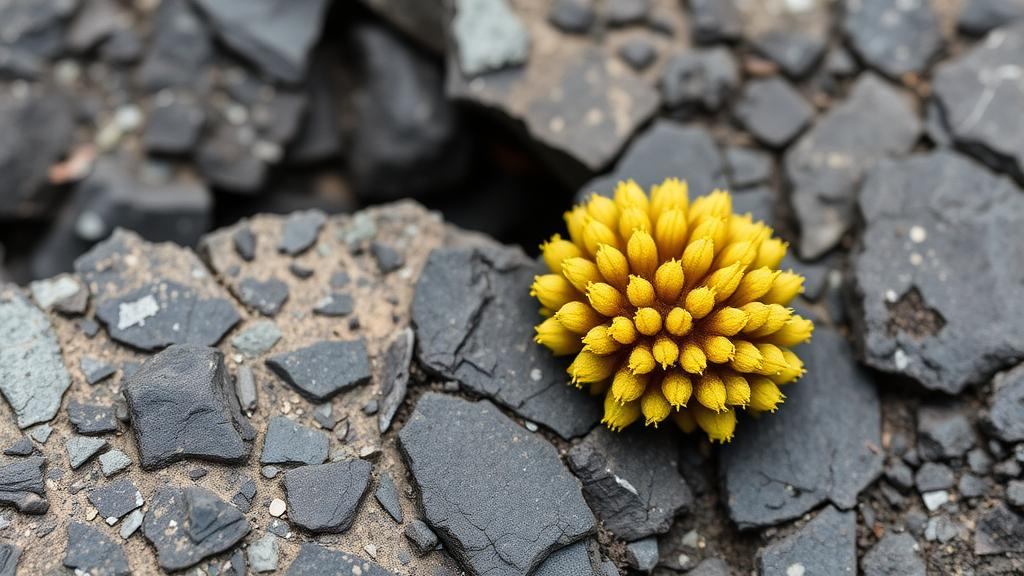
On some of Europe’s most hostile bedrock, a rare crust-forming lichen has quietly solved a problem that has puzzled biologists for decades: how to survive on stone that poisons most life. Solenopsora liparina, a pale, rosette-shaped lichen restricted almost entirely to ultramafic rocks — magnesium- and heavy-metal-rich substrates derived from ancient oceanic lithosphere — persists across a fragmented belt of outcrops stretching from Great Britain through the Massif Central, the Apennines, and the Balkans into Western Asia. A new study published in IMA Fungus shows that its survival does not depend on a single, tightly locked partnership with its algal and fungal symbionts. Instead, the lichen assembles a flexible, compositionally shifting consortium of partners that changes with climate from site to site, while its overall symbiotic diversity remains remarkably stable.
Ultramafic substrates are among the most stressful environments for any organism. They carry toxic concentrations of magnesium, nickel, chromium, and cobalt, while severely limiting macronutrients such as nitrogen, phosphorus, potassium, and calcium. Their dark bedrock absorbs and retains heat, water-holding capacity is poor, and ultraviolet exposure is intense. Plants on such soils have long served as model systems for studying local adaptation and speciation, and microbial communities show shifts in composition and metal tolerance. But lichens — symbiotic entities that integrate a fungal partner, photosynthetic algae or cyanobacteria, and a diverse microbiome into a single functional unit known as a holobiont — had remained largely unexplored in this context. Only eight lichen species worldwide are known exclusively from ultramafic substrates, and the structure of their internal symbiotic communities was essentially unknown.
To address this gap, an international team led by researchers studying the genus Solenopsora combined ecological niche modeling with multilocus phylogenetics and environmental metabarcoding across the entire known range of S. liparina. The team sampled 32 specimens from 10 populations, covering the vast majority of known localities, and compared the results with two sister species — S. candicans and S. cesatii — which grow on calcareous rocks and served as ecological reference taxa. Habitat suitability models built with MaxEnt, using 24 confirmed occurrences for the ultramafic specialist and hundreds of records for the congeners, revealed that precipitation during the wettest and driest quarters, and during the coldest part of the year, were the dominant climatic predictors of where S. liparina can persist. This contrasts with its calcicolous relatives, whose distributions depend more on temperature-related variables and precipitation seasonality.
The niche analysis showed that S. liparina occupies a narrower and partially distinct climatic space relative to its congeners, primarily along gradients of precipitation. Niche equivalency and similarity tests found no significant divergence between the ultramafic specialist and its calcicolous relatives, suggesting that the species’ climatic envelope overlaps broadly with theirs but is further constrained by moisture availability during physiologically critical periods. In practical terms, not all ultramafic habitats are climatically equivalent for this lichen: the substrate defines where it can potentially live, but precipitation patterns determine where it actually does.
Inside the thalli, the team found that S. liparina is typically dominated by a single lineage of the green algal genus Symbiochloris, which contributes nearly all photobiont reads in most samples. Additional algal lineages, when present, occur at low relative abundance — a pattern indicating low-frequency co-occurrence rather than balanced multi-partner symbiosis. Phylogenetic reconstructions based on the nuclear ITS region and the chloroplast rbcL gene confirmed the diversity within Symbiochloris and revealed two previously unrecognized clades. Two dominant Symbiochloris lineages were restricted to the ultramafic specialist, while two others were linked to the calcicolous congeners, but low-abundance lineages were broadly shared across all host species.
When the researchers modeled how environmental variables shape photobiont community composition, precipitation during the warmest quarter emerged as the strongest predictor, with altitude contributing an additional signal. This means that as one moves across the species’ range, the identity of the dominant algal partner changes in a climate-associated pattern of lineage turnover. Yet alpha diversity — the number and relative abundance of photobiont lineages within individual samples — remained largely stable across environmental gradients. Only photobiont richness responded to annual temperature range, declining as thermal variability increased. The overall picture is one in which climate reshuffles which partners are present, but does not fundamentally alter how many partners coexist within a given thallus.
The endolichenic fungi — melanized, yeast-like fungi living inside the lichen tissue — told a complementary story. These fungi exhibited higher species richness, greater evenness, and more intra-population variability than the photobionts. One taxon, Paracladophialophora sp. 1, was consistently detected across all S. liparina samples but was absent from the calcicolous congeners, a striking pattern given that the genus belongs to the Chaetothyriales, an order renowned for extremotolerant, melanized members. However, the limited sampling of the calcicolous species prevents a formal assessment of whether this reflects genuine substrate adaptation, host preference, or incomplete sampling. Other endolichenic lineages, including dark septate endophytes in the genera Cladophialophora and Rhinocladiella, were broadly distributed across samples spanning the precipitation gradient, with their relative abundance varying among sites rather than showing a uniform directional response.
Together, these results support a model of mixed host- and substrate-associated symbiont assembly. Dominant photobiont lineages exhibit host- or substrate-linked preferences, while low-abundance associates show weaker specificity and broader ecological overlap across environmental and host contexts. The substrate effects observed here are interpreted as host-associated lineage patterns rather than independently quantified drivers, since substrate chemistry was not explicitly included as a separate predictor in the statistical models. Nevertheless, the contrast between the ultramafic specialist and its calcicolous relatives suggests that substrate identity can selectively influence which photobiont taxa dominate, even as minor partners remain broadly shared.
The findings carry broader implications for understanding how symbiotic systems respond to environmental extremes. Because S. liparina does not produce asexual propagules that would allow joint dispersal of all partners, its mycobiont must repeatedly reassemble its symbiotic consortium from locally available photobionts and fungi after sexual spore dispersal. This reassembly process, filtered by climate and modulated by substrate, appears to be the mechanism that sustains the species across its fragmented range. Rather than depending on obligate partner specificity — a strategy that would make the lichen vulnerable to local partner absence — the ultramafic specialist draws from a shared pool of generalist photobionts, with local climatic conditions determining which lineages dominate at any given site.
As climate change alters precipitation patterns across the Mediterranean and adjacent regions, the sensitivity of both photobiont and endolichenic fungal communities to warm-season precipitation suggests that the composition of these symbioses may shift in the coming decades. The study’s authors note that microclimatic refugia — sheltered rock fissures, shaded surfaces, and deep moist valleys — likely play a key role in buffering harsh conditions and sustaining symbiotic function in otherwise hostile environments. Whether these refugia will be sufficient to maintain viable populations under future climatic scenarios remains an open question, but the flexible, compositionally dynamic symbiotic strategy revealed by this work offers a compelling explanation for how life on toxic stone has persisted across evolutionary timescales — and a warning about how fragile that persistence may prove under rapid environmental change.
Subject of Research: Symbiotic partner assembly in the ultramafic specialist lichen Solenopsora liparina
Article Title: Ultramafic specialist lichens persist through flexible symbioses structured by climate-driven filtering and modulated by substrate effects
Article References: Caboň, M., Slovák, M., Svitok, M., Steinová, J., Fačkovcová, Z., Gužiková, J., Kučera, J., Paoli, L., Větrovský, T., Hindáková, A., Senko, D., Zozomová-Lihová, J., Melichárková, A., Gajdošová, Z., & Guttová, A. (2026). Ultramafic specialist lichens persist through flexible symbioses structured by climate-driven filtering and modulated by substrate effects. IMA Fungus, 17, Article e199447. https://doi.org/10.3897/imafungus.17.199447
Image Credits: AI Generated
DOI: 10.3897/imafungus.17.199447
Keywords: lichen, ultramafic substrates, Solenopsora liparina, photobiont, endolichenic fungi, holobiont, climatic filtering, Symbiochloris, ecological niche modeling, metabarcoding, symbiosis, Mediterranean Basin
Cite Scienmag News
Drew Townsend. (October 16, 2026). Flexible partnerships help a rare lichen survive toxic rocky islands. Scienmag. https://scienmag.com/flexible-partnerships-help-a-rare-lichen-survive-toxic-rocky-islands/
Drew Townsend. "Flexible partnerships help a rare lichen survive toxic rocky islands." Scienmag, 16 October 2026, https://scienmag.com/flexible-partnerships-help-a-rare-lichen-survive-toxic-rocky-islands/. Accessed 16 October 2026.
Drew Townsend. "Flexible partnerships help a rare lichen survive toxic rocky islands." Scienmag. October 16, 2026. https://scienmag.com/flexible-partnerships-help-a-rare-lichen-survive-toxic-rocky-islands/


