


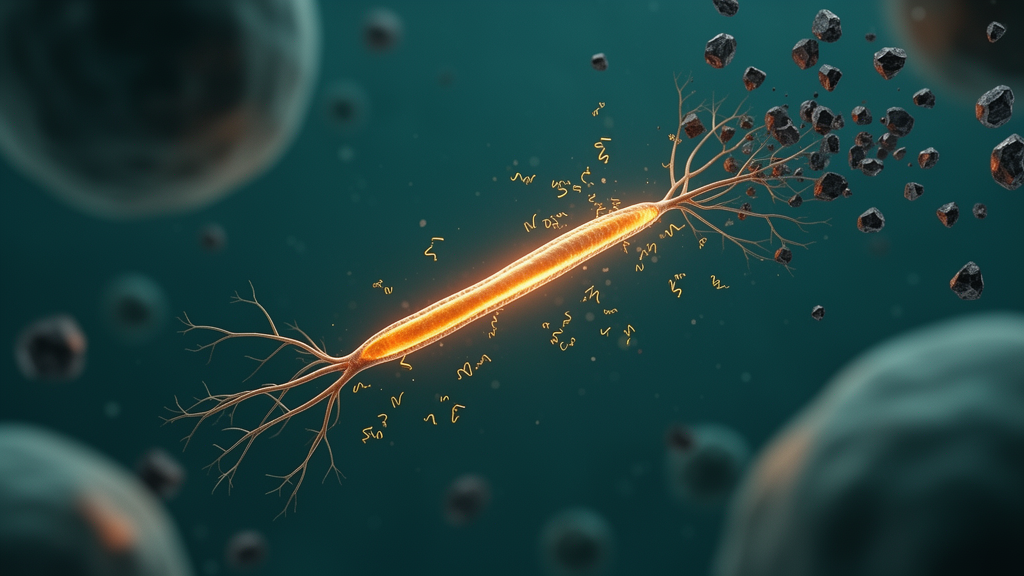
Chemotherapy saves lives, but for millions of cancer survivors it leaves behind a painful and often disabling legacy: chemotherapy-induced peripheral neuropathy, or CIPN. The condition, marked by numbness, tingling and burning pain in the hands and feet, has no established prevention or cure, and it frequently forces oncologists to reduce drug doses or abandon treatment altogether. Now, a team of researchers in South Korea has uncovered a molecular mechanism that may explain how damaged peripheral nerves attempt to repair themselves, and their findings point to an unexpected player: a miniature RNA molecule called miR-378f that appears to act as a master switch for the cellular recycling program that nerves rely on to recover.
The study, published in Frontiers in Molecular Neuroscience, grew out of an earlier investigation in which the researchers used small RNA sequencing to profile the blood of patients with advanced gastric cancer receiving XELOX chemotherapy, a widely used combination of capecitabine and oxaliplatin. Oxaliplatin is notorious for its neurotoxicity, and the team had previously identified five microRNAs whose circulating levels changed with chemotherapy exposure. When the researchers validated those candidates using quantitative PCR, only one of them, miR-378f, showed a statistically significant correlation with the severity of peripheral neuropathy. That single hit became the thread the team followed into the molecular machinery of nerve repair.
MicroRNAs are short non-coding RNAs, typically 21 to 23 nucleotides long, that fine-tune gene expression after a gene has been transcribed. They bind to complementary sequences in messenger RNA molecules, either blocking translation into protein or tagging the mRNA for degradation. Because a single microRNA can regulate dozens or even hundreds of targets, these molecules sit at critical control points in cellular networks, and their dysregulation has been implicated in cancer, neurological disorders and inflammation. In the context of nerve injury, microRNAs have been shown to modulate oxidative stress, neuroinflammation, axonal growth and autophagy, making them attractive both as biomarkers and as potential therapeutic levers.
To find what miR-378f might be controlling, the team turned to bioinformatic prediction tools. Using the miRNet platform, which integrates experimentally validated target data from TarBase and miRTarBase, they mapped the targets of all five chemotherapy-associated microRNAs. Among the predicted targets, calcium-binding protein 39, or CAB39, stood out: it was targeted by three of the five candidates, including miR-378f itself. CAB39 was already known to the researchers as an activator of AMPK, a cellular energy sensor that, when switched on, suppresses the growth-promoting kinase mTOR and thereby triggers autophagy. The stage was set for a hypothesis: when miR-378f levels fall, CAB39 rises, and the autophagy program in nerve cells is unleashed.
Autophagy, literally self-eating, is a genetically controlled process in which cells build double-membraned vesicles called autophagosomes that engulf damaged proteins, dysfunctional organelles and other cytoplasmic debris, delivering them to lysosomes for destruction and recycling. Far from being a destructive act, autophagy is fundamentally protective: it supplies nutrients under stress and clears out the molecular wreckage that accumulates after injury. In the peripheral nervous system, where nerves retain a remarkable capacity for regeneration, autophagy has been shown to facilitate the clearance of myelin debris, support axonal repair and promote functional recovery after injury. Inhibiting mTOR to activate autophagy has even been shown to provide neuroprotection in the early stages of nerve damage.
The experimental work was carried out in SH-SY5Y cells, a human neuroblastoma-derived cell line widely used as a neuronal model. The researchers transfected the cells with synthetic miR-378f mimics to overexpress the microRNA and with inhibitors to suppress it, optimizing dose and timing before measuring outcomes. The morphological results were striking: blocking miR-378f significantly extended the length of neurites, the slender projections that neurons use to connect and communicate, while overexpressing the microRNA shortened them. Branching followed a similar pattern. In short, less miR-378f meant more nerve growth, a result consistent with the idea that the microRNA acts as a brake on regenerative programs.
To confirm that CAB39 was a direct target rather than an indirect consequence, the team performed dual-luciferase reporter assays. They cloned the wild-type 3-prime untranslated region of CAB39, the segment where microRNAs typically bind, into a reporter plasmid, alongside a mutant version with the predicted binding site disrupted. Co-transfecting the wild-type construct with the miR-378f mimic reduced luciferase activity, while the inhibitor increased it, but neither manipulation affected the mutant construct. That clean pattern is the molecular equivalent of a smoking gun: miR-378f binds directly to the CAB39 transcript and represses it.
Western blotting then traced the signaling cascade downstream. When miR-378f was inhibited, CAB39 protein levels rose, phosphorylated AMPK increased and phosphorylated mTOR decreased, while total AMPK and mTOR remained unchanged, indicating that the microRNA was altering the activation state of the pathway rather than the abundance of its components. The autophagy markers shifted in the expected direction: Beclin-1, an initiator of autophagosome formation, went up; the ratio of lipidated LC3-II to LC3-I, a hallmark of autophagosome biogenesis, increased; and p62, a cargo receptor that accumulates when autophagic degradation stalls, went down. Overexpressing miR-378f produced the mirror-image pattern. Together, the data show that suppressing miR-378f activates the molecular signature of autophagy through the CAB39-AMPK-mTOR axis.
The clinical validation, though modest in scale, aligned with the cell culture results. The researchers analyzed blood samples from ten gastric cancer patients treated at Pusan National University Hospital, divided into those who had received fewer than four cycles of XELOX and those who had received four to six. Patients with greater cumulative exposure and more severe neuropathy, graded by oncologists using the National Cancer Institute’s Common Terminology Criteria for Adverse Events, showed significantly lower miR-378f levels alongside elevated CAB39, Beclin-1 and LC3-II transcripts. The authors interpret this as evidence that autophagy is enhanced as neuropathy worsens, likely reflecting a compensatory repair response rather than a cause of the damage itself.
The researchers are careful about the limits of their work. Autophagic flux and autophagosome formation were not directly measured, the neuronal cells were never exposed to chemotherapy drugs, and no animal experiments were performed. SH-SY5Y cells, moreover, do not fully replicate primary peripheral sensory neurons, and the clinical cohort lacked a chemotherapy-exposed control group without neuropathy. Still, the study sketches a coherent and testable pathway: chemotherapy injures peripheral nerves, miR-378f falls as part of a counter-regulatory response, CAB39 is derepressed, AMPK is activated, mTOR is inhibited, and the autophagy machinery mobilizes to clear damage and support regeneration. If future work in primary neurons, animal models and larger patient cohorts confirms the mechanism, miR-378f could serve double duty as a biomarker for identifying patients at risk of severe neuropathy and as a therapeutic target whose manipulation might one day help protect the nerves that cancer treatment so often sacrifices.
Subject of Research: The role of miR-378f and CAB39 in regulating autophagy in chemotherapy-induced peripheral neuropathy
Article Title: miR-378f targets CAB39 to regulate autophagy in chemotherapy-induced peripheral neuropathy
Article References: Kim, Y., Jeong, M., Kwon, H., Kim, J., Ju, Y., Kang, D.-Y., Jang, A., & Choi, G.-E. (2026). miR-378f targets CAB39 to regulate autophagy in chemotherapy-induced peripheral neuropathy. Frontiers in Molecular Neuroscience, 19, Article 1958322. https://doi.org/10.3389/fnmol.2026.1958322
Image Credits: AI Generated
DOI: 10.3389/fnmol.2026.1958322
Keywords: miR-378f, CAB39, autophagy, chemotherapy-induced peripheral neuropathy, microRNA, AMPK, mTOR, oxaliplatin, neuroregeneration, Beclin-1, LC3, gastric cancer
Cite Scienmag News
Nathaniel Bowman. (October 16, 2026). Tiny RNA Molecule Reveals How Nerves Fight Back Against Chemotherapy Damage. Scienmag. https://scienmag.com/tiny-rna-molecule-reveals-how-nerves-fight-back-against-chemotherapy-damage/
Nathaniel Bowman. "Tiny RNA Molecule Reveals How Nerves Fight Back Against Chemotherapy Damage." Scienmag, 16 October 2026, https://scienmag.com/tiny-rna-molecule-reveals-how-nerves-fight-back-against-chemotherapy-damage/. Accessed 16 October 2026.
Nathaniel Bowman. "Tiny RNA Molecule Reveals How Nerves Fight Back Against Chemotherapy Damage." Scienmag. October 16, 2026. https://scienmag.com/tiny-rna-molecule-reveals-how-nerves-fight-back-against-chemotherapy-damage/


