


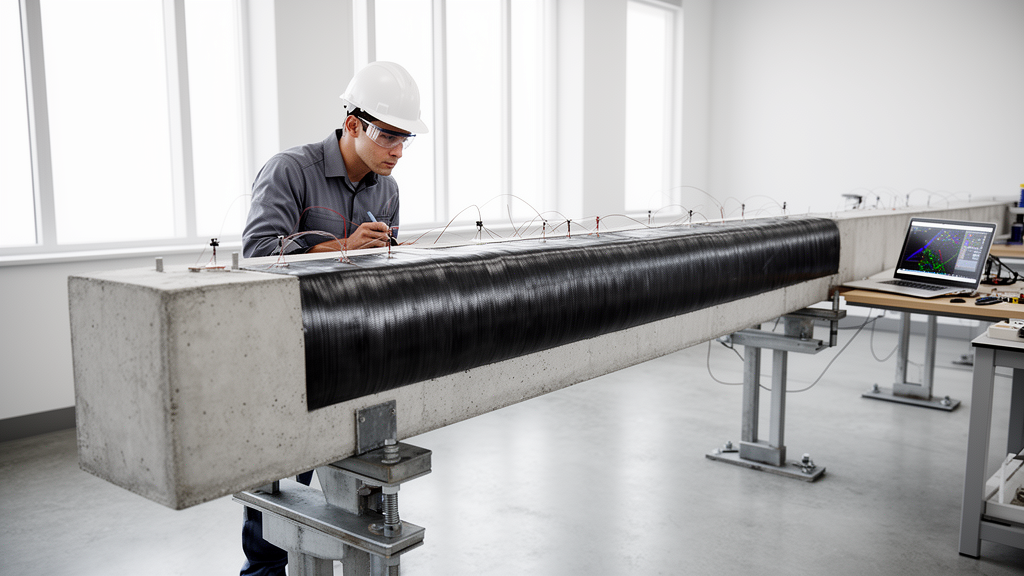
Every year, engineers around the world face the same stubborn problem: reinforced concrete beams that were built decades ago are no longer strong enough for the loads they must carry, and tearing them down and replacing them is ruinously expensive for both budgets and the planet. The built environment already accounts for roughly forty percent of global energy use and solid waste, which makes extending the life of existing structures one of the most powerful sustainability levers available. A widely adopted answer is to wrap or bond beams with fiber-reinforced polymer, or FRP, a family of lightweight composite materials, including carbon, glass, aramid and basalt variants, that can dramatically boost a beam’s ultimate load capacity without adding significant weight. But deciding whether a strengthened beam will actually perform safely has traditionally demanded extensive laboratory characterization of its geometry and material properties, a process that is slow, costly and resource-intensive. A new open-access study in Discover Sustainability argues that much of that burden is unnecessary, and it uses machine learning not just to make predictions but to prove which measurements can be safely thrown away.
The research team, led by Opeyemi Bamidele and Joseph Adisa of Ladoke Akintola University of Technology in Nigeria, together with Benjamin Labar and Nurullah Bektas, working with institutions in Nigeria and Hungary, assembled an experimental database of 624 FRP-strengthened reinforced concrete beam specimens drawn from published laboratory studies. Rather than predicting a single number, their models tackle two tasks at once: classifying which failure mode will govern a strengthened beam’s behavior, and regressing its ultimate load capacity. These are genuinely different challenges, because FRP-strengthened beams can fail in several distinct ways, from crushing of the concrete to debonding of the composite sheet, and each mode responds differently to the interplay of beam dimensions, reinforcement ratios, concrete strength and FRP properties. Getting the mode wrong can render a load prediction meaningless, so the joint prediction is a demanding test of any model.
The reported accuracy is striking. Under a random specimen-level evaluation protocol, the classification models achieved a Macro-F1 score of 0.93 and a Matthews correlation coefficient of 0.91, both indicating reliable discrimination across failure-mode classes even when those classes are imbalanced. For capacity prediction, the models reached a coefficient of determination of 0.96 with a root mean square error of 9.59 kilonewtons, meaning the predicted breaking loads tracked the measured laboratory values closely. Crucially, the authors did not stop at this favorable split. Because databases compiled from many separate studies can inflate apparent performance when specimens from the same experiment land in both training and test sets, they also ran grouped cross-validation and leave-one-study-out cross-validation, in which entire independent source studies are held out, to probe how well the models generalize beyond the data they have seen.
Yet the paper’s central contribution is not the leaderboard. It is a staged feature-elimination pipeline designed to answer a deceptively simple question: how many input measurements are actually needed? The pipeline begins with Boruta screening, a wrapper method that compares each real feature against shuffled copies of itself to determine whether it carries information beyond noise. Surviving features are then ranked using cross-validated SHAP values, a game-theoretic attribution technique that quantifies each variable’s contribution to individual predictions, alongside permutation importance, which measures how much model performance degrades when a feature’s values are randomly scrambled. Finally, the team performed factorial ablation, systematically removing candidate features and retraining, with paired statistical significance testing to confirm that any performance drop was real rather than a fluctuation of the random number generator.
That statistical rigor is what separates this work from the many machine learning papers that publish a high R-squared and move on. The researchers explicitly corrected their significance tests for two well-known pitfalls: the non-independence of repeated cross-validation folds, which can make paired comparisons look more confident than they are, and multiple comparisons, which inflate false positives when many feature combinations are tested. They also quantified uncertainty with bootstrap confidence intervals, checked their conclusions across alternative model families, including random forest, XGBoost, CatBoost, LightGBM and support vector machines, and verified feature redundancy using variance inflation factors. The result is a defensible claim rather than an optimistic one.
The defensible claim turns out to be remarkable. Two of the twelve input variables could be eliminated with no statistically significant loss in predictive performance on the holdout test set, and one of them is FRP tensile strength, a property whose determination requires destructive coupon testing, meaning physically cutting and pulling apart samples of the composite material. Removing it therefore eliminates an entire laboratory workflow, not merely a row in a spreadsheet. The trimmed input set of ten parameters constitutes what the authors call a minimum viable assessment parameter set, a validated recipe of what an engineer genuinely needs to measure before deciding whether an FRP retrofit will be safe and effective.
The benefits ripple outward in ways that connect directly to the United Nations Sustainable Development Goals on industry and infrastructure, responsible consumption and climate action. Fewer required tests mean less material consumed in coupon preparation, less energy spent in laboratories, faster turnaround for retrofit decisions and, potentially, more structures assessed within the same budget. The leaner feature set also cuts model training time by approximately fifteen percent, a modest but meaningful gain for practitioners deploying such models on ordinary hardware, and it reduces the risk that a field assessment stalls because one expensive measurement cannot be obtained. In effect, the study converts a data-science exercise into a practical testing protocol.
What makes the approach broadly influential is that the pipeline itself is portable. The combination of Boruta screening, cross-validated SHAP and permutation ranking, and statistically corrected factorial ablation could be applied to any engineering prediction problem where the cost of gathering inputs is a bottleneck, from predicting the capacity of FRCM-strengthened elements, which related recent work has explored, to assessing fiber-reinforced concrete columns and slab-beam systems. In each case the same logic applies: a model is only as practical as the data it demands, and demonstrating that a variable is expendable is often more valuable than squeezing out another decimal point of accuracy. The authors frame their work as supporting structural health monitoring and circular-economy goals, since reliable, low-burden assessment makes life-extension of existing assets more attractive than demolition and replacement.
The study is not without the caveats its authors openly acknowledge. The statistical evidence for eliminating the two variables holds on the holdout test set and is supported by robustness checks and uncertainty quantification, but the underlying database, however broad, consists of laboratory specimens, and full-scale beams in the field can behave differently. The grouped and leave-one-study-out evaluations temper optimism about generalization, showing that the team took the risk seriously rather than hiding it. Independent validation on new experimental campaigns will be the natural next step, and regulatory acceptance of any reduced testing regime will require exactly the kind of statistically disciplined evidence this paper provides.
Even so, the direction of travel is clear. Machine learning in civil engineering has often been criticized as a parade of ever-larger models trained on ever-larger databases, with little attention to what the predictions actually cost to produce. This study inverts that framing, treating the testing burden itself as the enemy and using careful statistics to shrink it. For the engineers deciding whether a tired concrete beam can carry another few decades of traffic with a layer of carbon fiber on its flanks, the message is pragmatic and quietly revolutionary: you may need far fewer measurements than you thought, and the proof that you can skip the destructive coupon test is now published, peer-reviewed and freely available. In a sector responsible for a huge share of the world’s energy use and waste, that kind of verified subtraction may matter as much as any new material.
Subject of Research: Machine learning with staged feature elimination to predict failure mode and ultimate load capacity of FRP-strengthened reinforced concrete beams
Article Title: Resource-efficient machine learning via multi-staged feature elimination for sustainable structural assessment and life-extension of FRP-strengthened RC beams
Article References: Bamidele, O., Adisa, J., Labar, B., & Bektas, N. (2026). Resource-efficient machine learning via multi-staged feature elimination for sustainable structural assessment and life-extension of FRP-strengthened RC beams. Discover Sustainability. https://doi.org/10.1007/s43621-026-04913-z
Image Credits: AI Generated
DOI: 10.1007/s43621-026-04913-z
Keywords: machine learning, FRP-strengthened RC beams, feature elimination, structural assessment, ultimate load capacity, failure mode prediction, SHAP, sustainability, retrofitting, reinforced concrete, circular economy, life-extension
Cite Scienmag News
Sloane Callahan. (October 16, 2026). Leaner AI Cuts Testing Burden for Predicting Strength of Retrofit Concrete Beams. Scienmag. https://scienmag.com/leaner-ai-cuts-testing-burden-for-predicting-strength-of-retrofit-concrete-beams/
Sloane Callahan. "Leaner AI Cuts Testing Burden for Predicting Strength of Retrofit Concrete Beams." Scienmag, 16 October 2026, https://scienmag.com/leaner-ai-cuts-testing-burden-for-predicting-strength-of-retrofit-concrete-beams/. Accessed 16 October 2026.
Sloane Callahan. "Leaner AI Cuts Testing Burden for Predicting Strength of Retrofit Concrete Beams." Scienmag. October 16, 2026. https://scienmag.com/leaner-ai-cuts-testing-burden-for-predicting-strength-of-retrofit-concrete-beams/


