


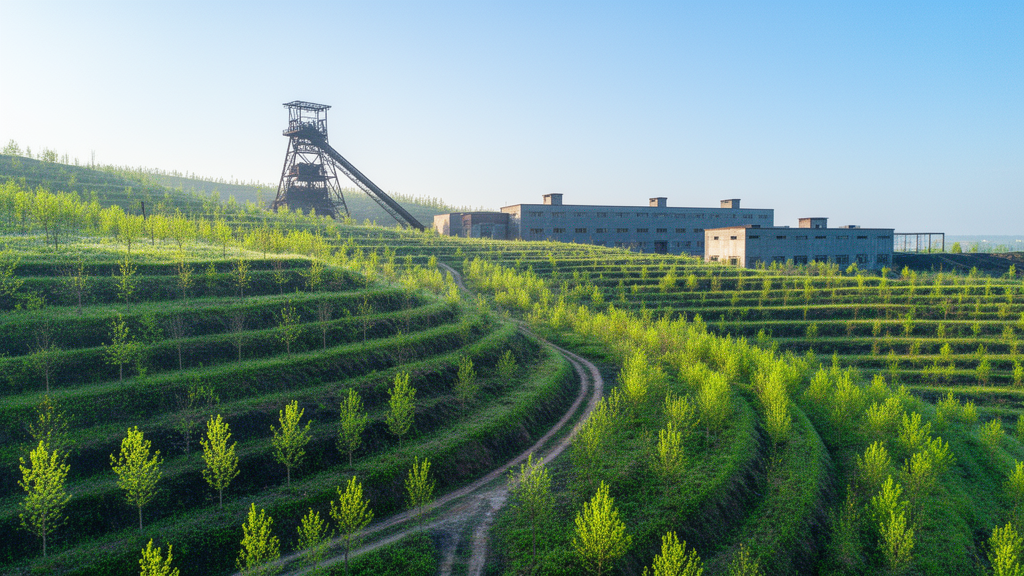
In the hilly basins of southern Shanxi, where coal-fired heating stacks and metallurgical plants pump emissions into a semi-enclosed pocket of the Loess Plateau each winter, a new study has mapped exactly where the region’s carbon and smog problems concentrate—and found that the shape of the landscape itself may be one of the most powerful levers for fixing them. The research, published in Frontiers in Environmental Science, combines satellite imagery, ground-based air monitors, and spatial statistics to reveal how buildings and green spaces jointly drive two of China’s most stubborn environmental burdens: particulate matter pollution and carbon dioxide emissions.
The study area spans 34,484 square kilometers across the cities of Linfen and Yuncheng, a region long dominated by coal mining, chemical production, and heavy industry. During the winter heating season, cold, dry Siberian air masses settle over the basin, wind speeds drop, and the surrounding mountains trap pollutants close to their sources. Coal-fired heating and open straw burning add to the burden, making winter the season with the most severe and complex pollution episodes. It is precisely this combination of topography, meteorology, and intensive human activity that made southern Shanxi an ideal natural laboratory for asking whether the arrangement of urban landscapes can measurably shape air quality and carbon output.
To answer that question, the researchers assembled an unusually detailed dataset. Carbon emissions came from the Open Data Inventory for Anthropogenic Carbon Dioxide, a 1-kilometer gridded product built by disaggregating nighttime lights, power plant emissions, and sectoral energy use. Particulate matter concentrations for PM2.5 and PM10 were drawn from 66 ground monitoring stations run by Shanxi’s environmental authorities between November 2022 and March 2023, then interpolated into continuous pollution surfaces using Bayesian kriging—a method that quantifies its own uncertainty and copes well with unevenly spaced stations. Cross-validation showed the interpolation performed reliably, with coefficients of determination of 0.714 for PM2.5 and 0.705 for PM10.
The landscape itself was characterized at remarkable resolution. Sentinel-2A imagery at 10 meters, processed with atmospheric correction and object-based classification, divided the land into green land, wetland, cropland, water body, and impervious surface, achieving an overall classification accuracy of 83.2 percent. For the vertical dimension of the city, the team turned to Gaofen-2 imagery at 0.8 meters, exploiting the geometric relationship between building shadows and true building heights—validated with field measurements—to calculate metrics such as floor area ratio, building coverage ratio, average height, and a newly constructed building rugosity index. Green space was described with eight patch-level indices capturing coverage, patch density, shape, contiguity, and connectivity, supplemented by satellite-derived net primary productivity as a measure of vegetation’s carbon-sequestration capacity.
The resulting maps revealed a striking and somewhat counterintuitive geography. Carbon emissions clustered intensely in the industrial heartlands—Yaodu District, Yanhu District, and Hejin City—where maximum emission intensity reached 168,486 tonnes per square kilometer. Particulate matter, by contrast, followed a southwest-to-northeast gradient, highest around Yanhu District and lowest in the greener, better-ventilated northeastern counties such as Gu, Anze, and Fushan. Crucially, the two pollution types overlapped locally but diverged overall: Yanhu District was a hotspot for both, yet Yaodu District, a core carbon-emission zone, did not show correspondingly peak particulate levels. County-level Pearson analysis confirmed only weak positive correlations between emissions and PM2.5 (r = 0.422) or PM10 (r = 0.362), a finding the authors attribute in part to Yaodu’s service-heavy economy, higher penetration of natural gas and electricity, centralized heating, and strict emission controls in the urban core.
When the team correlated seventeen landscape indices against emissions and pollution, a clear pattern emerged. Architectural intensity was consistently bad news: floor area ratio showed a strong positive correlation with carbon emissions (r = 0.716 in winter), and the building rugosity index correlated strongly with both PM2.5 (r = 0.845) and PM10 (r = 0.759). The mechanism is twofold. Denser, taller construction directly increases energy demand and emissions, while rougher urban canopies modify airflow, restrict ventilation pathways, create recirculation zones, and prolong the time that particles linger in the air people breathe. Green landscapes told the opposite story. The percentage of vegetated land correlated negatively with PM2.5 at a remarkable r = −0.930, and patch cohesion, largest patch index, and net primary productivity all tracked lower pollution and lower emissions. Vegetation intercepts and deposits particles, stabilizes carbon uptake, and forms ecological corridors that aid dispersion. Notably, carbon emissions proved more sensitive to vegetation productivity, while particulate concentrations responded more strongly to the spatial morphology of green patches and the structural form of buildings.
Because averages can hide local variation, the researchers applied geographically weighted regression, which fits a separate set of coefficients at every location rather than one global average. The models explained the spatial variation well—adjusted R-squared values of 0.769 for carbon emissions, 0.680 for PM2.5, and 0.789 for PM10—and the local coefficients revealed pronounced spatial heterogeneity, with strong effects concentrated in the northern, southwestern, and northeastern parts of the region and weaker effects in the center and southeast. Spatial autocorrelation analysis using Moran’s I with 999 Monte Carlo simulations confirmed significant clustering for both variables, with particulate pollution showing stronger spatial clustering than carbon emissions, consistent with the regional transport of aerosols across county boundaries.
One of the study’s most elegant analyses focused on Yuncheng Salt Lake, a unique inland saline ecosystem ringed by thirty concentric 1-kilometer buffer zones extending 30 kilometers from the lake’s edge. Carbon emissions and particulate concentrations both declined steadily outward from the lake, tracking the fading intensity of building development. In the near zone, where floor area ratios and building coverage remained high, the link between construction and pollution was strongest; in the far zone, it essentially vanished, apart from a localized emissions peak at 29 kilometers traced to the industrial built-up area of Yongji City rather than a data artifact. Meanwhile, the negative regulatory effect of green space grew stronger with distance from the lake: fragmented green patches near the shore offered limited protection, while the large, connected, highly productive green landscapes of the outer suburbs delivered the strongest pollution-blocking and carbon-sinking benefits.
The practical implications are direct. Rather than treating smog and carbon as a single problem, the authors argue for differentiated landscape planning tuned to each county’s dominant burden. Areas prioritizing particulate control, such as Yonghe and Xi counties, should build protective forest belts and ventilation corridors along mountains and river valleys while strictly regulating building forms and floor area ratios. Areas prioritizing carbon reduction, such as Wenxi and Daning counties, should expand ecological green space and vegetation productivity while curbing construction intensity. Regions needing both, including Ruicheng, Yongji, Linyi, and Hejin, should weave core carbon-sink green spaces, dust-retention buffers, and ventilation corridors into a single ecological network alongside compact, low-carbon building layouts. Around the salt lake itself, the team proposes a gradient framework: strict lakeside development restrictions and greenway connections in the near zone, large ecological patches and industrial-residential separation in the middle zone, and a reinforced mountain-and-farmland ecological barrier in the far zone. The authors caution that their analysis covers only one winter heating season, includes only building and green space landscape types, and cannot fully disentangle meteorological and socioeconomic drivers—but the core message stands. In China’s coal country, and in resource-based regions across the Yellow River Basin, the cheapest combined attack on smog and carbon may already be growing in the ground: well-connected, productive green landscapes, deployed where the data say they will work hardest.
Subject of Research: Driving mechanisms of atmospheric particulate matter and carbon emissions under the influence of landscape patterns in southern Shanxi, China
Article Title: Analysis of the driving mechanisms of atmospheric particulate matter and carbon emissions under the influence of landscape patterns in southern Shanxi, China
Article References: Analysis of the driving mechanisms of atmospheric particulate matter and carbon emissions under the influence of landscape patterns in southern Shanxi, China. (n.d.). https://doi.org/10.3389/fenvs.2026.1944157
Image Credits: AI Generated
DOI: 10.3389/fenvs.2026.1944157
Keywords: air pollution, carbon emissions, PM2.5, landscape patterns, urban green space, geographically weighted regression, remote sensing, Shanxi, Yellow River Basin, Yuncheng Salt Lake, winter heating season, spatial heterogeneity
Cite Scienmag News
Russell Cooper. (October 16, 2026). Green Landscapes Emerge as a Double Weapon Against Smog and Carbon in China’s Coal Country. Scienmag. https://scienmag.com/green-landscapes-emerge-as-a-double-weapon-against-smog-and-carbon-in-chinas-coal-country/
Russell Cooper. "Green Landscapes Emerge as a Double Weapon Against Smog and Carbon in China’s Coal Country." Scienmag, 16 October 2026, https://scienmag.com/green-landscapes-emerge-as-a-double-weapon-against-smog-and-carbon-in-chinas-coal-country/. Accessed 16 October 2026.
Russell Cooper. "Green Landscapes Emerge as a Double Weapon Against Smog and Carbon in China’s Coal Country." Scienmag. October 16, 2026. https://scienmag.com/green-landscapes-emerge-as-a-double-weapon-against-smog-and-carbon-in-chinas-coal-country/


