


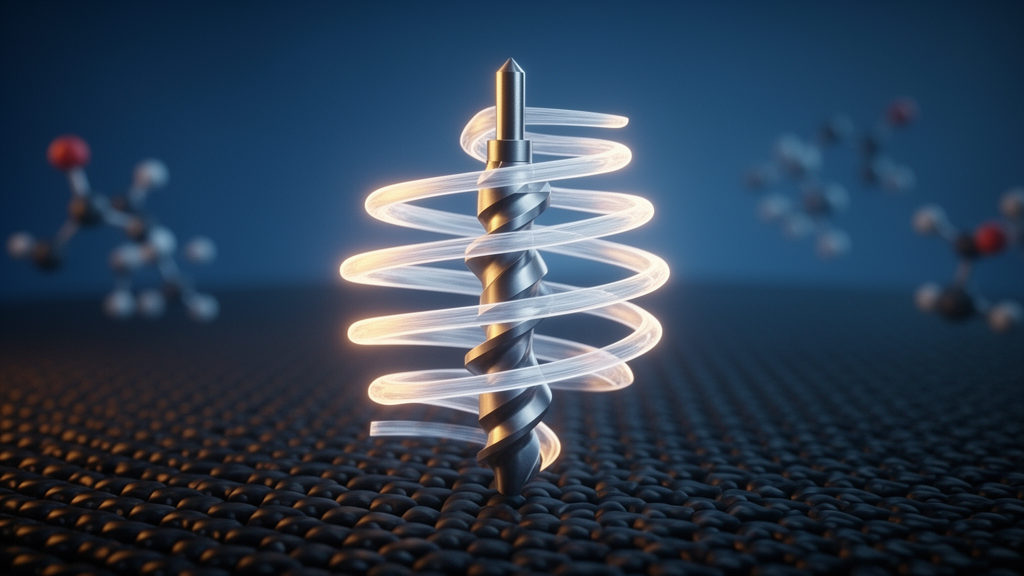
For decades, chemists have chased a deceptively simple dream: a molecule that spins in only one direction, like a microscopic windmill, powered by nothing more exotic than an electric current. Now a team of researchers from Germany, the Czech Republic, Spain and Switzerland has demonstrated a fundamentally new way to achieve it — one that relies not on mechanical barriers, but on the ghostly rotation of quantum orbitals themselves.
The study, published in Nature Chemistry, showcases a molecular motor whose unidirectional rotation is driven by the transfer of orbital angular momentum from an electrical current to a chiral rotor. The mechanism sidesteps the two ingredients that every previous design depended upon: steric hindrance and high-energy transitional excited states. Instead, the directionality is woven into the very fabric of the molecule’s electronic structure, carried by helical orbitals in an upright axle.
Understanding why this matters requires a brief tour of how molecular motors have worked until now. In biology, molecular machines such as ATP synthase achieve directional rotation through elaborate protein scaffolds that channel conformational changes along a preferred path. In synthetic chemistry, the celebrated Feringa-type motors — which earned Ben Feringa a share of the 2016 Nobel Prize in Chemistry — rely on a different trick: light excites the molecule into a high-energy transitional state, and as it relaxes back to a low-energy configuration, steric hindrance blocks movement along one of the two possible directions. The molecule has no choice but to return the ‘long way round’, and this repeated bias produces net rotation.
The new motor, designed and synthesized by Nico Balzer, Jan Lukášek, Michal Valášek and Marcel Mayor at Karlsruhe Institute of Technology and the University of Basel, dispenses with this excitation-relaxation cycle entirely. The molecule consists of three parts: a rigid platform that anchors it to a gold surface, an upright axle rising from the platform, and a chiral rotor moiety mounted on the axle. When a current flows through the molecule — injected by the tip of a scanning tunneling microscope (STM) — the rotor spins in one direction only.
The secret lies in the axle. Theoretical work by Štěpán Marek, María Camarasa-Gómez, Jan Wilhelm, Ferdinand Evers and Richard Korytár revealed that the axle’s molecular orbitals are helical: they wind around the axle like the threads of a screw. When current flows through these helical orbitals, it generates circulating orbital currents — tiny vortices of electron flow that wind around the axle. These circulating currents carry orbital angular momentum, a quantum property associated with the rotation of an electron’s wavefunction around an axis.
Crucially, the helical orbitals act as a conduit for this angular momentum. As the current passes through the axle, the orbital angular momentum it carries is transferred to the rotor, exerting a mechanical torque. Because the orbitals are helical — and because the rotor is chiral — the torque always acts in the same rotational sense. The rotor spins in one direction, powered by the continuous stream of angular momentum delivered by the current. Reversing the current’s flow would reverse the orbital currents and thus the direction of rotation, giving the researchers a switchable motor.
The experiments, performed by Julian Skolaut, Lukas Gerhard and Wulf Wulfhekel at Karlsruhe Institute of Technology, used an STM to both drive the motor and observe its rotation. The researchers placed individual molecules on a gold surface and used the STM tip to inject current through the axle. By monitoring the rotor’s position over time, they confirmed that it rotated in one direction only — a hallmark of a true molecular motor rather than a simple oscillator.
The theoretical framework underlying the discovery draws on the emerging field of orbitronics, which explores how orbital angular momentum in solids can be harnessed for information processing. The researchers computed the circulating currents in the helical orbitals using density functional theory, employing codes such as TURBOMOLE, FHI-aims and VASP, along with a custom transport simulation package called TSaint. Their calculations showed that the orbital angular momentum carried by the current through the axle is substantial enough to drive the rotor against thermal fluctuations.
The design of the molecule itself is a tour de force of synthetic chemistry. The rigid platform — based on a spirobifluorene scaffold — ensures that the molecule stands upright on the gold surface, with the axle perpendicular to the surface. The chiral rotor, a biphenyl-based moiety, is mounted on the axle in a way that allows free rotation while maintaining its chirality. The researchers synthesized several variants of the molecule to probe how structural changes affect the motor’s behavior.
The implications of this work extend far beyond the laboratory curiosity of a spinning molecule. Molecular motors powered by orbital angular momentum could one day drive nanoscale machinery, transport cargo across surfaces, or act as switches in molecular electronics. Because the mechanism relies on electronic structure rather than mechanical barriers, it could be more robust and easier to integrate into devices than previous designs. Moreover, the connection to orbitronics suggests that molecular motors could serve as model systems for studying orbital angular momentum transport at the ultimate limit of miniaturization — a single molecule.
The research also deepens our understanding of how quantum properties of electrons — beyond charge and spin — can be harnessed to do mechanical work. Just as spintronics exploits the electron’s spin angular momentum, this work demonstrates that orbital angular momentum can be channeled through molecular orbitals to produce directional motion. The helical orbitals in the axle act as a quantum gearbox, converting the abstract rotation of an electron’s wavefunction into the very real rotation of a molecular rotor.
As the field of molecular machines matures, designs like this one — where directionality emerges from electronic structure rather than mechanical constraints — may prove to be the key to building molecular machines that are both efficient and robust. The demonstration that a current flowing through helical orbitals can drive unidirectional rotation opens a new chapter in the quest to harness the strange rules of the quantum world for practical purposes.
Subject of Research: Unidirectional rotation in a molecular motor driven by angular-momentum transfer via helical orbitals
Article Title: Unidirectional rotation in a molecular motor driven by angular-momentum transfer via helical orbitals
Article References: Unidirectional rotation in a molecular motor driven by angular-momentum transfer via helical orbitals. (n.d.). https://doi.org/10.1038/s41557-026-02264-w
Image Credits: AI Generated
DOI: 10.1038/s41557-026-02264-w
Keywords: molecular machines, molecular electronics, helical orbitals, angular momentum, scanning tunneling microscopy, nanotechnology, chemistry, physics, Unidirectional, rotation, molecular, motor
Cite Scienmag News
Bethany Barker. (October 16, 2026). Helical orbitals drive unidirectional rotation in a molecular motor. Scienmag. https://scienmag.com/helical-orbitals-drive-unidirectional-rotation-in-a-molecular-motor/
Bethany Barker. "Helical orbitals drive unidirectional rotation in a molecular motor." Scienmag, 16 October 2026, https://scienmag.com/helical-orbitals-drive-unidirectional-rotation-in-a-molecular-motor/. Accessed 16 October 2026.
Bethany Barker. "Helical orbitals drive unidirectional rotation in a molecular motor." Scienmag. October 16, 2026. https://scienmag.com/helical-orbitals-drive-unidirectional-rotation-in-a-molecular-motor/


