


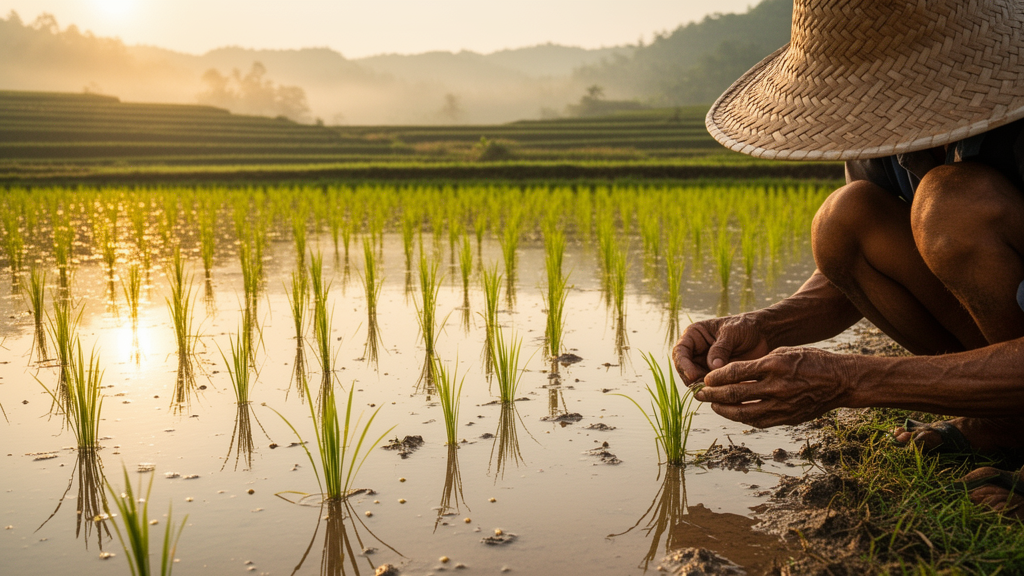
Rice feeds roughly half the world’s population, supplying essential calories to about 3.5 billion people, yet the way it is traditionally grown is under mounting strain. The classic puddled transplanted system, in which nursery-raised seedlings are moved into flooded fields, demands enormous quantities of water—nearly 5,000 liters for every kilogram of grain—and heavy manual labor. With climate change squeezing water supplies by an expected 10 to 15 percent in agriculture and rural labor becoming scarcer, researchers are racing to find crop establishment methods that can sustain yields while conserving resources. A new study from India offers a detailed roadmap for one such alternative.
A team at the Pandit Jawaharlal Nehru College of Agriculture and Research Institute in Karaikal, Puducherry, set out to answer a deceptively simple question: which rice varieties perform best when seeds are sown directly into the field instead of transplanting seedlings? Direct-seeded rice has already gained popularity across South and Southeast Asia because it cuts labor, irrigation water and production costs, and it can also lower methane emissions, since aerobic or intermittently flooded soils produce far less of the potent greenhouse gas than continuously flooded paddies. But the success of direct seeding hinges on choosing the right genotype for the right establishment conditions.
The researchers evaluated thirty rice genotypes—seventeen released varieties, four landraces and nine advanced breeding lines—under three contrasting crop establishment methods: dry direct-seeded rice, where dry seed is drilled into unpuddled soil; wet direct-seeded rice, where pre-germinated seed is sown into puddled, wet soil; and conventional transplanted rice. The field trial, conducted during the March-to-June 2025 season in a strip plot design with three replications, captured twenty-two traits spanning phenology, physiology, yield components and grain quality, including canopy temperature depression, chlorophyll fluorescence, root and shoot biomass, spikelet number, panicle fertility, milling recovery and starch content.
Analysis of variance revealed highly significant differences among genotypes, among establishment methods and, crucially, in their interaction for nearly every trait measured. The only exceptions were thousand grain weight, milled rice recovery and head rice recovery, which proved insensitive to the genotype-by-environment interplay. This pattern carries a powerful message for breeders: a variety that excels in a transplanted paddy may falter when seeds are drilled into dry soil, so selection must be carried out in the environment where the crop will actually be grown.
Correlation analysis shed light on which traits drive yield under each system. Across all three methods, single plant yield was positively associated with shoot fresh weight, shoot dry weight, spikelet number per panicle and panicle fertility percentage. Under dry direct seeding, thousand grain weight also contributed significantly, while the number of productive tillers emerged as an important factor in the wet-seeded system. In the transplanted treatment, the normalized difference vegetation index—a remote-sensing measure of canopy vigor—joined the list of significant yield partners. These findings suggest that biomass accumulation and sink capacity, the crop’s ability to form and fill grains, are universal engines of productivity, but their relative importance shifts with soil moisture and aeration.
Hierarchical clustering grouped the thirty genotypes into five distinct clusters under each establishment method, yet the membership of those clusters changed depending on how the crop was established. That reshuffling is further evidence that the establishment environment reshapes the expression of the traits used to classify varieties, echoing earlier reports that rice germplasm suitable for direct and transplanted systems belongs to different genetic groupings.
The centerpiece of the study was the multi-trait genotype-ideotype distance index, or MGIDI, a statistical tool that compresses many correlated traits into a single selection score by measuring how far each genotype sits from an ideal conceptual variety. Eight principal components retained roughly 78 percent of the total phenotypic variation in each environment, giving the index ample signal to work with. Under dry direct seeding, the top performers were MTU 2716, Improved White Ponni, PMK 4, KR 21003, CO 51, ADT 58, KKL(R) 2 and TKM 9. In wet direct seeding, the winners were MTU 2716, Improved White Ponni, ADT 48, IR 50, CO 51, ADT 54, KKL(R) 2 and KR 21002, while for transplanted rice they were BPT 5204, IR 20, Improved Samba Mahsuri, MTU 2716, KR 21003, IR 50, KKL(R) 2 and CO 51. Notably, MTU 2716, CO 51 and KKL(R) 2 appeared among the elite set in all three environments, marking them as broadly adaptable candidates.
A strengths-and-weaknesses breakdown of the MGIDI results showed that each selected genotype excelled in different groups of traits, offering complementary attribute combinations that breeders can exploit in crossing programs. The analysis also projected meaningful selection gains, including double-digit percentage improvements in single plant yield and spikelet number under several environments, indicating that multi-trait selection can simultaneously push yield, biomass and grain quality forward without letting undesirable trait combinations slip through.
Perhaps the most striking result came from the box-and-whisker comparison of plot yields: wet direct-seeded rice outyielded both dry direct seeding and conventional transplanting in the trial. The wider spread of yield values in the wet-seeded and transplanted plots signals greater genotype differentiation, but the elevated central tendency of the wet-seeded system points to favorable establishment conditions—uniform stand establishment in puddled, moist soil—that let superior genotypes fully express their potential. This is significant because wet direct seeding retains much of the labor and water savings of direct seeding while matching or exceeding the productivity of transplanting under suitable management.
The authors caution that the experiment covered a single location and one season, and that direct measurements of water use, water-use efficiency and economic returns were not included. Multi-location, multi-season trials will be needed to confirm the stability of the identified varieties and the practical economics of the wet-seeded system. Still, the study demonstrates a replicable framework: pair environment-specific evaluation with multi-trait statistical selection to fast-track rice varieties tailored for resource-efficient production. As water tables fall and labor costs climb across Asia’s rice bowls, that combination of agronomy and quantitative genetics may prove essential to keeping the world’s most important staple both abundant and sustainable.
Subject of Research: Multi-trait evaluation of rice genotypes for adaptation to direct-seeded and transplanted crop establishment methods
Article Title: Direct-seeded rice as a promising approach for sustainable rice cultivation: multi-trait evaluation and selection of adapted genotypes
Article References: Praveen, R., Krishnan, V., Umamaheswari, D., Saravanane, P., Thirumeni, S., Sakthi Anand, M. K., Preetha, K., Arathi, J., Shivada, A., & Lakshmi Nikhil, A. (2026). Direct-seeded rice as a promising approach for sustainable rice cultivation: multi-trait evaluation and selection of adapted genotypes. Frontiers in Agronomy, 8, Article 1955392. https://doi.org/10.3389/fagro.2026.1955392
Image Credits: AI Generated
DOI: 10.3389/fagro.2026.1955392
Keywords: direct-seeded rice, rice breeding, genotype-environment interaction, MGIDI, water-use efficiency, sustainable agriculture, crop establishment methods, phenotypic correlation, cluster analysis, grain yield, South Asia, Oryza sativa
Cite Scienmag News
Alan Morgan. (October 16, 2026). Scientists pinpoint rice varieties that thrive without transplanting, paving the way for water-saving farming. Scienmag. https://scienmag.com/scientists-pinpoint-rice-varieties-that-thrive-without-transplanting-paving-the-way-for-water-saving-farming/
Alan Morgan. "Scientists pinpoint rice varieties that thrive without transplanting, paving the way for water-saving farming." Scienmag, 16 October 2026, https://scienmag.com/scientists-pinpoint-rice-varieties-that-thrive-without-transplanting-paving-the-way-for-water-saving-farming/. Accessed 16 October 2026.
Alan Morgan. "Scientists pinpoint rice varieties that thrive without transplanting, paving the way for water-saving farming." Scienmag. October 16, 2026. https://scienmag.com/scientists-pinpoint-rice-varieties-that-thrive-without-transplanting-paving-the-way-for-water-saving-farming/


