


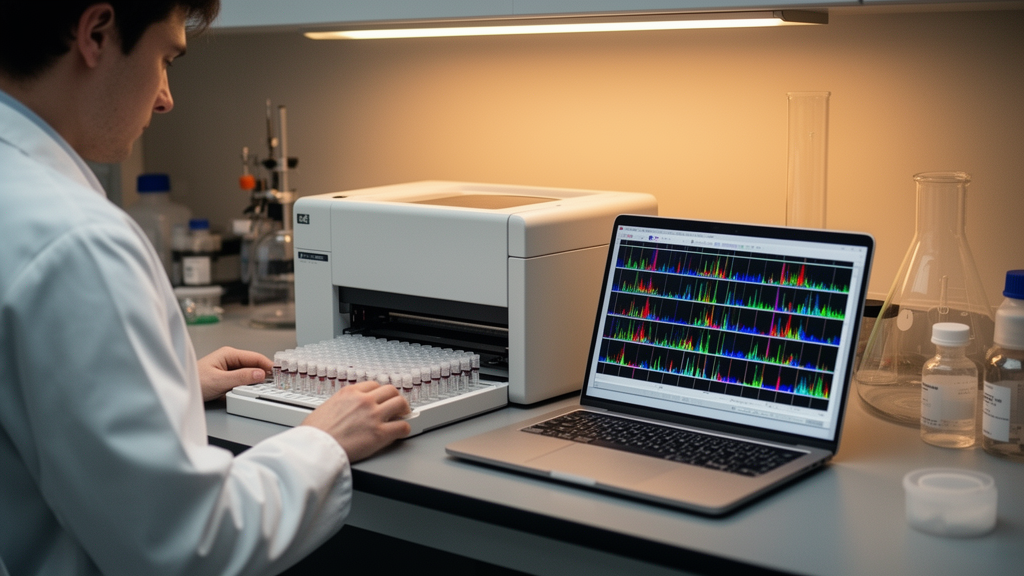
Sanger sequencing, the technology that read the first human genome, is still the workhorse of biodiversity research. Field ecologists pull individual roots, fruiting bodies and leaves out of soil, amplify a DNA barcode and send the samples off for sequencing, often thousands at a time. What comes back is a stack of chromatogram trace files that must be inspected, trimmed, aligned, compared against reference databases and assigned to species by hand. That curation is slow, inconsistent and error-prone, and it has long been the bottleneck standing between a field campaign and a usable species list. A new open-source tool called MycorrhizaTracer now promises to automate nearly all of it.
Described in the Biodiversity Data Journal, MycorrhizaTracer is a bioinformatic pipeline that takes raw Sanger chromatograms and delivers classified, functionally annotated taxa with minimal human intervention. It was built with fungi and plants in mind, particularly the fungal internal transcribed spacer (ITS) region and the plant markers ITS2 and rbcL, but its developers say it can be adapted to essentially any group of organisms simply by swapping in an appropriate reference database and primers. The software is written in Python and released under an MIT licence through GitHub, making it free for any laboratory to install, inspect and modify.
The pipeline’s architecture follows five main steps: consensus calling, taxonomic classification, clustering, salvaging and functional annotation. In the consensus stage, forward and reverse reads for each sample are loaded and quality-trimmed using PHRED scores together with chromatogram peak heights, evaluated through a sliding window that strips low-quality regions from the ends of each read. Reads that pass the filters are aligned with Biopython’s pairwise aligner, and a consensus sequence is generated: matching bases are kept with the higher quality value, while disagreements between the two strands are recorded as ambiguous Ns. Samples for which neither read survives quality control are discarded outright, a deliberate design choice meant to keep unreliable data from contaminating downstream results.
Classification then proceeds by BLASTn search against a user-specified database, most commonly UNITE for fungal ITS sequences. Hits are filtered by alignment length and coverage thresholds, and a taxonomic assignment is only accepted when the top hits, defined as those within 0.5 percent identity of the best match, agree with one another. Where they disagree, the assignment is truncated to the last rank shared by all candidates, and further minimum-identity cutoffs constrain how deep the label can go, with 97 percent identity required for species-level calls. Sequences matched against UNITE also receive the database’s species hypothesis numbers, a convention that supports reproducible comparisons across studies. Anything that cannot be named at species level is routed onward to clustering.
The clustering module applies strict quality and length filters, uses ITSx to confirm that a full ITS region is present, and then groups the remaining sequences into operational taxonomic units with VSEARCH at a default 97 percent identity threshold. These de novo clusters, labelled denovo_X, represent lineages that exist in the samples but not in the reference database, which is a common situation for fungi given how many species remain formally undescribed. An optional salvaging step then gives poor-quality sequences a second chance: they are searched against the OTUs already identified in the study with a lenient bitscore-based match, but a rescued sequence is only accepted if another sample from the same predefined salvage group, such as a soil core or a site, has independently been assigned to that same OTU. That guard rail is designed to stop sequencing artefacts from inflating local diversity estimates.
The final optional stage bridges taxonomy and ecology. Fungal taxa resolved to genus or species level are run through FUNGuild, a widely used annotation tool that assigns trophic mode and lifestyle, distinguishing for example ectomycorrhizal symbionts from wood-decaying saprotrophs or pathogens. The pipeline also accepts user-supplied regional species lists so that classifications remain ecologically plausible, although the authors caution that such lists can accidentally filter out newly arriving or poorly documented species. Every threshold in the workflow, from quality windows to identity cutoffs, is exposed as a command-line argument, so users can tune behaviour without touching the code.
To demonstrate performance, the team ran the pipeline on a real-world dataset: 2,357 ectomycorrhizal root tips collected from 63 soil plots across England through the UK Department for Environment, Food and Rural Affairs’ Natural Capital and Ecosystem Assessment programme. The samples generated 14,134 chromatograms spanning three target regions and deliberately included both pristine and poor-quality traces. On average, 88 percent of targets yielded a consensus sequence, and of the samples that could be classified, 62 percent of fungal ITS sequences reached species level and 79 percent reached genus level, with somewhat lower figures for the plant markers. In total the run resolved 677 fungal OTUs, 19 plant OTUs from ITS2 and 15 from rbcL.
The efficiency numbers are striking. The entire dataset, all 2,357 samples and 14,134 chromatograms, was processed through the core pipeline with clustering and salvaging enabled in under 20 minutes on an ordinary consumer laptop, a MacBook Air with 16 gigabytes of memory, using six CPU cores. No high-performance computing facility is required, which matters enormously for field-based and resource-limited research groups in the very settings where Sanger sequencing remains most popular. Salvage success proved sensitive to how groups are defined: 122 of 257 poor-quality fungal samples were rescued when the whole country was treated as one group, compared with 58 when each of the 63 sites stood alone, illustrating the trade-off between recovering rare taxa and avoiding artefacts.
The authors position MycorrhizaTracer alongside existing tools such as SangerFlow, SCATA, PipeBar and SangerAnalyzeR, and argue that, to their knowledge, it is the only pipeline carrying raw chromatograms all the way through to functional annotation. Competing pipelines typically stop at consensus generation, accept pre-processed FASTA files instead of trace files, or lack clustering and FUNGuild integration. The developers are equally candid about limitations: performance depends heavily on the quality of the incoming chromatograms, a single clustering threshold may not suit all fungal lineages given their variable rates of molecular diversification, and classification accuracy is ultimately bounded by the completeness of reference databases. They stress that expert judgement, microscopy and ecological knowledge remain essential companions to any automated workflow.
The broader message is that Sanger sequencing and high-throughput sequencing are complements rather than rivals. Short Illumina reads of roughly 550 base pairs capture only fragments of the full ITS region that reference databases like UNITE were built around, while long-read platforms overshoot those references entirely. Sanger reads of 600 to 1,000 base pairs, by contrast, match the databases almost perfectly, offering higher taxonomic resolution at modest cost. By removing the manual bottleneck that has long accompanied this technology, MycorrhizaTracer could let ecologists, conservationists and taxonomists turn thousands of field samples into named, ecologically annotated species lists within an afternoon, unlocking biodiversity data that has been sitting unread in trace files all along.
Subject of Research: An open-source bioinformatic pipeline for automated taxonomic classification of Sanger DNA barcodes from fungi and plants
Article Title: MycorrhizaTracer: A bioinformatic pipeline for fungi and plant classification of Sanger DNA sequences
Article References: MycorrhizaTracer: A bioinformatic pipeline for fungi and plant classification of Sanger DNA sequences. (n.d.). https://doi.org/10.3897/BDJ.14.e198617
Image Credits: AI Generated
Keywords: MycorrhizaTracer, Sanger sequencing, DNA barcoding, bioinformatics, mycorrhizal fungi, ITS region, taxonomic classification, BLAST, OTU clustering, FUNGuild, biodiversity, open-source software
Cite Scienmag News
Juliet Wilcox. (October 16, 2026). New Open-Source Pipeline Turns Thousands of Sanger Sequences into Named Species in Minutes. Scienmag. https://scienmag.com/new-open-source-pipeline-turns-thousands-of-sanger-sequences-into-named-species-in-minutes/
Juliet Wilcox. "New Open-Source Pipeline Turns Thousands of Sanger Sequences into Named Species in Minutes." Scienmag, 16 October 2026, https://scienmag.com/new-open-source-pipeline-turns-thousands-of-sanger-sequences-into-named-species-in-minutes/. Accessed 16 October 2026.
Juliet Wilcox. "New Open-Source Pipeline Turns Thousands of Sanger Sequences into Named Species in Minutes." Scienmag. October 16, 2026. https://scienmag.com/new-open-source-pipeline-turns-thousands-of-sanger-sequences-into-named-species-in-minutes/


