


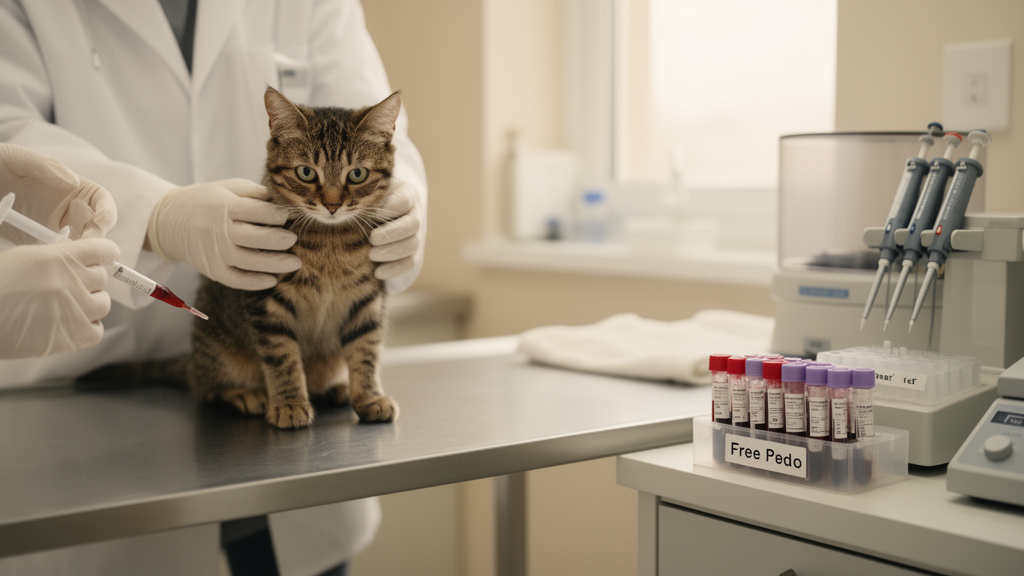
Feline infectious peritonitis, or FIP, remains one of the most feared diagnoses in veterinary medicine. The disease arises when a common and usually harmless feline coronavirus mutates inside its host, transforming a benign gut inhabitant into a lethal pathogen that triggers runaway inflammation, fluid accumulation, and progressive organ failure. Because early symptoms are vague and overlap with many other conditions, clinicians often cannot confirm FIP until the disease is well advanced, by which point treatment options narrow dramatically. A new study published in Experimental Biology and Medicine suggests that a solution may be circulating in the blood itself. Researchers report that a signature of small regulatory RNA molecules carried inside tiny membrane vesicles called exosomes can distinguish FIP-affected cats from healthy animals with high accuracy, offering a non-invasive route to earlier diagnosis.
The research team, led by Hongxia Gu and Huisheng Wu of Ganzhou Vocational and Technical College, enrolled 32 cats with confirmed FIP, split evenly between the exudative form, characterized by abundant fluid in body cavities, and the non-exudative form, which lacks visible effusions. Twenty age- and breed-matched healthy cats served as controls, each verified free of coronavirus infection through routine blood work, serum biochemistry, and polymerase chain reaction testing. FIP diagnoses were made according to a 2021 expert consensus from the Chinese Veterinary Medical Association, and ten randomly selected FIP cases underwent histopathological and immunohistochemical confirmation, revealing the classic granulomatous lesions and viral antigen expression that define the disease.
Exosomes are nanoscale vesicles, typically 30 to 150 nanometers in diameter, that cells release into bodily fluids as a form of intercellular communication. They ferry proteins, lipids, and nucleic acids between cells, and the microRNAs they encapsulate are of particular interest to diagnosticians. Because the vesicle membrane shields its cargo from the RNase enzymes that would otherwise rapidly degrade free RNA in serum, exosomal microRNAs remain remarkably stable and detectable. In this study, the team isolated exosomes from five-milliliter blood samples using differential ultracentrifugation following guidelines from the International Society for the Study of Extracellular Vesicles, then rigorously characterized the preparations.
Quality control was thorough. Transmission electron microscopy revealed the characteristic cup-shaped vesicles with average diameters of 80 to 150 nanometers. Nanoparticle tracking analysis measured particle concentrations of roughly 3.1 by 10 to the tenth particles per milliliter in the FIP group and 2.8 by 10 to the tenth in controls, a difference that was not statistically significant. Western blotting confirmed strong expression of the exosome marker proteins CD63 and TSG101 in the isolated fractions but not in whole serum, indicating minimal contamination from non-exosomal material. Notably, neither particle concentration nor size differed between diseased and healthy animals, which the authors interpret to mean that FIP does not alter the sheer quantity of circulating exosomes but instead changes the microRNA cargo they carry.
High-throughput sequencing on the Illumina HiSeq 4000 platform detected 489 microRNAs across the samples, of which 23 showed statistically significant differential expression between FIP cases and controls, using a stringent threshold of at least a four-fold change and a corrected p-value below 0.05. Five stood out. Three were upregulated in FIP: miR-21-5p, with a log2 fold change of 3.82; miR-155-5p at 2.95; and miR-486-5p at 2.13. Two were downregulated: miR-423-5p at minus 2.67 and miR-200c-3p at minus 1.98. Quantitative reverse transcription PCR validated the sequencing results with a correlation coefficient of 0.92, and miR-21-5p was independently confirmed as upregulated approximately 14.3-fold in FIP cats, while miR-423-5p fell to about 22 percent of control levels.
The biological plausibility of these signatures adds weight to the findings. Bioinformatic pathway analysis associated the upregulated miR-21-5p and miR-155-5p with NF-kappa-B and toll-like receptor signaling, pathways central to the inflammatory cascade that FIP provokes. The authors suggest these microRNAs may suppress PTEN expression and promote the release of pro-inflammatory cytokines such as IL-6 and TNF-alpha, potentially aggravating the granulomatous inflammation characteristic of the disease. The downregulated miR-423-5p is linked to the PI3K-Akt pathway and may relate to the immunosuppressive state seen in late-stage FIP. The researchers caution, however, that these mechanisms are inferred from pathway enrichment and cross-species comparisons; no functional experiments were performed to confirm direct regulatory roles.
Importantly, the microRNA expression patterns were consistent across both clinical forms of the disease. Stratified analysis showed that all five markers behaved similarly in exudative and non-exudative cases, with coefficients of variation below 15 percent and no significant differences between the subgroups. This uniformity matters clinically, because non-exudative FIP, which produces no telltale fluid to sample, is especially difficult to diagnose. Molecular tests such as RT-PCR can detect coronavirus genetic material with high sensitivity but cannot reliably distinguish the pathogenic FIPV mutant from the ubiquitous non-pathogenic enteric coronavirus FECV, and antibody tests face the same limitation along with interference from maternal antibodies in kittens.
To translate the expression data into a practical diagnostic, the team built a logistic regression model combining three key microRNAs: miR-21-5p, miR-155-5p, and miR-423-5p. Receiver operating characteristic analysis yielded an area under the curve of 0.93, with a 95 percent confidence interval of 0.86 to 0.98. The combined model achieved 88.6 percent sensitivity and 91.2 percent specificity, with positive and negative predictive values of 89.4 and 90.7 percent respectively. Each individual microRNA performed notably worse, with areas under the curve ranging from 0.75 to 0.82, underscoring the value of the multi-marker approach. The combined model also substantially outperformed alpha-1-acid glycoprotein, a conventional FIP biomarker that reached an area under the curve of only 0.75, improving overall diagnostic accuracy by roughly 24 percent. Subgroup areas under the curve were 0.91 for exudative and 0.89 for non-exudative disease, a difference that was not statistically significant.
The practical implications are considerable. The test requires only five milliliters of peripheral blood, avoids invasive tissue biopsy, and could in principle enable diagnosis before the characteristic fever, abdominal distension, or ocular inflammation appear. This matters because antiviral therapies derived from nucleoside analogues such as GS-441524 and remdesivir have transformed FIP from an almost uniformly fatal disease into a treatable condition in many cases, but their success depends heavily on early intervention. A blood-based molecular signature that flags disease early, works for both clinical phenotypes, and reflects the host’s pathological state rather than mere viral presence addresses several key gaps in the existing diagnostic arsenal.
The authors are candid about the study’s limitations. The cohort of 32 FIP cats and 20 healthy controls is modest, which may limit statistical power, and critically, the control group did not include cats carrying asymptomatic FECV infection. Because distinguishing FIP from benign coronavirus carriage is precisely the hardest diagnostic problem in practice, validating specificity against FECV-positive, FIP-negative animals is an essential next step, ideally in multi-center cohorts spanning different breeds, ages, and regions. Mechanistic claims likewise await confirmation through luciferase reporter assays or gene knockout experiments. Still, the study demonstrates that the microRNA cargo of serum exosomes carries a readable molecular record of FIP pathology, and the team envisions developing a high-throughput rapid detection platform based on the three-microRNA panel. If larger validation studies bear out the reported performance, this signature could become a cornerstone of early FIP diagnosis and, in doing so, extend the window in which antiviral treatment can save affected cats.
Subject of Research: Serum exosomal microRNA biomarkers for the early diagnosis of feline infectious peritonitis
Article Title: The value of serum exosomal miRNA signature profiles for the early diagnosis of feline infectious peritonitis
Article References: Gu, H., & Wu, H. (2026). The value of serum exosomal miRNA signature profiles for the early diagnosis of feline infectious peritonitis. Experimental Biology and Medicine, 251, Article 10915. https://doi.org/10.3389/ebm.2026.10915
Image Credits: AI Generated
Keywords: feline infectious peritonitis, exosomes, microRNA, biomarkers, early diagnosis, feline coronavirus, liquid biopsy, ROC curve, veterinary medicine, miR-21-5p, non-invasive diagnostics, value
Cite Scienmag News
Ophelia Keating. (October 16, 2026). Blood-Borne microRNA Signature Shows Strong Accuracy for Early FIP Diagnosis in Cats. Scienmag. https://scienmag.com/blood-borne-microrna-signature-shows-strong-accuracy-for-early-fip-diagnosis-in-cats/
Ophelia Keating. "Blood-Borne microRNA Signature Shows Strong Accuracy for Early FIP Diagnosis in Cats." Scienmag, 16 October 2026, https://scienmag.com/blood-borne-microrna-signature-shows-strong-accuracy-for-early-fip-diagnosis-in-cats/. Accessed 16 October 2026.
Ophelia Keating. "Blood-Borne microRNA Signature Shows Strong Accuracy for Early FIP Diagnosis in Cats." Scienmag. October 16, 2026. https://scienmag.com/blood-borne-microrna-signature-shows-strong-accuracy-for-early-fip-diagnosis-in-cats/


