


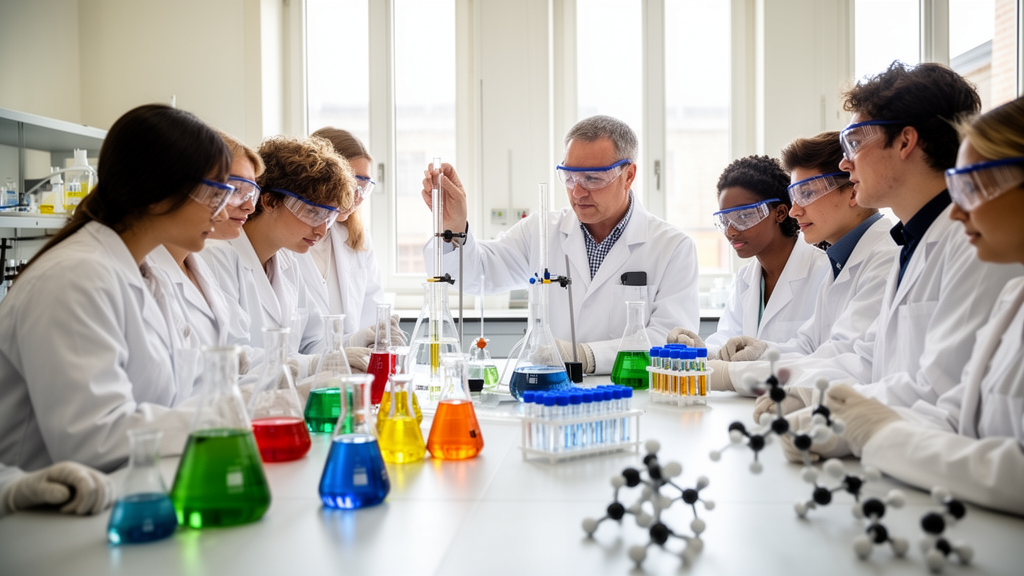
Environmental chemistry has quietly become one of the fastest-growing disciplines in European higher education, and a sweeping new survey now puts hard numbers on that expansion. In the academic year 2024/25, the Division on Chemistry and the Environment of the European Chemical Society, known as EuChemS-DCE, conducted a continent-wide survey of university programmes that teach environmental chemistry, either as a principal discipline or as embedded content within broader interdisciplinary and multidisciplinary curricula. The results, published in Environmental Science and Pollution Research, identify 428 programmes at the first and second study levels across Europe, a roughly 30 percent increase compared with the previous survey conducted in 2012, when 336 relevant programmes were identified at 237 institutions in 28 countries. The actual figure is likely even higher, the authors caution, because some programmes almost certainly remained undetected.
The scale of the data collection was ambitious. Around 400 departments and institutes at universities in 36 European countries were invited to participate, and responses eventually arrived from 31 countries. In total, 113 study programmes at the first study level, typically bachelor degrees of 180 or 240 ECTS, and 156 programmes at the second study level, including MSc, MEng, MA and Diplom degrees, provided basic information, while 31 doctoral programmes also responded. Notably, only a minority of responding programmes shared detailed information on their contents, teaching tools, needs and future plans: 42 percent at the first level, 35 percent at the second level and 19 percent at the third level. The remaining respondents provided only programme titles and the names of their host institutions. To fill gaps, particularly in countries with severe lack of data, the authors performed additional web searches in the academic year 2025/26, verifying that curricula explicitly contained environmental chemistry-related aspects such as the cycling and fate of chemical species in environmental compartments, biogeochemistry, hydrology, water, air and soil science, impact assessment, pollution monitoring, environmental analysis and ecotoxicology.
The response rate varied dramatically across countries, which severely undermined the representativeness of the findings for Europe as a whole. Some countries with long-standing traditions of environmental chemistry education, including the United Kingdom, the Netherlands and France, returned few or even no questionnaires, meaning the reported numbers for those countries could be significant underestimates. In both surveys, the highest numbers of curricula were identified in Germany, Spain, France, Italy and the United Kingdom. Because of these limitations, no statement on increase or decrease of programme numbers since 2012 is possible for many countries, although the number increased significantly in Austria, Cyprus, Portugal, Slovenia and Switzerland, while a significant decrease was nowhere apparent. The total figure of 428 programmes should therefore be understood as a lower estimate rather than the result of a census.
One of the most striking findings concerns how rarely environmental chemistry declares itself as the principal focus of a degree. Among the 113 programmes that responded at the first study level, only nine declared themselves as mainly focused on environmental chemistry or as assigning it an important role within interdisciplinary curricula such as water science, environmental forensics or environmental science. Thirty-eight programmes declared the content as embedded within another discipline, for example environmental engineering, environmental science or environmental management, while 66 provided no detailed categorisation. At the second study level, 21 programmes reported environmental chemistry as the main focus, 33 declared embedded contents, and 122 did not opt for either option. At the doctoral level, only six programmes among the 31 respondents were sorted, four as mainly focused and two as embedded. The authors verified this self-categorisation by independently categorising a randomly selected test set of 18 programmes, an exercise that demonstrated the robustness of the respondents’ own sorting, although the aim was not to assess correctness but rather to explore how the invisible boundaries between curricula are drawn by the actors who implement them.
The technical content of the programmes that did share details reveals a discipline built on broad chemical foundations. Around 70 percent of first-level programmes with environmental chemistry as their main content include the core chemistry disciplines, with roughly 10 ECTS typically allocated per chemistry type, giving total chemistry credits ranging from 12 to 115 ECTS including environmental chemistry. Biology and data analysis are also given near 10 ECTS on average, while most other contents receive 3 to 8 ECTS. At the second level, 9 to 72 ECTS are allocated to any type of chemistry including environmental chemistry, with physical, analytical and instrumental chemistry keeping high mean scores of 8 to 12 ECTS, although only analytical chemistry including instrumental analysis shows a relatively high frequency of occurrence, appearing in roughly 30 percent of the responding programmes. Compartment-specific chemistry receives 6 to 10 ECTS, while water treatment and air pollution prevention technologies are given 10 to 15 ECTS on average. Students are thus trained not only in chemistry but also in microbiology, hydrogeology and ecotoxicology, and less frequently in agriculture, hygiene and sanitation.
The ECTS ranges allocated to environmental chemistry itself expose a deep inconsistency in how the discipline is understood. Among programmes declaring environmental chemistry as their main focus or an important role in an interdisciplinary curriculum, the declared range spans from 5 to 180 ECTS at the first study level: two programmes indicated less than 10 ECTS, four programmes 30 to 40 ECTS, one programme 105 ECTS and one programme 180 ECTS, which considered the whole programme as environmental chemistry without providing any content-related breakdown. At the second level, the range spans 8 to 120 ECTS, with only two programmes declaring 100 percent allocation and others reporting 39 to 40.5, 45 to 75 or 80 to 100 ECTS. This persisting wide range indicates that no uniform understanding exists of what exactly constitutes environmental chemistry, nor of the difference between a main topic within an interdisciplinary programme and embedded content within a multidisciplinary one. The authors attribute this most probably to the very broad boundaries of the discipline itself.
A comparative analysis of the frequency of specific terms in programme titles adds further texture to the picture. Programmes focused mainly on environmental chemistry include the terms science, chemistry including geochemistry, and protection, but also engineering and water, indicating compartment-related approaches even from the first study level. Almost the same terms appear as most frequent at the second educational level, accompanied by technology and toxicology, and finally by health, climate and climatology, water, protection and sustainability. Programmes with embedded environmental chemistry content also frequently include science, engineering and chemistry in their titles, with the term energy more frequent at the first level and resources more frequent at the second. Beyond these, the titles reveal connections to technology, ecology, biology, physics, meteorology and economics, while themes like health, climate, soil, sustainability and biodiversity recur throughout. The water, climate, protection and sustainability themes are very common across the whole educational offering, and environmental chemistry is taught quite frequently in engineering programmes as well as in science programmes.
The survey also examined skills, tools and the integration of the social sciences and humanities. Contents from law, economics, business and management, ethics, governance and public communication of environmental issues are well represented in first-level curricula with 3.5 to 7 ECTS on average, but at the second level fewer than one third of responding programmes include them, with 3 to 5.5 ECTS on average. This may suggest that insufficient care is taken in educating young professionals from different disciplines to reach a mutual understanding of societal needs and the instruments for their fulfilment, although master programmes may legitimately focus more on technical depth. Soft skills cultivation, including communication, public speech, problem solving and scientific writing, is included in more than 50 percent of second-level programmes and even higher at the first level. Digital skills are well integrated, ranging from basic IT skills to working with databases and simple programming, while green skills relate mainly to knowledge of new green processes. Teaching tools remain largely traditional, dominated by lectures, practical exercises, lab work, seminars, discussions, field trips and visits to industry, although project-based learning, numerical modelling seminars, virtual environments, 3D printing and e-learning platforms were also reported. Tutored compulsory internships were offered by only three of nine first-level programmes and six of twenty-one second-level programmes.
The graduate numbers reported by respondents, although informed estimations rather than quantified alumni data, give a sense of the discipline’s output. Programmes with environmental chemistry as their main focus reported 100 to 545 graduates per programme at the first level over the last five years, totalling roughly 1000, with estimated employability of 50 to 95 percent. At the second level, 10 to 500 graduates per programme completed their studies, totalling roughly 1800, with similar estimated employability of 45 to 100 percent. Multidisciplinary programmes with embedded content reported close to 4200 graduates at the first level and 2000 at the second level over the same period, leading the authors to estimate that tens of thousands of graduates earned some credits in environmental chemistry. Looking ahead, six of nine responding first-level programmes and six of twenty-one second-level programmes will modify their foci in the coming years, with green and sustainable chemistry, data analysis, management, circular economy, science communication and public policy identified as coming emphases at the second level.
The authors argue that the way forward lies in better definition and coordination. Faculty-specific curriculum design often results in inconsistent and incomparable graduate competencies, creating fragmented qualifications across institutions, a problem already highlighted in the 2012 survey. Universities should adopt coordinated national or European subject benchmark guidelines that include minimum ECTS requirements, and a collaborative effort to define the core content and boundaries of the discipline would ensure greater consistency in learning outcomes and skills. Environmental chemistry education faces a dual challenge: graduates must possess deep expertise in tracking chemical cycles while mastering broad, cross-disciplinary skills, including statistics and machine learning alongside engineering and life sciences. The authors suggest a T-shaped educational design that pairs deep specialisation in one field with a broad understanding of complementary areas, including the social sciences and humanities, supported by structured internships, soft skills training and innovative tools such as virtual interactive environments, which remain rarely utilised despite digital and green skills already being well covered. The survey provides the professional community with a list of programmes that can be used to explore contents, learning outcomes and skills in the context of revising existing or designing new educational offerings, and it highlights the continued evolution of the discipline towards greater interdisciplinarity while emphasising the urgent need for further academic discussion regarding its educational scope, core competencies and future development.
Subject of Research: Environmental Chemistry in higher education across Europe
Article Title: Environmental Chemistry in higher education across Europe
Article References: Ivančev-Tumbas, I., Heath, E., & Lammel, G. (2026). Environmental Chemistry in higher education across Europe. Environmental Science and Pollution Research. https://doi.org/10.1007/s11356-026-38307-5
Image Credits: AI Generated
DOI: 10.1007/s11356-026-38307-5
Keywords: Environmental, Chemistry, higher, education, across, Europe, scientific research
Cite Scienmag News
Zachary Osborne. (October 16, 2026). Environmental Chemistry Education Surges Across Europe, Landmark Survey Reveals. Scienmag. https://scienmag.com/environmental-chemistry-education-surges-across-europe-landmark-survey-reveals/
Zachary Osborne. "Environmental Chemistry Education Surges Across Europe, Landmark Survey Reveals." Scienmag, 16 October 2026, https://scienmag.com/environmental-chemistry-education-surges-across-europe-landmark-survey-reveals/. Accessed 16 October 2026.
Zachary Osborne. "Environmental Chemistry Education Surges Across Europe, Landmark Survey Reveals." Scienmag. October 16, 2026. https://scienmag.com/environmental-chemistry-education-surges-across-europe-landmark-survey-reveals/


