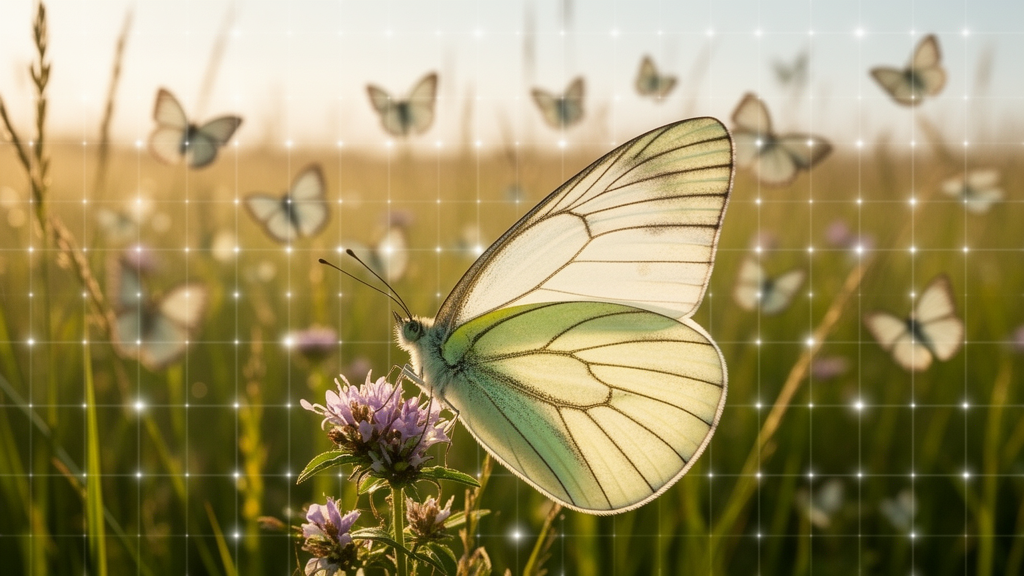
A European research team has unveiled a formal blueprint for simulating one of the continent’s most familiar butterflies, the green-veined white (Pieris napi), in unprecedented detail. The model, published in the Food and Ecological Systems Modelling Journal, is designed to be built into the Animal Landscape and Man Simulation System, or ALMaSS, a powerful software framework that recreates entire agricultural landscapes down to a resolution of one square metre. The ultimate goal is ambitious: to give pesticide regulators a rigorous, systems-based tool for assessing how agrochemicals affect butterfly pollinators before those chemicals ever reach the field.
Unlike its close relatives, the large white and small white, the green-veined white is not a crop pest. It shuns garden cabbages and instead lays its eggs on wild crucifers, guided by subtle differences in plant volatiles that distinguish its preferences from those of Pieris rapae. That ecological separation matters for modellers, because responses observed in pest species cannot simply be transplanted onto this butterfly. Fortunately, P. napi is relatively well studied, allowing the team to construct a formal model grounded in decades of empirical work on its development, movement and mortality.
The modelling philosophy is agent-based: every egg, larva, pupa and adult female exists as a separate simulated individual with its own age, size, location and pesticide burden. These characteristics feed back into behaviour, since a larger female, for example, carries greater reproductive capacity. The landscape around them is equally detailed. ALMaSS represents farms as collections of fields with crop rotations arranged in agronomically sensible sequences, models vegetation growth daily according to weather, management and soil, and even simulates pollen and nectar availability from flowering plants, giving the virtual butterflies a realistic foraging environment.
Temperature is the engine of the model. Insects develop faster under fluctuating temperatures than under constant ones, a consequence of the non-linear, asymmetrical relationship between temperature and growth explained by Jensen’s inequality. The team therefore adopted a thermal performance curve approach, specifically the four-parameter Lobry–Rosso–Flandrois model, using parameters fitted to Swedish populations of P. napi for each life stage. Eggs, larvae and pupae each carry their own cardinal temperatures: the minimum, optimum and maximum temperatures at which development can proceed, along with the maximum growth rate at the optimum.
Diapause, the overwintering strategy of the species, adds a further layer of sophistication. Pupae initiate diapause in response to shortening day length, with the likelihood rising sharply through the larval instars: only about 3 per cent of first-instar larvae exposed to short photoperiods produce diapausing pupae, compared with 87.5 per cent of fifth instars. Termination of diapause, however, is governed by temperature, requiring roughly three months of cold. The model captures this bifurcation, allowing first-generation adults to emerge from a mixture of second- and third-generation pupae when conditions permit a partial extra brood, a flexibility that mirrors real phenology across Europe.
Reproduction is handled with equal care. Females of P. napi receive a large nuptial gift from males, an ejaculate averaging 15 per cent of male body mass and rich in nitrogen, yet the model’s authors judged the population-level consequences too uncertain to simulate, treating mating frequency instead as stochastic variation in egg-laying timing. Egg size is modelled as a function of maternal size, age and temperature, while total fecundity scales with female weight, drawing on experimental studies showing that polyandrous females can produce substantially more eggs than monandrous ones.
Movement integrates foraging, dispersal and egg laying into a single behavioural loop. Each simulated day, the butterfly assesses whether its stomach contains nectar; if not, it forages, and if eggs are ready, it seeks host plants. Flight hours, determined hourly by temperature and rainfall thresholds, scale the distance a butterfly can cover, which also declines with age and varies between generations. The model draws on field observations suggesting females of the related small white fly around 700 metres per day, and on Japanese studies indicating P. napi is comparatively sedentary, drifting over hundreds of metres across weeks rather than migrating.
Mortality comes from several directions. A dynamically coupled agent-based model of parasitoids and hyperparasitoids will simulate the wasps that can parasitise more than half of P. napi larvae in the wild, with attributes covering search efficiency, handling time, hibernation success and emergence triggers. Background mortality is applied stochastically to all stages, farm operations such as soil cultivation, harvest and cutting kill all non-adult stages in affected areas, and winter or temperatures below minus 10 degrees Celsius prove fatal to any non-diapausing individual.
The pesticide component, though deliberately simple at this stage, tracks three exposure routes: ingestion of contaminated nectar or leaves, contact with sprayed plant surfaces, and direct overspray during spraying events. An accumulated body burden drives a daily probability of acute mortality, with a decay rate clearing the chemical over time. The authors stress this toxicological module is a starting point, to be expanded with sub-lethal effects and toxicokinetic-toxicodynamic detail in future regulatory iterations.
What makes the work notable is its transparency and honesty about uncertainty. The team explicitly lists what the model excludes, from population genetics to long-distance dispersal, and flags where parameters must be reverse-fitted, such as the density-dependent reduction in larval growth that shrinks pupae by roughly 10 per cent at high densities. As climate change shifts butterfly phenology, with flight periods starting earlier in the Netherlands and warmer temperatures cutting development times by around 30 per cent, a temperature-driven model of this kind offers regulators a way to test pesticide scenarios against realistic, weather-sensitive populations before harm is done.
Subject of Research: Agent-based simulation modelling of the green-veined white butterfly for pesticide risk assessment
Article Title: The Formal Model for the butterfly Pieris napi ( Lepidoptera , Pieridae ) agent-based model in the Animal Landscape and Man Simulation System (ALMaSS)
Article References: Topping, C. J., & Duan, X. (2025). The Formal Model for the butterfly Pieris napi (Lepidoptera, Pieridae) agent-based model in the Animal Landscape and Man Simulation System (ALMaSS). Food and Ecological Systems Modelling Journal, 6, Article e142802. https://doi.org/10.3897/fmj.6.142802
Image Credits: AI Generated
DOI: 10.3897/fmj.6.142802
Keywords: Pieris napi, green-veined white, agent-based model, ALMaSS, pollinators, pesticide risk assessment, thermal performance curve, diapause, parasitoids, agricultural landscapes, ecological modelling, butterfly ecology
Cite Scienmag News
Gavin Prescott. (October 16, 2026). Digital Butterflies: New Agent-Based Model Puts Green-Veined White Under the Regulatory Microscope. Scienmag. https://scienmag.com/digital-butterflies-new-agent-based-model-puts-green-veined-white-under-the-regulatory-microscope/
Gavin Prescott. "Digital Butterflies: New Agent-Based Model Puts Green-Veined White Under the Regulatory Microscope." Scienmag, 16 October 2026, https://scienmag.com/digital-butterflies-new-agent-based-model-puts-green-veined-white-under-the-regulatory-microscope/. Accessed 16 October 2026.
Gavin Prescott. "Digital Butterflies: New Agent-Based Model Puts Green-Veined White Under the Regulatory Microscope." Scienmag. October 16, 2026. https://scienmag.com/digital-butterflies-new-agent-based-model-puts-green-veined-white-under-the-regulatory-microscope/