


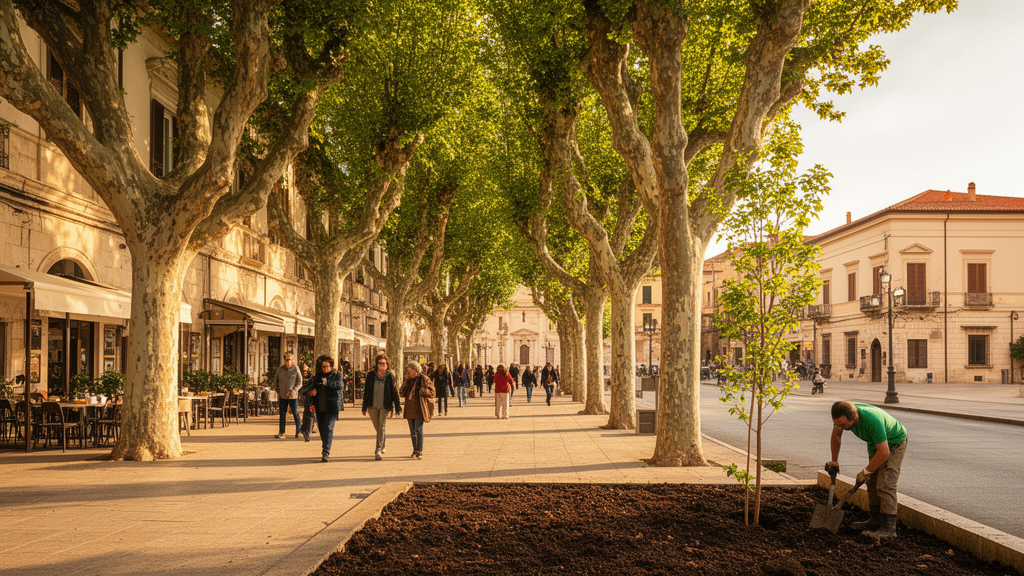
A sweeping survey of urban forestation across the southern Italian region of Apulia has revealed one of the most detailed pictures yet of how Mediterranean cities are fighting back against heat, pollution and degradation with native trees. Researchers conducted a systematic census of reforestation projects planned or implemented across all six Apulian provinces, documenting 40 separate interventions ranging from tiny street-corner plantings of a few hundred seedlings to vast peri-urban forests covering more than 220 hectares. The work, published in the Italian Botanist, offers a region-wide assessment of which species are being planted, where the money and ambition are concentrated, and whether the right trees are ending up in the right places.
The study comes at a pivotal moment. Italy’s National Recovery and Resilience Plan has earmarked funding for an urban forestry program described as unique in Europe, targeting the country’s 14 metropolitan cities and 1,268 municipalities, an area covering 15.47 percent of the national territory. By 2026, at least 4.5 million trees and shrubs are expected to be planted across roughly 4,500 hectares, with 3.5 million of those individuals destined for designated final areas. The program operates under the Urban and Peri-Urban Forestry Plan and a ministerial decree built on the principle of planting the right tree in the right place, following biogeographical and ecological criteria standardized at the national level. Globally, the urgency is clear: the UN’s International Resource Panel projects that 2.5 billion people will move into cities by 2050, driving resource consumption up by as much as 125 percent, while cities already account for over 70 percent of greenhouse gas emissions and more than 60 percent of energy use.
To map what is actually happening on the ground, the research team combined a comprehensive bibliographic and documentary review with an analysis of municipal planning documents, technical reports, project plans, online documentation and gray literature. They then verified and expanded the documentary record through direct field observations conducted in August and September 2025, census-ing the plant species used in each intervention. All recorded species were classified by botanical family, chorological type, biological form and native or alien status in Italy, following current national checklists. The team compiled the geographic distribution of the projects using QGIS software, producing the first complete overview of urban forestry activity across the region.
The results show a striking geographic imbalance. Of the 40 interventions identified, the Metropolitan City of Bari accounts for 25 initiatives, far outpacing Lecce with six, Foggia and Taranto with three each, Brindisi with two and Barletta-Andria-Trani with just one. The researchers attribute this concentration to the priorities of densely populated metropolitan areas, the availability of financial resources partly supported by national recovery funds, and the growing integration of urban planning with climate adaptation policies. The scale of ambition in Bari is remarkable: the Terre dell’Alta Murgia and Dalla Murgia all’Adriatico projects alone cover 220 hectares with 220,000 trees, while smaller sites such as Parco Rossani, at just 0.03 hectares, pack in 200 trees and 1,000 shrubs. The 14-hectare Parco della Rinascita, rising on a former industrial site, will host 2,000 trees and 50,000 shrubs.
Beyond the metropolitan capital, the survey documented a network of smaller interventions across the region. In Ruvo di Puglia, a Green Lane project combines 214 trees with 2,400 shrubs; Modugno’s ASI Urban Park received 3,000 trees on a single hectare; and the former Marrasca landfill in Noci was transformed with 3,584 plantings of downy oak, Trojan oak, field maple and Mediterranean shrubs. In Lecce province, peri-urban afforestation at Minervino and Nardò reached a combined 11,000 individuals, dominated by holm oak, kermes oak, stone pine and carob. Taranto’s projects, including the Paolo VI district and the Archaeological Park of the Magna-Greek Walls, total roughly 5,500 individuals, while Foggia’s urban and industrial forests, part of a corporate partnership, planted up to 1,650 trees including holm oak, manna ash and wild pear.
The species census recorded 55 tree and shrub taxa, and the family-level breakdown tells a story of deliberate ecological choice. The Fagaceae, the oak family, dominate with 11 taxa, followed by Rosaceae with six, and the Lamiaceae and Oleaceae with four each. Within Fagaceae, the genus Quercus stands out with eight taxa, reflecting both the ecological versatility of oaks across different soil and climate conditions and their deep cultural significance in the Apulian landscape, where they are a defining element of the traditional forest scenery. Other frequently planted natives include carob, nettle tree, field maple, manna ash, Aleppo pine, myrtle, mastic tree, strawberry tree and Mediterranean buckthorn, all species shaped by millennia of adaptation to drought, heat and poor calcareous soils.
Chorological analysis confirmed a strong native-first strategy: 44 of the 55 recorded taxa are native to Italy, with just six naturalized aliens, three casual aliens, two invasive aliens and two cryptogenic species. The researchers argue this preference carries multiple advantages. Native species generally require less maintenance and irrigation while supporting key ecosystem services such as microclimate regulation, stormwater management, carbon sequestration and mitigation of the urban heat island effect. They also bolster urban biodiversity by providing habitat and food for fauna and by creating ecological corridors linking city green spaces to the surrounding natural landscape, and greater botanical heterogeneity itself enhances ecosystem resilience against environmental stressors, disease and climate change.
The standout case study is the Poggiofranco district in Bari, which the authors present as a model of advanced ecological design. Implemented in February 2024 on about 1.2 hectares of calcareous soil, the project brought together the University of Bari’s Department of Soil, Plant and Food Sciences, the municipal administration, the Campanale forest nursery and the Alberitalia Foundation. All 1,400 plantings were one- to two-year-old natives grown from certified seeds collected in Apulian regional forests, a measure intended to guarantee locally adapted genotypes. The seedlings were arranged in an irregular curvilinear pattern with four meters between rows and 1.5 meters within rows, deliberately mimicking natural forest structure. Five tree species and four shrub species were selected for drought tolerance and consistency with the area’s potential natural vegetation, specifically the Cyclamino hederifolii–Quercetum ilicis plant association of the dry thermo-Mediterranean zone. Holm oak led the planting with 400 individuals, while four other species received 180 each and three, including cork oak, were limited to 60.
Perhaps the most socially resonant finding is how many projects target degraded or abandoned land: the former Fibronit industrial site in Bari, the former Marrasca landfill in Noci, and several peripheral and industrial zones across the region. The survey frames urban reforestation as a tool of environmental and social regeneration, converting neglected, sometimes contaminated spaces into accessible, multifunctional public areas that raise urban quality of life and strengthen social cohesion, with thematic parks, green memorials and pedestrian pathways woven into local planning.
Yet the study also sounds a note of caution. Despite the strong native emphasis, the presence of naturalized or potentially invasive taxa such as paper mulberry and London plane highlights the need for continuous monitoring and adaptive management to prevent harmful impacts on urban biodiversity. The authors conclude that Apulia’s experience offers a replicable model for other Mediterranean regions, but only if future planning deepens interdisciplinary collaboration among ecologists, urban planners and policymakers so that species selection, planting design and long-term management remain consistent with local ecological conditions and the escalating realities of climate change.
Subject of Research: Urban forestation projects and native tree species selection in Apulia, southern Italy
Article Title: Urban forestation in Apulia (southern Italy): An overview
Article References: Urban forestation in Apulia (southern Italy): An overview. (n.d.). https://doi.org/10.3897/italianbotanist.21.181254
Image Credits: AI Generated
DOI: 10.3897/italianbotanist.21.181254
Keywords: urban forestry, Apulia, native species, reforestation, Mediterranean ecosystems, Quercus, biodiversity, urban heat island, ecosystem services, Bari, climate resilience, invasive species
Cite Scienmag News
Sloane Callahan. (October 16, 2026). Native Trees Take Over Southern Italy’s Cities in a Bold Green Experiment. Scienmag. https://scienmag.com/native-trees-take-over-southern-italys-cities-in-a-bold-green-experiment/
Sloane Callahan. "Native Trees Take Over Southern Italy’s Cities in a Bold Green Experiment." Scienmag, 16 October 2026, https://scienmag.com/native-trees-take-over-southern-italys-cities-in-a-bold-green-experiment/. Accessed 16 October 2026.
Sloane Callahan. "Native Trees Take Over Southern Italy’s Cities in a Bold Green Experiment." Scienmag. October 16, 2026. https://scienmag.com/native-trees-take-over-southern-italys-cities-in-a-bold-green-experiment/


