


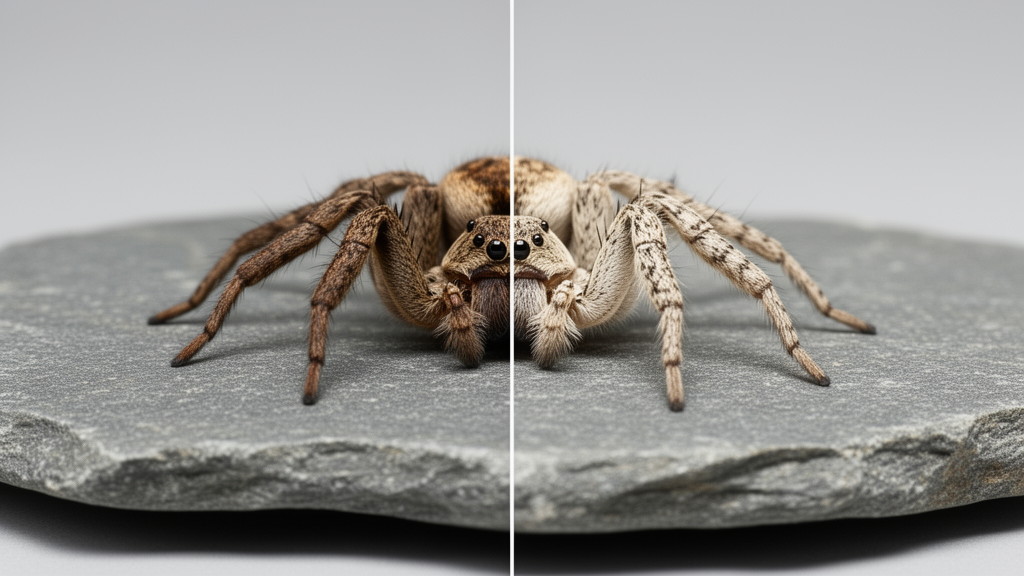
In a streamside forest near the Georgian capital, a spider that looked, at first glance, like an ordinary male wolf spider turned out to be something far stranger. Under the microscope, the specimen carried not only the modified pedipalps that male spiders use to transfer sperm, but also an underdeveloped female genital opening. The animal, a wolf spider of the species Trochosa cachetiensis, is the first intersexual spider ever documented from Georgia and the first recorded case of transverse intersexuality in this species anywhere in the world. The discovery, published in the journal Caucasiana, adds a rare data point to one of the most puzzling corners of arachnid developmental biology.
The specimen was collected on 1 September 2025 during fieldwork in the village of Telovani, roughly 925 metres above sea level on the forested slopes near Tbilisi. Three adult spiders were found hiding under rocks and logs along the bank of a stream, and the collector initially sorted them as two males and one female. Only later, when the animals were examined under a stereomicroscope at Ilia State University in Tbilisi, did it become clear that one of the supposed males was neither fully male nor fully female, but something in between. The specimen is now preserved in 96 percent ethanol and stored at minus 22 degrees Celsius in the university’s scientific collections, registered under the CaBOL barcode initiative that documents the Caucasus biodiversity hotspot.
Sexual anomalies in spiders come in two broad flavours, and the distinction matters. A gynandromorph is an animal in which male and female tissues coexist but are each normally developed, often producing a strikingly split appearance, with one half of the body male and the other half female. An intersex, by contrast, shows sexual characters that are either intermediate or underdeveloped, as if the developmental program for one or both sexes never fully executed. The classification most widely used today was proposed by Roberts and Parker in 1973, who grouped spider sexual anomalies into 14 morphological types nested within three basic patterns: lateral, transverse, and quartered. In a transverse arrangement, male and female features are distributed across the front and rear halves of the body rather than the left and right sides, which can make the condition extremely difficult to detect without close inspection of the genitalia.
That is precisely what the Georgian specimen shows. Its overall body plan, body length of 11.7 millimetres, thick legs, and the short, dark, broad fovea on its back all place it firmly in the female category; females of this species reach about 11.8 to 12.6 millimetres, while males top out around 8.6. Yet the ornamentation of its carapace, particularly the thin, light, irregular margin that is interrupted toward the front, matches the males rather than the females. Most tellingly, both pedipalps bear a pair of underdeveloped palpal bulbs, the sperm-transfer organs that define an adult male spider, while the underside of the abdomen carries a reduced, poorly sclerotized epigyne, the external female genital plate.
The fine anatomy of these structures tells an even more detailed story. In a normal male Trochosa cachetiensis, the cymbium, the spoon-shaped tip of the pedipalp, is brown and houses a well-formed alveolus from which the mating organ unfolds. In the intersex, the cymbium is yellow and instead carries a thin distal slit, within which malformed structures resembling the embolus, median apophysis, and tegulum, the working parts of the male intromittent organ, are faintly visible. On the female side, the epigyne is roughly 2.8 times smaller in height than in a fully developed female and less hardened, with a shortened median septum and reduced epigynal hoods. Most striking of all, the internal female genitalia, the endogyne, are entirely absent, meaning the animal possessed no functional sperm-storage or fertilization apparatus at all.
The identification of the species itself rests on solid ground. Because two normally developed adult males and one female of Trochosa cachetiensis were collected the same day from the same population, the researchers could compare the anomalous specimen directly against confirmed conspecifics. Measurements of the carapace length-to-width ratio in the intersex, 1.29, fall within the range recorded for both sexes in the new study and in earlier work on the species, so body proportions offer no additional clue. The species was originally described by the Georgian arachnologist Konstantin Mcheidze in 1997, and the new record is only the second case of a sexual anomaly ever documented in the genus Trochosa, following a gynandromorphic Trochosa terricola reported from the Netherlands in 1959.
Sexual anomalies remain genuinely rare in spiders. Depending on the estimate, they occur in roughly one in 5,000 to one in 17,000 individuals, which means most arachnologists will encounter only a handful in a career, usually by accident during routine faunal surveys. The very first report dates back to 1867, when Blackwall described a bilateral gynandromorph of the spitting spider Crossopriza lyoni in which, as he put it, the two sexes were united. Since then, cases have trickled in from across the spider family tree and from every continent, though they remain concentrated in a few well-studied groups. Among wolf spiders, the family Lycosidae to which the Georgian specimen belongs, the new record is the eighteenth species in which such abnormalities have been reported, joining species of Pardosa, Alopecosa, Arctosa, Piratula, Hogna, and Schizocosa documented across Europe, Asia, and North America.
Outside of spiders, the phenomenon is even scarcer. Only a handful of cases have been reported from other arachnid orders, including harvestmen, scorpions, camel spiders, and ticks and mites, which makes spiders the standout group for studying these anomalies among arachnids. What causes them is still not settled. Early hypotheses implicated internal parasites, and endocrine or chromosomal irregularities have also been proposed, while more recent work points toward genetic mechanisms, including anomalies in sex chromosome segregation during cell division. The truth may be that several different disruptions can produce superficially similar outcomes, which is one reason the literature has not always applied the terms gynandromorphy and intersexuality consistently, a confusion Roberts and Parker tried to untangle more than fifty years ago.
One of the most tantalizing lost opportunities concerns behavior. Studies of gynandromorphic jumping spiders in Japan, published in 1992 and 2019, stand out because the researchers were able to observe how these conflicted animals actually behaved: how they courted, how they were treated by conspecifics, and which sex they functionally identified with. For the Georgian wolf spider, such observations will never be possible, because the abnormal morphology was only noticed after the specimen had been preserved in ethanol. The authors note that it would have been particularly valuable to know how the animal functioned in life, whether it courted like a male, was received like a female, or was ignored altogether by both sexes in its streamside population.
For now, the specimen stands as a documented first: the first intersexual spider recorded from Georgia, a country whose spider fauna Mcheidze himself spent decades cataloguing, and the first transverse intersexuality described in Trochosa cachetiensis. As biodiversity surveys intensify across the Caucasus, aided by DNA barcoding programs and increasingly accessible imaging techniques such as focus-stacking macrophotography, researchers expect that more such anomalies will come to light, each one a small window into how tightly, and how fragilely, the developmental machinery of sex is wired in the eight-legged world.
Subject of Research: Transverse intersexuality in the wolf spider Trochosa cachetiensis from Georgia
Article Title: Stuck in between: First case of transverse intersexuality in Trochosa cachetiensis Mcheidze, 1997 ( Araneae , Lycosidae ) from Georgia
Article References: Seropian, A. (2025). Stuck in between: First case of transverse intersexuality in Trochosa cachetiensis Mcheidze, 1997 (Araneae, Lycosidae) from Georgia. Caucasiana, 4, 153-161. https://doi.org/10.3897/caucasiana.4.e173667
Image Credits: AI Generated
DOI: 10.3897/caucasiana.4.e173667
Keywords: spiders, intersexuality, gynandromorphy, Lycosidae, Trochosa, Georgia, arachnology, developmental anomaly, wolf spiders, Caucasus biodiversity, sexual anomalies, genital morphology
Cite Scienmag News
Margaret Porter. (October 16, 2026). Half male, half female: Georgian wolf spider reveals rare transverse intersexuality for the first time. Scienmag. https://scienmag.com/half-male-half-female-georgian-wolf-spider-reveals-rare-transverse-intersexuality-for-the-first-time/
Margaret Porter. "Half male, half female: Georgian wolf spider reveals rare transverse intersexuality for the first time." Scienmag, 16 October 2026, https://scienmag.com/half-male-half-female-georgian-wolf-spider-reveals-rare-transverse-intersexuality-for-the-first-time/. Accessed 16 October 2026.
Margaret Porter. "Half male, half female: Georgian wolf spider reveals rare transverse intersexuality for the first time." Scienmag. October 16, 2026. https://scienmag.com/half-male-half-female-georgian-wolf-spider-reveals-rare-transverse-intersexuality-for-the-first-time/


