


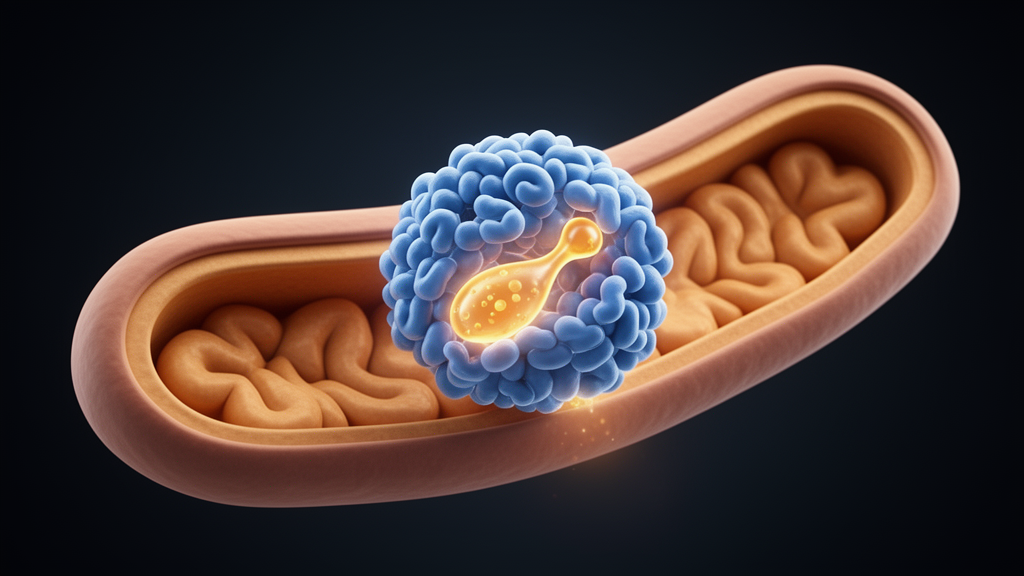
Myoglobin has long been cast in a supporting role: a small, heme-studded protein in heart and skeletal muscle that stores oxygen and ferries it to the mitochondria where fuel is burned. But a new computational study suggests the protein is far more than a passive oxygen tank. According to research published in Frontiers in Bioinformatics, the specific lipid metabolite riding on myoglobin actively reshapes how the protein docks onto the outer mitochondrial membrane, changing which membrane lipids it prefers, how long it stays attached, and how much force is needed to pull it away. The finding adds a surprising layer of control to one of the most fundamental handoffs in biology: the delivery of oxygen to the machinery of cellular respiration.
The research team, led by Andriy Anishkin, Sangita Kachhap, and Sree V. Chintapalli across institutions including the University of Maryland and the Arkansas Children’s Nutrition Center, focused on two closely related metabolic cargo molecules. The first is palmitate, a sixteen-carbon saturated fatty acid that circulates abundantly in the bloodstream. The second is palmitoylcarnitine, the same fatty acyl chain but shuttled on a carnitine headgroup, the form in which long-chain fatty acids cross into mitochondria for beta-oxidation. Earlier work from the same group had shown that oxygenated myoglobin binds both molecules in a hydrophobic pocket near the heme, and that acylcarnitines actually grip the protein more tightly than free fatty acids do. What remained unknown was whether this bound cargo changes the protein’s behavior once it reaches the mitochondrial surface.
To answer that question, the team turned to molecular dynamics simulations, a technique that models every atom of a protein and membrane as they jiggle, rotate, and interact according to the laws of physics. They built two physiologically distinct models of the outer mitochondrial membrane. The first, an average-composition membrane, reflected the typical mixture of phosphatidylcholine, phosphatidylethanolamine, phosphatidylinositol, and other headgroups found across the mitochondrial surface. The second, a contact-site membrane, was enriched in cardiolipin, a doubly charged phospholipid that clusters at specialized regions where the outer and inner mitochondrial membranes come into close apposition. Cardiolipin is best known as a signature lipid of the inner membrane, but its presence at contact sites makes those patches distinctly more negatively charged than the rest of the surface.
Into each membrane environment the researchers placed oxygenated myoglobin carrying either palmitate or palmitoylcarnitine, testing six different starting orientations of the protein so that no single docking pose would dominate the results. The simulation protocol unfolded in three stages. First, a weak steering force of roughly eleven piconewtons nudged each protein toward the membrane over forty nanoseconds, allowing thermal motion to rotate and reposition the complex so the final contact configuration depended little on the initial orientation. Then the external force was removed entirely, and each system relaxed for another forty nanoseconds to see whether the newly formed contacts would hold. Finally, a steered molecular dynamics phase pulled the protein away from the membrane at a constant velocity, recording the force required to break the association.
The results were striking in two ways. First, both lipid-bound forms of oxygenated myoglobin showed a clear preference for the cardiolipin-rich contact-site membrane over the average-composition membrane. The stability of the association, measured by how many protein-membrane atomic contacts survived the unrestrained relaxation phase, was 2.3-fold higher at the contact site for palmitate-bound myoglobin and 2.7-fold higher for palmitoylcarnitine-bound myoglobin. This mirrors the team’s earlier finding that unliganded oxygenated myoglobin also favors contact-site regions, and it suggests that cardiolipin’s negative charge acts as a general electrostatic beacon for the oxygen-carrying protein.
But the second result is what makes the new study stand out: the identity of the bound lipid changed everything about how the protein behaved at the membrane. Palmitate-bound myoglobin was ten to twenty percent more stable overall than its palmitoylcarnitine-bound counterpart, and when the researchers pulled the complexes off the membrane, palmitate-bound myoglobin required roughly twice the detachment force. At the contact-site membrane, the average detachment forces were 74.7 piconewtons for the palmitate complex versus 40.8 piconewtons for the palmitoylcarnitine complex. Lipid-specific contact analysis revealed why the two complexes behaved so differently: palmitate-bound myoglobin was strongly stabilized by cardiolipin, while palmitoylcarnitine-bound myoglobin leaned instead on phosphatidylethanolamine and phosphatidylinositol, with a smaller contribution from cardiolipin.
What makes this divergence remarkable is that the two cargo molecules share the identical sixteen-carbon palmitoyl chain. The only meaningful difference is the polar headgroup: palmitate carries a carboxylate, while palmitoylcarnitine carries the bulkier carnitine moiety. Yet that single chemical distinction was enough to rewire the entire network of protein-lipid contacts. Residue-level mapping showed that lysine-rich regions of the protein, particularly around helix F and the loop connecting helices C and D, dominated the membrane interactions, but the relative contributions of individual residues shifted depending on which lipid was bound. The authors emphasize that membrane stabilization was distributed across multiple residues and lipid species rather than concentrated at a single interaction site, pointing to a multicomponent, orientation-dependent mode of association.
The orientation result may prove to be the most consequential. In several palmitoylcarnitine-bound configurations, the heme crevice, the structural gateway through which oxygen enters and exits myoglobin, faced toward the membrane, whereas the more firmly anchored palmitate complex tended to adopt different membrane-facing poses. The researchers are careful to note that they did not directly simulate or measure oxygen release, so these orientation differences cannot yet be interpreted as evidence of faster or slower oxygen delivery. Still, the structural implications are tantalizing, because recent experimental work has shown that membrane contact itself perturbs the heme environment. A 2026 study in the Journal of the American Chemical Society reported that association with model liposomes roughly doubled the rate of oxygen dissociation from myoglobin, and complementary resonance Raman experiments showed that membrane-mimicking surfaces weaken the iron-oxygen bond. If the membrane is not just a docking site but an active participant in unloading oxygen, then the orientation of the heme crevice relative to the membrane surface becomes a potentially critical variable, and one that the bound metabolite appears to control.
The physiological context gives the finding real weight. Long-chain acylcarnitines accumulate in the blood and tissue when mitochondrial fatty acid oxidation falls behind substrate supply, a situation that arises during myocardial ischemia and in various metabolic disorders. Endurance exercise, fasting, and dietary fat intake all shift the balance between free fatty acids and acylcarnitine intermediates in muscle. The new simulations suggest that these metabolic fluctuations could change not just how much lipid-bound myoglobin sits at the mitochondrial surface, but in what configuration, potentially coupling oxygen delivery to the cell’s current fuel mix. The authors also point toward broader nutrient-sensing pathways such as mTORC1, which governs lipid metabolism and mitochondrial function, as a possible upstream regulator of the fatty acid and acylcarnitine pools that myoglobin encounters.
The study has clear limitations that the authors acknowledge candidly. Their membrane models contained only phospholipids, omitting the integral and peripheral proteins that crowd the real outer mitochondrial membrane, and the detachment forces measured under nonequilibrium pulling conditions cannot be read as equilibrium binding affinities. Oxygen release and lipid transfer were not directly measured, and the sampling, though broadened by six starting orientations per condition, represents a subset of the full conformational landscape. Even so, the central message is hard to escape: myoglobin’s metabolic cargo is not a passenger but a steering wheel. The same protein, carrying the same acyl chain, grips the mitochondrial surface with different strength, different lipid preferences, and different geometry depending on whether that chain arrives as a free fatty acid or a carnitine ester. Future experiments that directly measure oxygen release kinetics and lipid transfer from these complexes will determine whether this structural plasticity translates into a genuine regulatory mechanism, one that could tie the rhythm of cellular respiration to the shifting tides of fat metabolism in working muscle.
Subject of Research: How fatty acid and acylcarnitine binding modulates oxygenated myoglobin's interaction with the outer mitochondrial membrane
Article Title: Long-chain fatty acid- and acylcarnitine-bound oxygenated myoglobin interactions with outer mitochondrial membrane
Article References: Long-chain fatty acid- and acylcarnitine-bound oxygenated myoglobin interactions with outer mitochondrial membrane. (n.d.). https://doi.org/10.3389/fbinf.2026.1986755
Image Credits: AI Generated
DOI: 10.3389/fbinf.2026.1986755
Keywords: myoglobin, mitochondria, molecular dynamics, palmitate, palmitoylcarnitine, cardiolipin, outer mitochondrial membrane, oxygen transport, fatty acid metabolism, acylcarnitines, heme, simulations
Cite Scienmag News
Drew Townsend. (October 16, 2026). Myoglobin’s Fat Cargo Decides How Firmly It Grips the Mitochondrial Surface. Scienmag. https://scienmag.com/myoglobins-fat-cargo-decides-how-firmly-it-grips-the-mitochondrial-surface/
Drew Townsend. "Myoglobin’s Fat Cargo Decides How Firmly It Grips the Mitochondrial Surface." Scienmag, 16 October 2026, https://scienmag.com/myoglobins-fat-cargo-decides-how-firmly-it-grips-the-mitochondrial-surface/. Accessed 16 October 2026.
Drew Townsend. "Myoglobin’s Fat Cargo Decides How Firmly It Grips the Mitochondrial Surface." Scienmag. October 16, 2026. https://scienmag.com/myoglobins-fat-cargo-decides-how-firmly-it-grips-the-mitochondrial-surface/


