


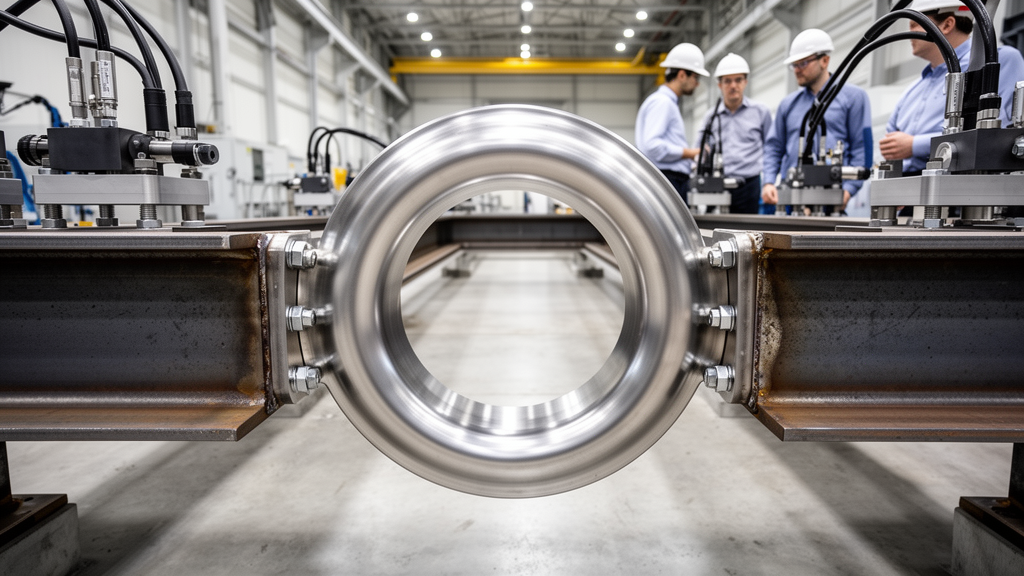
Engineers testing a new way to join two very different building materials have reported results that could reshape how earthquake-prone cities build their frames. In a study published in Scientific Reports, Bo Zha of Imperial College London and Shichun Zhang of Harbin Institute of Technology Shenzhen put eight scaled-down beam-column joints through a punishing simulated earthquake and found that a novel externally stiffened ring connection between concrete-filled steel tubular columns and reinforced concrete beams can deliver the ductility and energy dissipation that seismic codes demand. The work addresses a long-standing headache in structural engineering: how to connect a steel tube packed with concrete to a conventional reinforced concrete beam without resorting to fussy detailing that slows construction and weakens the column itself.
Concrete-filled steel tubular columns, known in the trade as CFST columns, have become a favorite of designers of high-rise and long-span structures. The concept is elegantly synergistic. The steel tube confines the concrete core, boosting its strength and delaying crushing, while the concrete core props up the steel tube from inside, preventing the thin walls from buckling inward. The result is a column with high strength, high stiffness, and remarkable ductility, all in a compact cross-section that frees up floor space. But the column is only as good as its connections, and this is where the technology has historically stumbled.
Conventional CFST column to reinforced concrete beam joints typically require steel bars and plates to pass through the column wall or through the concrete core itself. That means drilling, cutting, and welding inside a confined space, interrupting the continuous tube and sometimes reducing the column’s load-carrying capacity precisely where the forces are greatest. The detailing is complex, quality control on site is difficult, and construction crews lose time on operations that cannot easily be standardized. For a technology whose selling points are speed and efficiency, the connection detail has been an awkward contradiction.
The solution proposed by Zha and Zhang moves the problem outside the column. Their externally stiffened ring connection wraps a stiffening ring around the outside of the steel tube, giving the beam’s forces a continuous external path to travel through rather than forcing them to penetrate the tube wall. The researchers tested two configurations: a welded version, in which the connection components are welded together into a continuous load path, and a lapped version, in which elements overlap and rely on bearing and bond. Eight specimens, all built at 1:5 scale, were fabricated and subjected to low-cycle reversed loading, the laboratory equivalent of the back-and-forth swaying a structure experiences during a strong earthquake.
The test matrix was designed to isolate two key design variables. The first was the axial compression ratio, set at either 0.33 or 0.50, which represents how heavily the column is squeezed by the gravity loads above it. Higher axial compression generally changes how a joint fails and how much ductility it retains. The second variable was the length of the corbel, the short steel bracket that projects from the column to support the beam, tested at 120 millimeters and 240 millimeters. Corbel length matters because it determines how far the beam’s forces are carried before they are transferred into the joint region, influencing whether the concrete cracks early or the steel yields in a controlled, energy-absorbing way.
The headline result is reassuring for designers: every one of the eight specimens achieved a ductility coefficient greater than 5, satisfying seismic design requirements. Ductility, the ability to deform well beyond first yield without losing strength, is the property that lets a building absorb earthquake energy and warn occupants before collapse. That all configurations cleared this threshold suggests the externally stiffened ring concept is fundamentally sound. But the tests also revealed a clear hierarchy among the variants, and the differences came down to how smoothly forces could flow through the joint.
Welded connections emerged as the standout performers. Their hysteretic loops, the force-displacement curves traced over repeated loading cycles, were full and spindle-shaped, the signature of a joint that dissipates energy steadily cycle after cycle without pinching or degradation. Stiffness degradation, the gradual softening that accumulates as damage spreads, remained stable and gradual. The researchers attribute this superior behavior to continuous force transmission through the welds, which keeps the load path uninterrupted and lets the steel yield in a distributed, controlled manner. In seismic terms, the welded joints behaved like well-tuned shock absorbers.
The lapped connections told a more cautionary tale. Those built with short 120-millimeter corbels suffered premature concrete splitting and used their materials inefficiently, because the shortened bearing length concentrated forces and cracked the concrete before the steel could do its share of the work. Lengthening the corbel to 240 millimeters improved ductility, giving the forces more room to spread and delaying local failure, but the researchers judged the longer version less economically attractive, since the added steel and dimensions eroded the cost advantages that motivated the design in the first place. The lesson is that in connection design, geometry is destiny: too short invites brittle cracking, too long wastes material.
Alongside the physical tests, the team built nonlinear finite element models in ABAQUS, the widely used simulation platform, to validate the experiments and peer inside the joints where instruments cannot reach. The models employed the concrete damaged plasticity model, a constitutive framework that tracks cracking and crushing of concrete under cyclic loading, together with a layered simulation approach that captures the distinct behaviors of steel and concrete. The simulations accurately reproduced the observed failure modes and the backbone curves, the envelopes of peak response traced across loading cycles, with errors within 10 percent. That level of agreement means engineers can now use these validated models to explore design variations without fabricating and breaking a new specimen each time, dramatically accelerating future development.
The practical upshot is a clear recommendation: welded externally stiffened ring connections are the configuration the researchers propose for real CFST frames, offering a balance of seismic performance, constructability, and design simplicity. Because the stiffening ring sits outside the column, the tube remains continuous, the concrete core is undisturbed, and the awkward through-tube detailing that has plagued conventional joints disappears. For cities in seismic zones racing to build taller and span farther with structures that must also survive the big one, a connection detail that is simultaneously stronger, simpler, and faster to build is not a small refinement. It is the kind of unglamorous innovation that quietly determines whether buildings stand or fall when the ground starts shaking.
Subject of Research: Seismic performance of externally stiffened ring connections between concrete-filled steel tubular columns and reinforced concrete beams
Article Title: Seismic performance of externally stiffened ring connections between concrete-filled steel tubular columns and reinforced concrete beams
Article References: Seismic performance of externally stiffened ring connections between concrete-filled steel tubular columns and reinforced concrete beams. (n.d.). https://doi.org/10.1038/s41598-026-75173-0
Image Credits: AI Generated
DOI: 10.1038/s41598-026-75173-0
Keywords: concrete-filled steel tube, beam-column connection, externally stiffened ring, seismic performance, quasi-static test, finite element analysis, ductility, hysteretic behavior, energy dissipation, earthquake engineering, structural engineering, reinforced concrete
Cite Scienmag News
Violet Maxwell. (October 16, 2026). New Steel Ring Connection Could Make Earthquake-Resistant Buildings Safer and Cheaper. Scienmag. https://scienmag.com/new-steel-ring-connection-could-make-earthquake-resistant-buildings-safer-and-cheaper/
Violet Maxwell. "New Steel Ring Connection Could Make Earthquake-Resistant Buildings Safer and Cheaper." Scienmag, 16 October 2026, https://scienmag.com/new-steel-ring-connection-could-make-earthquake-resistant-buildings-safer-and-cheaper/. Accessed 16 October 2026.
Violet Maxwell. "New Steel Ring Connection Could Make Earthquake-Resistant Buildings Safer and Cheaper." Scienmag. October 16, 2026. https://scienmag.com/new-steel-ring-connection-could-make-earthquake-resistant-buildings-safer-and-cheaper/


