


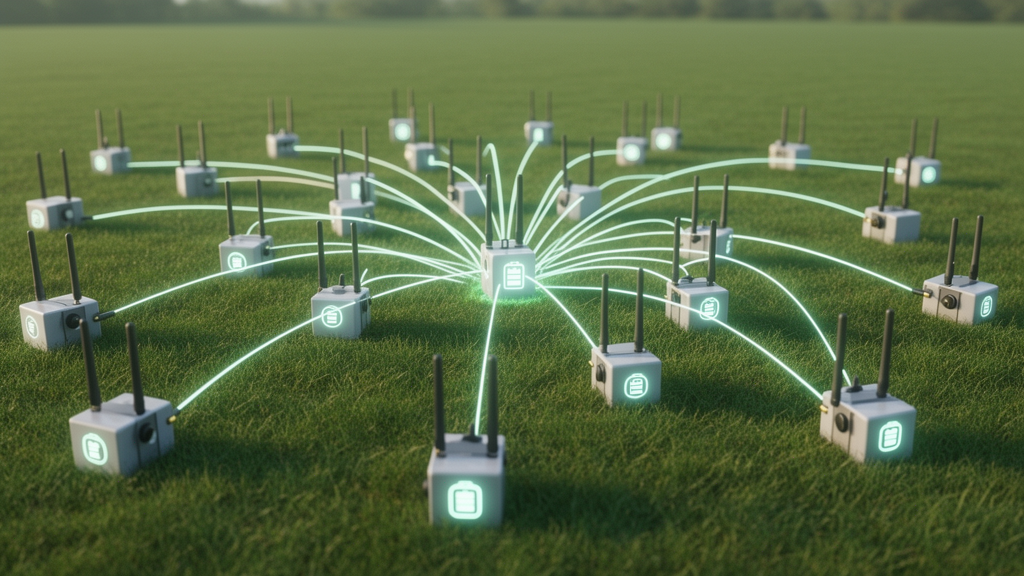
Wireless sensor networks (WSNs) are the invisible nervous system of modern infrastructure, monitoring everything from forest fires to factory floors and patient vital signs. But teaching artificial intelligence across thousands of battery-powered sensors has always been a brutal trade-off: either ship raw data to a central server and drain the batteries, or let each device learn in isolation and accept mediocre results. A new study published in Cluster Computing by Zouheir Belfeki, Moez Krichen, Mondher Bouazizi, and Salah Zidi offers a way out of this dilemma, reporting that a cleverly reorganized clustering strategy for federated learning can slash energy consumption by up to 45 percent while cutting communication overhead by as much as 4 percent.
The research tackles one of the most persistent obstacles in decentralized machine learning: data heterogeneity. In a real-world sensor network, no two nodes see the world the same way. A sensor on a sunny ridge records different temperatures than one in a shaded valley, and a smoke detector near a kitchen behaves nothing like one in a hallway. When federated learning trains a shared model across such mismatched devices, the updates from statistically dissimilar nodes can pull the global model in conflicting directions, slowing convergence and forcing extra rounds of communication that battery-powered hardware can ill afford.
The team’s answer is a Service-Oriented Federated Learning (SOFL) framework built on the principles of Service-Oriented Computing. Rather than hard-wiring the learning pipeline into each device, SOFL treats federated learning as a dynamically provisioned service, dubbed Federated Learning as a Service (FLaaS). This architectural choice allows the network to adapt its learning configuration on the fly, reassigning roles and resources as conditions change, which the authors argue is essential for the unpredictable environments where sensor networks typically operate.
At the heart of the framework lies the paper’s key technical contribution: a Data-Aware Disk Covering Problem (DA-DCP) clustering method. The disk-covering problem is a classical geometry challenge, asking how to cover a set of points with the fewest possible circles, and its roots trace back to Richard Kershner’s 1939 work on covering sets with circles. The researchers repurpose this geometric machinery for machine learning by treating sensor nodes as points in a data space and grouping them into clusters whose members share similar statistical profiles. The crucial twist is that the clustering decisions are informed by central knowledge, an aggregated view of the data distributions across the network, rather than relying solely on local or purely spatial information.
This data-awareness matters because the composition of a federated learning cluster directly shapes the gradient updates it contributes. When nodes with similar data distributions are grouped together, their model updates reinforce one another rather than cancel out, which accelerates global convergence. The authors demonstrate through comprehensive simulations that incorporating central knowledge into clustering decisions significantly enhances the convergence of the global model compared with traditional clustering approaches that lack this awareness.
The energy savings are the headline result. Wireless sensor nodes spend the overwhelming majority of their power budget on radio communication, not computation, so every redundant transmission is a direct hit on battery life. By reducing communication overhead by up to 4 percent and achieving energy savings of up to 45 percent relative to conventional clustering, DA-DCP translates abstract algorithmic improvements into tangible extensions of network lifetime. For deployments in remote forests, disaster zones, or agricultural fields where replacing batteries is impractical or impossible, the difference between these figures can determine whether a monitoring system survives a single season or endures for years.
The study builds on the authors’ earlier work applying federated learning to natural disaster management, including a 2025 survey in Cluster Computing that mapped the challenges and opportunities of the field and a prior conference paper on clustered federated learning in WSNs. It also situates itself within a broader research landscape that includes clustered federated learning techniques designed to handle heterogeneous data under privacy constraints, communication-efficient gradient methods such as quantization and sparsification, and hierarchical architectures that distribute learning across client, edge, and cloud tiers.
What distinguishes the new approach is its explicit quantification of the benefit that central knowledge brings to clustering. Many existing clustering schemes for federated learning rely on heuristics such as geographic proximity or resource similarity, which can group nodes whose data distributions remain wildly different. By contrast, DA-DCP uses the network’s collective statistical picture to draw cluster boundaries that align with the actual structure of the data, and the simulation results put hard numbers on how much this alignment is worth in terms of convergence speed, communication cost, and energy expenditure.
The implications extend well beyond sensor networks. Federated learning has become the backbone of privacy-preserving machine learning in healthcare, smart agriculture, industrial automation, and the Internet of Things, and every one of those domains grapples with the same triad of heterogeneous data, communication bottlenecks, and constrained hardware. A framework that treats learning as a modular, adaptive service while grounding its cluster geometry in rigorous optimization could be adapted wherever devices must learn together without surrendering their raw data.
The authors note that their code for simulation and model training is available from the corresponding author upon reasonable request, and the study was conducted without specific external funding. As sensor networks continue to multiply across the planet’s infrastructure, results like these suggest that the future of distributed intelligence may depend less on raw computational horsepower and more on the quiet geometric elegance of how devices are grouped together in the first place.
Subject of Research: Data-aware disk-covering clustering for federated learning in wireless sensor networks
Article Title: Data-aware disk-covering clustering for federated learning in WSNs: communication overhead and energy analysis
Article References: Belfeki, Z., Krichen, M., Bouazizi, M., & Zidi, S. (2026). Data-aware disk-covering clustering for federated learning in WSNs: communication overhead and energy analysis. Cluster Computing, 29(15), Article 852. https://doi.org/10.1007/s10586-026-06689-3
Image Credits: AI Generated
DOI: 10.1007/s10586-026-06689-3
Keywords: federated learning, wireless sensor networks, clustering, energy efficiency, communication overhead, Service-Oriented Computing, distributed machine learning, edge computing, Data-aware, disk-covering, federated, learning
Cite Scienmag News
Veronica Carney. (October 16, 2026). Data-aware disk-covering clustering cuts energy costs for federated learning in wireless sensor networks. Scienmag. https://scienmag.com/data-aware-disk-covering-clustering-cuts-energy-costs-for-federated-learning-in-wireless-sensor-networks/
Veronica Carney. "Data-aware disk-covering clustering cuts energy costs for federated learning in wireless sensor networks." Scienmag, 16 October 2026, https://scienmag.com/data-aware-disk-covering-clustering-cuts-energy-costs-for-federated-learning-in-wireless-sensor-networks/. Accessed 16 October 2026.
Veronica Carney. "Data-aware disk-covering clustering cuts energy costs for federated learning in wireless sensor networks." Scienmag. October 16, 2026. https://scienmag.com/data-aware-disk-covering-clustering-cuts-energy-costs-for-federated-learning-in-wireless-sensor-networks/


