


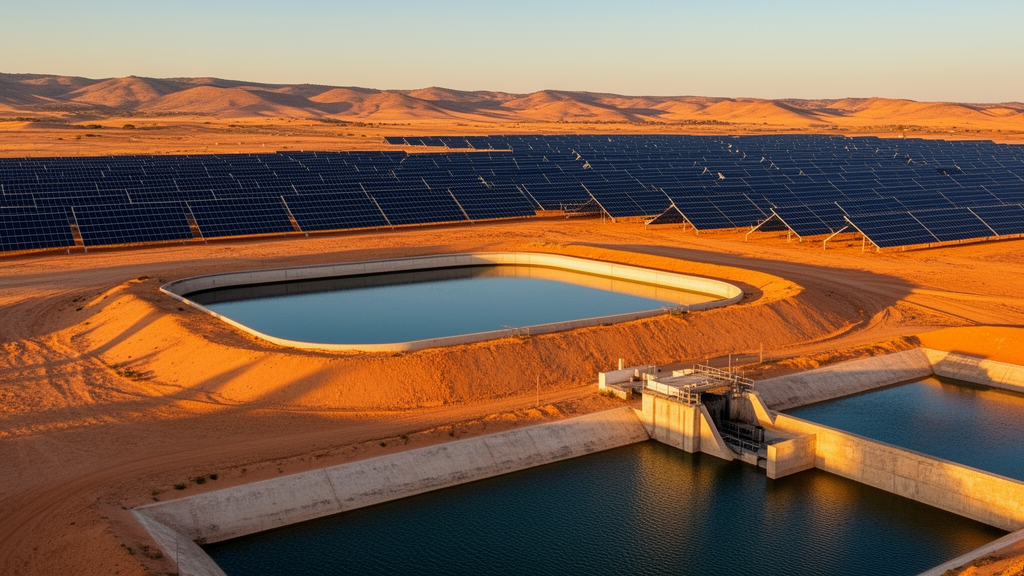
Tunisia could run its entire electricity grid on renewable energy by 2050, according to a new techno-economic study that models the country’s path to 100% renewable electricity using solar photovoltaics, hydropower and pumped hydro energy storage. The research, published in Frontiers in Energy Research, presents the first comprehensive national-scale least-cost optimization for Tunisia and shows that proven technologies, not futuristic ones, could meet the country’s growing power needs while cutting its heavy reliance on imported natural gas.
The stakes are considerable. Although Tunisia enjoys abundant sunshine, with average horizontal irradiance of 4.5 to 5.5 kilowatt-hours per square metre per day across most regions, its electricity system remains structurally dependent on fossil fuels. Natural gas-fired plants dominate generation, exposing the economy to volatile fuel prices and supply risks. Per capita electricity consumption is remarkably low at just 0.5 megawatt-hours per resident per year, a figure that highlights both the modest electrification achieved so far and the enormous growth potential as transport, industry, cooking and heating shift toward electricity in the decades ahead.
The research team, led by Hedi Trabelsi and Rym Belgaroui with colleagues at King Faisal University and the Laboratory of Economic and Management in Sfax, built a high-resolution model of Tunisia’s electrical future extending to 2050. The framework divides the country into nodes aligned with its governorates, maps transformation sites using QGIS software, and simulates the hourly balance between power supply and demand over a ten-year period from 2013 to 2022. Solar photovoltaics and hydropower are modeled as primary energy sources, while pumped hydro energy storage and, in some scenarios, transboundary electricity imports from Algeria and Libya provide system equilibrium.
At the heart of the methodology lies a nonlinear least-cost optimization solved with the Differential Evolution algorithm, a population-based stochastic technique well suited to complex, high-dimensional energy system problems. The optimizer minimizes the total levelized cost of electricity while satisfying hourly demand across the entire simulation horizon. Decision variables include installed photovoltaic capacity, pumped storage power and energy capacity, and cross-border transmission capacity. Hydropower capacity is treated as a fixed input under two development trajectories: a Reference Hydro scenario reflecting Tunisia’s current portfolio of small dam-connected installations, and an Ambitious Hydro scenario incorporating potential projects identified in national water and energy planning studies.
Solar resource data came from Solcast, providing hourly irradiance measurements from 2013 to 2022 across twenty-three representative locations. The researchers converted these into photovoltaic production profiles using the System Advisor Model developed by the US National Renewable Energy Laboratory, applying the PVWatts performance model to simulate conventional fixed-tilt systems. Pumped hydro storage potential was assessed using global greenfield evaluations that identify suitable off-river sites based on topography, elevation differences and reservoir configuration, categorized into cost classes reflecting construction expenses per unit of energy stored.
The scenario framework spans twelve least-cost pathways combining three electricity demand levels of 2, 5 and 9 megawatt-hours per capita per year by 2050, two hydropower trajectories, and import conditions. The results are striking. Under low demand with reference hydropower, hydroelectric generation satisfies most annual consumption with only minor solar and storage additions for diurnal balancing. Under the ambitious hydro scenario, hydropower output of roughly 169 terawatt-hours per year nearly eliminates the need for photovoltaics and pumped storage, producing surplus energy that could even support seasonal electricity exports.
As demand rises, however, solar photovoltaics becomes the system’s dominant energy source. Under the high-demand reference hydro case without imports, the model calls for approximately 344 gigawatts of photovoltaic capacity and 90 gigawatts of pumped storage with total storage capacity of roughly 2,445 gigawatt-hours. These figures represent maximum capacities under land, grid and investment constraints. When electricity imports are permitted, photovoltaic capacity drops to about 235 gigawatts and pumped storage to 53 gigawatts. Under the ambitious hydro scenario with imports, the same demand can be met with just 134 gigawatts of photovoltaics and 37 gigawatts of pumped storage, demonstrating how regional commerce and hydropower expansion together minimize infrastructure requirements.
The economics are equally revealing. Levelized cost of electricity ranges from about 164 to 264 Tunisian dinars per megawatt-hour across the twelve scenarios, with import-enabled configurations consistently cheaper than domestic-only systems. In the medium-demand reference hydro case, allowing imports reduces photovoltaic and pumped storage capacity requirements by roughly 21% and 41% respectively. Sensitivity analysis shows the levelized cost is most sensitive to solar photovoltaic investment costs and the discount rate. When the discount rate rises from 2% to 10%, system cost escalates by nearly 38%, underscoring that financing conditions matter as much as technology costs for capital-intensive systems dominated by photovoltaics and pumped storage.
The study’s implications extend well beyond Tunisia’s borders. The Global PHES Atlas has identified more than 2,800 eligible off-river pumped storage sites worldwide with combined potential storage capacity of almost 50,000 gigawatt-hours, vastly exceeding the model’s upper-bound storage need. Off-river development also reduces the social and environmental impacts associated with conventional reservoir systems. The researchers argue that strategic imports through moderate interconnection capacity of roughly 10.5 to 12 gigawatts could ease the strain on domestic storage capacity by 40% to 80%, consistent with findings from least-cost optimization studies in Bolivia, Malaysia and Southeast Asia where external connectivity lowers storage requirements by 50% to 80% without sacrificing reliability.
The findings align with Tunisia’s long-term net-zero strategy, its Nationally Determined Contribution and national development plans emphasizing renewable diversification, transmission expansion and concessional financing. They also support Sustainable Development Goal 7 on clean and affordable energy and Goal 13 on climate action. The authors caution that the results represent scenario-based planning pathways rather than deterministic forecasts, and that future research should incorporate wind power, battery storage, green hydrogen, sector coupling and climate-dependent hydrological variability. Nevertheless, the message is clear: with supportive regulation, affordable financing and integrated land-use planning, Tunisia’s abundant solar resource and emerging hydropower potential could deliver a resilient, fully renewable electricity system by mid-century, offering a template for other emerging economies with low per capita consumption and rich renewable endowments.
Subject of Research: Advancing 100% renewable electricity in Tunisia: techno-economic pathways for integrating solar PV, hydropower, and pumped hydro energy storage
Article Title: Advancing 100% renewable electricity in Tunisia: techno-economic pathways for integrating solar PV, hydropower, and pumped hydro energy storage
Article References: Trabelsi, H., Belgaroui, R., Hadj Kacem, H., & Boujelbene, Y. (2026). Advancing 100% renewable electricity in Tunisia: techno-economic pathways for integrating solar PV, hydropower, and pumped hydro energy storage. Frontiers in Energy Research, 14, Article 1921710. https://doi.org/10.3389/fenrg.2026.1921710
Image Credits: AI Generated
DOI: 10.3389/fenrg.2026.1921710
Keywords: Advancing, renewable, electricity, Tunisia, techno-economic, pathways, integrating, solar, hydropower, pumped, hydro, energy
Cite Scienmag News
Faith Mcneil. (October 16, 2026). Tunisia’s 100% renewable electricity future: solar PV, hydropower and pumped hydro storage pathways to 2050. Scienmag. https://scienmag.com/tunisias-100-renewable-electricity-future-solar-pv-hydropower-and-pumped-hydro-storage-pathways-to-2050/
Faith Mcneil. "Tunisia’s 100% renewable electricity future: solar PV, hydropower and pumped hydro storage pathways to 2050." Scienmag, 16 October 2026, https://scienmag.com/tunisias-100-renewable-electricity-future-solar-pv-hydropower-and-pumped-hydro-storage-pathways-to-2050/. Accessed 16 October 2026.
Faith Mcneil. "Tunisia’s 100% renewable electricity future: solar PV, hydropower and pumped hydro storage pathways to 2050." Scienmag. October 16, 2026. https://scienmag.com/tunisias-100-renewable-electricity-future-solar-pv-hydropower-and-pumped-hydro-storage-pathways-to-2050/


