


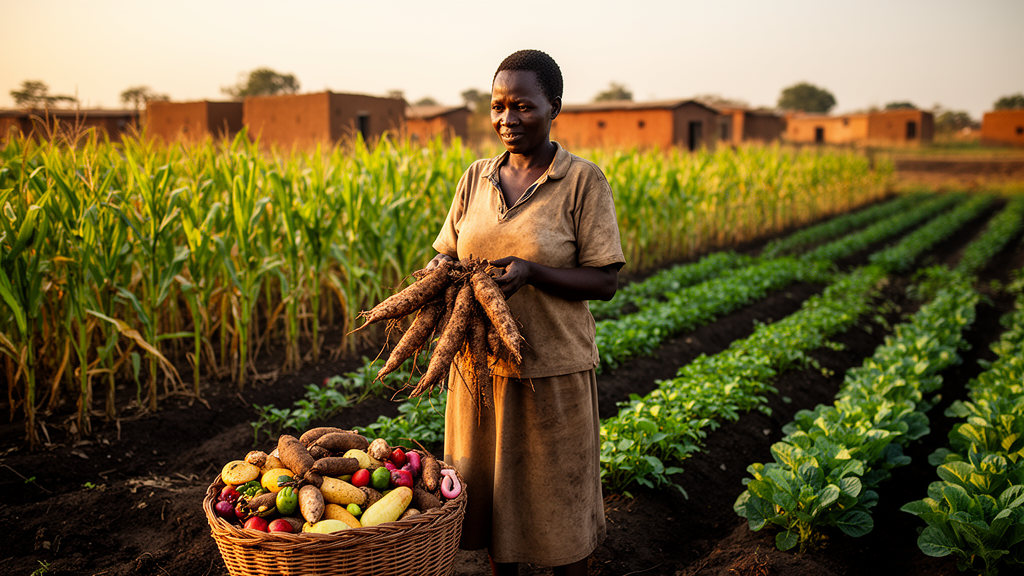
Planting many crops instead of one could mean the difference between living near Nigeria’s national poverty line and living in deep poverty, according to one of the most rigorous national studies ever conducted on the welfare effects of climate-smart agriculture. A new analysis of 3,229 farm households across Nigeria finds that crop diversification — spreading farmland across crops with different climate sensitivities and marketing seasons — nearly doubled the per capita consumption expenditure of adopting households and added roughly two full food groups to their weekly diets. The findings, published in Frontiers in Sustainable Food Systems, arrive at a moment when humanitarian assessments project that 26 to 33 million Nigerians face high levels of food insecurity and roughly four in ten Nigerians live below the poverty line.
The research team, led by Robert Ugochukwu Onyeneke of Alex Ekwueme Federal University together with Chukwuemeka Chinonso Emenekwe and Chinedum Uzoma Nwajiuba of Michael Okpara University of Agriculture, mined the fourth wave of Nigeria’s Living Standard Measurement Study – Integrated Surveys on Agriculture, a nationally representative household survey conducted by the National Bureau of Statistics in collaboration with the World Bank. Of the 3,229 farm households in the sample, 1,846 — about 57 percent — practiced crop diversification. The study then merged the survey data with gridded agro-climatic variables from the Climatic Research Unit of the University of East Anglia, linking each household’s geo-referenced location to historical rainfall, temperature, and elevation data at half-degree resolution.
What makes the study stand out is its econometric machinery. The central problem in measuring whether a practice like crop diversification actually improves welfare is self-selection: farmers who choose to diversify may differ systematically from those who do not, in ways both visible and invisible to the analyst. A naive comparison of adopters and non-adopters would confound the effect of the practice itself with the effect of these underlying differences. To solve this, the team employed an endogenous switching regression model, estimated by full information maximum likelihood, which simultaneously models the adoption decision and separate welfare functions for adopters and non-adopters while correcting for selection bias arising from both observed and unobserved household heterogeneity.
The model also required an exclusion restriction — at least one variable that affects the probability of adoption but has no direct effect on welfare except through the adoption decision. The researchers used elevation, mean temperature, and rainfall shocks as instruments, arguing on agronomic grounds that these biophysical factors shape the physical suitability of a plot for cultivating multiple crops rather than a single dominant crop. A falsification test supported their validity: the instruments significantly influenced the adoption decision but showed no significant relationship with welfare outcomes among non-adopting households, where they cannot operate through the adoption channel.
The headline results are striking. In the counterfactual scenario where adopting households had not diversified, their expected per capita consumption expenditure would have been about 63,640 naira — roughly 51 percent lower than the 130,875 naira they actually achieved. Nigeria’s 2018/19 national poverty line, set using the same survey round as the data underlying this study, was 137,430 naira per person per year. The expected expenditure of adopters under actual adoption sits close to that threshold, whereas their counterfactual expenditure falls well below it. For the average adopting household, crop diversification is closely associated with the difference between living near the national poverty line and living in deep poverty.
The dietary effects are equally consequential. The Household Dietary Diversity Score, which counts the number of food groups a household consumes over a seven-day recall period on a scale from 0 to 12, rose by an average treatment effect of 2.03 points among adopters. Because the score is bounded, that gain corresponds to adopters consuming roughly two additional food groups per week, moving the average adopting household from just under three-quarters of the maximum possible dietary diversity toward its upper range — a magnitude consistent with a meaningful improvement in micronutrient adequacy rather than a marginal statistical effect. The average treatment effect on per capita consumption expenditure was 0.72 log points, effects the authors describe as large relative to national poverty and dietary diversity benchmarks.
But the study also uncovered a set of counterintuitive adoption barriers that complicate the usual policy playbook. Each additional year of a household head’s schooling was associated with a 4.3 percentage-point reduction in the probability of adopting crop diversification — a magnitude similar to that of formal access to finance, which reduced adoption probability by 3.7 percentage points. The authors suggest that more educated household heads in Nigeria are more likely to pursue off-farm employment or specialized, market-oriented monocropping, and may substitute formal risk-management instruments such as savings, insurance, and non-farm income for the informal risk-spreading function that diversification provides. Extension and commercial input-supply networks organized around specific cash crops may also steer better-educated farmers toward input-intensive production of a single crop.
Access to finance itself showed a negative association with adoption, upending the assumption that credit relaxes the liquidity constraints limiting new practices. One explanation is that formal credit in this context is disproportionately extended for, or used to finance, specialized and input-intensive monocropping — certified seed and fertilizer packages for a single cash crop — rather than diversified cropping portfolios. Meanwhile, distance to road was positively associated with adoption while distance to market was negatively associated with it, a pattern consistent with a subsistence-oriented risk-spreading rationale: households remote from roads face higher transaction costs for market-oriented specialized production and rely more heavily on cultivating multiple crops to meet household food needs directly. Similar patterns have been reported among remote indigenous communities in the Ecuadorian Amazon, where diversification functions as a subsistence strategy rather than a commercial one.
The single most binding constraint, however, was climate itself. Exposure to a rainfall shock reduced the probability of adoption with a marginal effect of −0.717 — more than seven times larger in magnitude than the effect of education or access to finance, and more than an order of magnitude larger than the effect of distance to market. Rather than hedging ex ante against climate risk by diversifying, households that experienced a rainfall shock appear to have depleted the savings, labor, or seed stocks needed to expand into additional crops, retrenching instead toward fewer, more familiar staple crops to secure immediate food needs. The negative sign is consistent with an ex-post liquidity-constraint mechanism, in which shocks leave households without the capital needed to diversify.
The policy implications follow directly from these mechanisms. The authors argue that government agricultural and nutrition agencies should jointly fund a targeted conversion program that removes the specific barriers suppressing adoption: redesigning credit products to explicitly support diversified cropping portfolios rather than specialized monocropping, pairing rural road investment with market-access interventions so that improved connectivity does not simply erode the subsistence rationale for diversification without offering a viable alternative, and bundling diversification advice with climate information services and weather-index insurance in drought-prone areas. Because rainfall shock is the most binding barrier, an initial phase should prioritize scaling index-based weather insurance and post-shock input support in the most drought-exposed local government areas, with credit-product redesign and road–market pairing as complementary second-phase interventions. Extension services may also need two differentiated messaging tracks — one framed around resilience and food security for households already pursuing subsistence-oriented diversification, and another framed around risk-adjusted returns and market access for the more commercially oriented, better-educated households that currently favor specialization. The study’s limitations are acknowledged: the cross-sectional data cannot track how adoption and welfare evolve over time, the binary diversification measure does not capture intensity or interactions with other climate-smart practices, and the welfare measures do not capture asset accumulation, income volatility, or subjective wellbeing. Still, as the first nationally representative evidence on the welfare impacts of crop diversification in Nigeria using an endogenous switching regression framework, the study offers a sobering and actionable message: the practice works, but the systems surrounding it — credit, roads, markets, and climate shocks — currently work against it.
Subject of Research: Climate-Smart Agriculture
Article Title: Crop diversification as a climate-smart agriculture strategy and household welfare in Nigeria: evidence from living standard measurement survey
Article References: Onyeneke, R. U., Emenekwe, C. C., & Nwajiuba, C. U. (2026). Crop diversification as a climate-smart agriculture strategy and household welfare in Nigeria: evidence from living standard measurement survey. Frontiers in Sustainable Food Systems, 10, Article 1957540. https://doi.org/10.3389/fsufs.2026.1957540
Image Credits: AI Generated
DOI: 10.3389/fsufs.2026.1957540
Keywords: crop diversification, climate-smart agriculture, Nigeria, household welfare, dietary diversity, poverty, LSMS-ISA, endogenous switching regression, food security, smallholder farmers, Crop, diversification
Cite Scienmag News
Alan Morgan. (October 16, 2026). Crop Diversification Could Lift Nigerian Farm Households Out of Deep Poverty, Landmark National Survey Reveals. Scienmag. https://scienmag.com/crop-diversification-could-lift-nigerian-farm-households-out-of-deep-poverty-landmark-national-survey-reveals/
Alan Morgan. "Crop Diversification Could Lift Nigerian Farm Households Out of Deep Poverty, Landmark National Survey Reveals." Scienmag, 16 October 2026, https://scienmag.com/crop-diversification-could-lift-nigerian-farm-households-out-of-deep-poverty-landmark-national-survey-reveals/. Accessed 16 October 2026.
Alan Morgan. "Crop Diversification Could Lift Nigerian Farm Households Out of Deep Poverty, Landmark National Survey Reveals." Scienmag. October 16, 2026. https://scienmag.com/crop-diversification-could-lift-nigerian-farm-households-out-of-deep-poverty-landmark-national-survey-reveals/


