


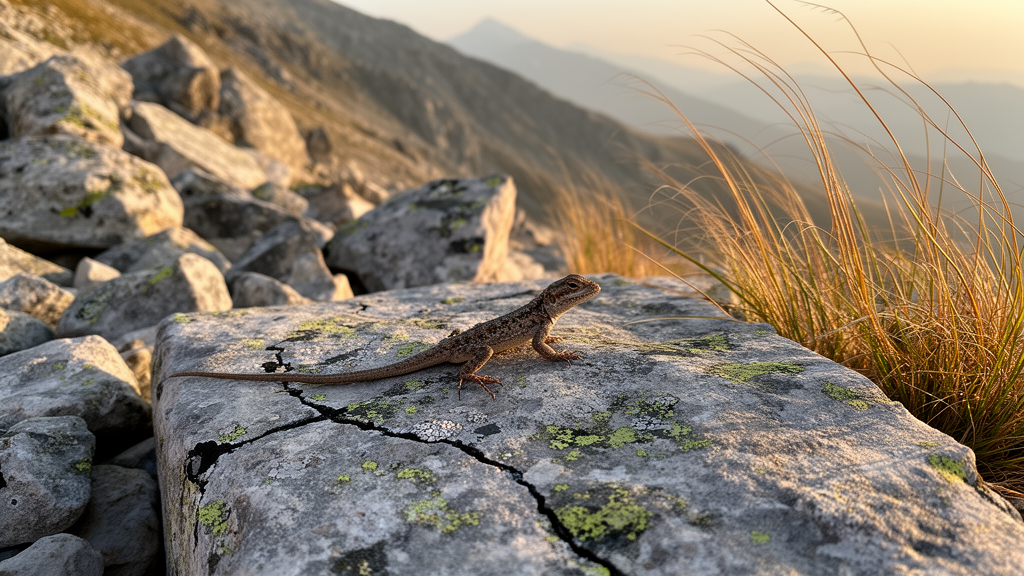
On the sun-baked slopes of Mount Spil in western Türkiye, a small rock lizard is quietly rewriting what scientists know about how cold-blooded animals survive in a warming world. A new field study of the Anatolian rock lizard, Anatololacerta anatolica, has revealed that these lizards are not passive prisoners of their environment but active thermal strategists, exploiting the fine-grained heat mosaic of rocks, sunlight, and vegetation to keep their bodies running at temperatures well above the surrounding air. The findings, published in the journal Herpetozoa, carry a pointed warning for conservation: climate models built on broad air-temperature averages may badly misjudge how vulnerable this endemic species really is.
Ectothermic animals, including reptiles, amphibians, and most invertebrates, cannot generate enough metabolic heat to regulate their internal temperature. Instead, they depend on external heat sources to reach the body temperatures needed to sustain their physiological and ecological processes. Species fall along a continuum between two extremes: thermoconformers, whose body temperature closely tracks their immediate surroundings, and thermoregulators, which actively maintain body temperature within a narrower preferred range by exploiting spatial and temporal thermal variation through behavior. Distinguishing between these strategies is fundamental to understanding a species’ thermal ecology and its potential vulnerability to climate change.
Lizards draw on several distinct physical pathways to gather heat. Solar radiation in the ultraviolet, visible, and shortwave-infrared spectra is generally the primary heat source for diurnal lizards, transferred by radiation. Substrate temperature, the temperature of the soil, rock, sand, or leaf litter in direct contact with the animal, transfers heat by conduction. Air temperature influences body temperature mainly through convective exchange. Lizards that raise body temperature primarily by basking in sunlight are classified as heliotherms, whereas those relying mainly on conductive exchange with warm substrates are thigmotherms. Many species combine both strategies, and wind can further modify heat balance by enhancing convective heat loss when body temperature exceeds air temperature.
Because these heat sources vary at very fine spatial scales, macroclimatic data such as weather-station air temperatures or gridded climate surfaces are often poor proxies for the temperatures ectotherms actually experience. Vegetation cover, rock crevices, orientation, slope, and substrate type create fine-scale thermal mosaics that provide opportunities for behavioral thermoregulation. By selecting favorable microhabitats, lizards can maintain body temperature near their preferred range even when macroclimatic conditions would predict otherwise, a phenomenon known as the Bogert effect, in which behavioral buffering of the thermal environment may slow the pace of physiological evolution and mask a species’ climatic vulnerability.
The Anatolian rock lizard is a small diurnal lacertid endemic to western Anatolia, distributed from north of the Büyük Menderes River to Bursa and extending eastward into Central Anatolia at elevations up to roughly 1,600 meters. The species typically inhabits rocky areas with dense vegetation and proximity to moisture, and is frequently found under stones at ambient temperatures of 25 to 30 degrees Celsius. Previous work reported a preferred body temperature of approximately 34.5 degrees Celsius in adults, but data on how individuals in natural populations integrate solar radiation, substrate temperature, air temperature, and wind at the microhabitat scale remained scarce. Bioclimatic modeling predicts a northward contraction of suitable habitat for the genus under future climate scenarios, making the question urgent.
To address this gap, researchers conducted field surveys on Mount Spil between April and October 2025, capturing 125 lizards and measuring cloacal body temperature within ten seconds of capture using a fast-response thermocouple, alongside simultaneous measurements of surface temperature, air temperature one centimeter above the ground, solar radiation with a pyranometer, and wind speed at the lizard’s own height. Of these, 89 individuals had complete records and were retained for statistical analysis. Sex was determined in the field, and adults were distinguished from juveniles by snout-vent length.
The results were striking. Mean field body temperature was 32.32 plus or minus 4.53 degrees Celsius, significantly higher than both mean surface temperature of 30.6 degrees and mean air temperature of 28.1 degrees, confirming that the population behaves as an active thermoregulator rather than a passive thermoconformer. Multiple regression analysis showed that surface temperature and solar radiation were the strongest positive predictors of body temperature, with air temperature also significant, while wind speed was not significant at the conventional threshold. The full model explained 67.4 percent of the variance in body temperature, and a reduced model containing only surface temperature and solar radiation still accounted for 60.2 percent of the variance, underscoring how tightly body temperature is coupled to the radiative-thermal environment.
Principal component analysis added a compelling layer to the story. Two components jointly explained approximately 76 percent of the total variance. The first axis represented a combined thermal-radiative gradient with high loadings from body temperature, surface temperature, solar radiation, and air temperature. The second axis was dominated almost entirely by wind speed, contributing 91.96 percent to that component, and was essentially orthogonal to the first. This statistical decoupling suggests that the lizards buffer convective cooling through strategic microhabitat selection, such as using rock crevices and the base of vegetation, effectively neutralizing wind as a determinant of their thermal balance while managing heat gain primarily through solar radiation and substrate temperature.
The study also uncovered a surprising sex difference. Despite the absence of detectable differences in body size between adult males and females, females maintained significantly higher field body temperatures than males, 33.59 versus 31.44 degrees Celsius, with a moderate effect size. Neither snout-vent length nor body mass predicted field body temperature in adults, making a thermal inertia explanation unlikely. The researchers suggest that sex-specific differences in thermoregulatory behavior or microhabitat use, possibly linked to the elevated thermoregulatory demands of vitellogenesis and gestation, warrant further investigation.
The broader implications are clear. The Mount Spil population combines heliothermy with a component of thigmothermy, with solar radiation acting as the ultimate heat source, and relies on microhabitat-scale thermal heterogeneity to stabilize its thermal safety margins. As climate change reshapes thermal landscapes, the authors argue that conservation assessments should prioritize the continuity of thermal refugia and fine-scale habitat heterogeneity over macroclimatic averages. For a species whose suitable habitat is projected to contract northward, the sheltered crevice or sun-warmed rock may matter far more than any regional temperature forecast, and future work quantifying preferred and operative temperatures will be essential to refine projections of its fate under a changing climate.
Subject of Research: Thermal ecology and microhabitat thermoregulation of the Anatolian rock lizard
Article Title: Microhabitat-scale thermal determinants of body temperature in Anatololacerta anatolica from Mount Spil, Western Anatolia
Article References: Microhabitat-scale thermal determinants of body temperature in Anatololacerta anatolica from Mount Spil, Western Anatolia. (n.d.). https://doi.org/10.3897/herpetozoa.39.e188838
Image Credits: AI Generated
DOI: 10.3897/herpetozoa.39.e188838
Keywords: thermoregulation, Anatololacerta anatolica, ectotherms, microhabitat, solar radiation, Bogert effect, heliothermy, thigmothermy, climate change, lizard ecology, Mount Spil, thermal refugia
Cite Scienmag News
Gavin Prescott. (October 16, 2026). Hidden Heat Maps: Rock Lizards Outsmart the Wind on a Turkish Mountain. Scienmag. https://scienmag.com/hidden-heat-maps-rock-lizards-outsmart-the-wind-on-a-turkish-mountain/
Gavin Prescott. "Hidden Heat Maps: Rock Lizards Outsmart the Wind on a Turkish Mountain." Scienmag, 16 October 2026, https://scienmag.com/hidden-heat-maps-rock-lizards-outsmart-the-wind-on-a-turkish-mountain/. Accessed 16 October 2026.
Gavin Prescott. "Hidden Heat Maps: Rock Lizards Outsmart the Wind on a Turkish Mountain." Scienmag. October 16, 2026. https://scienmag.com/hidden-heat-maps-rock-lizards-outsmart-the-wind-on-a-turkish-mountain/


