


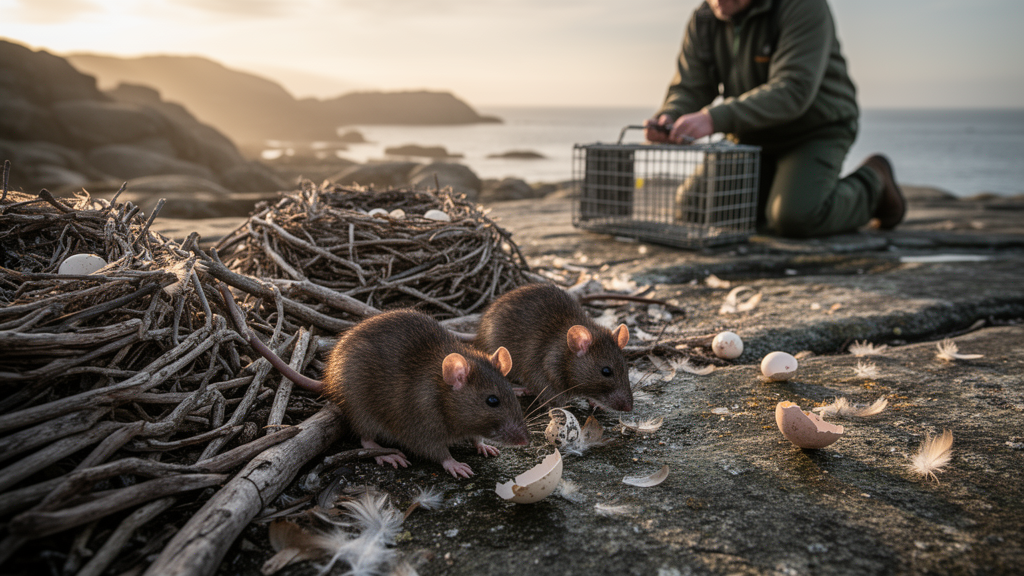
Invasive rodents have driven some of the most dramatic extinctions in island history, and their removal has become one of conservation’s most reliable rescue tools. Roughly 88 percent of documented island rodent eradication attempts succeed, delivering measurable gains for native seabirds, reptiles, plants, and whole food webs. Yet a troubling pattern is emerging as projects push onto larger, tropical, inhabited, and logistically constrained islands: eradications that follow every rule in the best-practice playbook still fail, sometimes because a mere handful of surviving rats quietly rebuild the population. A new perspective article in Frontiers in Conservation Science argues that the field’s central planning question has been left implicit for too long, and it proposes a decision framework to make it explicit.
David J. Will of Island Conservation in Santa Cruz, California, developed the framework around a distinction most eradication plans gloss over: the difference between whether an eradication can be implemented and whether the consequences of failure justify planning and resourcing for detection-triggered response. A project may be entirely feasible in that a best-practice baiting operation can be delivered effectively on schedule and on budget, while still lacking any credible plan for detecting and removing survivors. On high-risk islands, Will contends, that gap is where success or failure is increasingly decided.
The evidence motivating the framework comes partly from a workshop titled Improving success rates for rodent eradication on high-risk islands, convened at the 2026 Island Invasives Conference in Auckland, New Zealand. More than 100 practitioners, researchers, technical providers, policy makers, and funders examined why recent high-risk attempts have narrowly failed despite close adherence to accepted practice. Several rodent eradications on inhabited Pacific islands, including Lord Howe Island, Palmerston Atoll, Tetiaroa Atoll, and Wake Atoll, succeeded only after teams implemented targeted efforts to detect and remove remnant populations after the primary removal operation failed to eliminate them. High-profile tropical attempts on Floreana, Henderson, and Late reduced rodent populations to low densities yet still fell short of eradication.
The biological and operational constraints of tropical and inhabited systems explain why. Persistent year-round breeding, abundant alternative foods, bait competition from non-target species, rugged terrain, limited access permissions, and socio-political complexity all increase the likelihood that some individuals are never exposed to the primary removal method. In temperate, uninhabited islands where most eradication evidence was generated, those factors behave differently, so the transferability of past experience declines precisely where conservation and social stakes are highest. In many failed eradications, the causes remain unclear even after correlated risk factors are identified, requiring structured diagnosis to separate ecological from operational drivers.
Will’s framework sorts projects into three strategy archetypes. Single-event implementation relies on one primary removal method supported by strong comparable precedent, followed by one-time confirmation monitoring, with no predefined contingency beyond limited mop-up. Planned contingency response keeps the primary operation but adds survivor-focused monitoring and predefined corrective actions designed for specific, anticipated failure modes triggered by monitoring evidence. Adaptive multi-method campaigns go further, deploying multiple removal methods in sequence using decision thresholds based on evidence from survivor-focused monitoring, because survivorship mechanisms remain unresolved or the consequences of failure justify greater response readiness.
Six planning questions guide projects into the appropriate class. Teams first define what eradication success means locally and how much confidence is required before success can be declared, including their tolerance for failure risk. They then assess whether previous approaches on socio-ecologically similar islands provide a credible basis for expecting success, since factors influencing whether every rodent encounters the removal method on tropical islands may differ substantially from those that informed temperate-island strategies. Third, they identify poorly transferable or untested dependencies: where success rests on assumptions lacking precedent in comparable contexts, predefined detection and response pathways should be built in.
The remaining questions sharpen the risk calculus. Where previous attempts on the same island or comparable systems have failed and the cause of survivors remains unresolved, repeating the same strategy without additional response capacity is unlikely to reduce risk; unresolved prior failure generally pushes a project toward the adaptive campaign class. Teams then evaluate the consequences of failure, not only at the project level but across organizational, regional, and sector-wide impacts, since a high-profile failure can erode stakeholder confidence, future investment, regulatory support, and willingness to pursue similar interventions elsewhere. Finally, they judge whether a predefined correction is credible: if anticipated risks can be clearly bounded and addressed, contingency planning suffices, but where failure modes are poorly defined or no single correction is likely to resolve the risk, detection systems, response tools, governance triggers, and funding become core components of the strategy rather than optional backup.
A retrospective application to Wake Atoll illustrates the logic. The 700-hectare Pacific atoll saw a first eradication attempt remove one rat species but not the other. During the second attempt, survivors were detected following the initial removal operation, and an extended response phase was required to achieve eradication. At the design stage, comparable precedent was limited, prior failure was present, and the mechanisms of survivorship remained unresolved, while the consequences of a second unsuccessful attempt were high given the site’s conservation significance. Under these conditions, the framework would have favored planning the project as a multi-method campaign from the outset. In practice, the initial single-event implementation was followed by an extended response phase once survivors were detected, a sequence the framework aims to anticipate rather than improvise.
The framework carries practical weight for funders and communities as well as operators. It clarifies when some eradications responsibly require larger initial budgets, longer timelines, and flexible or staged funding to increase the likelihood of removing survivors before failure becomes entrenched. Although this raises upfront costs, it can substantially reduce the risk of total failure and avoid the far greater cost, delayed conservation benefits, and erosion of stakeholder confidence that follow when high-profile projects require repeated attempts. Not all contingencies provide meaningful risk reduction, however; their value depends on whether failure modes are understood, survivorship can be detected early enough to trigger a predefined response while success remains achievable, and the authority and funding to act are already in place. Adaptive management, in this view, is not simply the ability to adjust tactics after implementation but a structured, pre-planned process establishing decision points, response options, milestones, and learning loops in advance, co-designed with stakeholders.
Will is candid about the framework’s limits. It is qualitative, does not estimate eradication probability, rank projects by risk, or prescribe specific tools, and because it relies on practitioner judgement it remains vulnerable to overconfidence and misclassification, particularly where important ecological, operational, or social differences remain unresolved. Independent peer review of strategy classification should therefore be standard practice for high-risk projects, and important uncertainties persist around rodent behavior, bait uptake, detection probability, population dynamics, and environmental influences on bait effectiveness. Future use should focus on retrospective testing against completed eradications and prospective application during feasibility assessment. The framework assumes immigration has been prevented or managed, distinguishing survivorship from reinvasion, and it applies irrespective of delivery method, whether toxicants, trapping, hunting, or biological control. As eradications move into increasingly complex ecological and social contexts, the article concludes, success may depend as much on planning for how survivorship will be managed as on optimizing the primary removal operation itself.
Subject of Research: A decision framework for selecting eradication strategies that account for rodent survivorship risk on high-risk islands
Article Title: Selecting strategies for high-risk island rodent eradications
Article References: Will, D. J. (2026). Selecting strategies for high-risk island rodent eradications. Frontiers in Conservation Science, 7, Article 1957591. https://doi.org/10.3389/fcosc.2026.1957591
Image Credits: AI Generated
DOI: 10.3389/fcosc.2026.1957591
Keywords: island eradication, invasive rodents, survivorship, adaptive management, contingency planning, feasibility assessment, island restoration, tropical islands, detection-triggered response, conservation decision framework, Frontiers in Conservation Science, Selecting
Cite Scienmag News
Margaret Porter. (October 16, 2026). When a Handful of Rats Can Sink an Island Rescue: New Framework Plans for Survivorship. Scienmag. https://scienmag.com/when-a-handful-of-rats-can-sink-an-island-rescue-new-framework-plans-for-survivorship/
Margaret Porter. "When a Handful of Rats Can Sink an Island Rescue: New Framework Plans for Survivorship." Scienmag, 16 October 2026, https://scienmag.com/when-a-handful-of-rats-can-sink-an-island-rescue-new-framework-plans-for-survivorship/. Accessed 16 October 2026.
Margaret Porter. "When a Handful of Rats Can Sink an Island Rescue: New Framework Plans for Survivorship." Scienmag. October 16, 2026. https://scienmag.com/when-a-handful-of-rats-can-sink-an-island-rescue-new-framework-plans-for-survivorship/


