


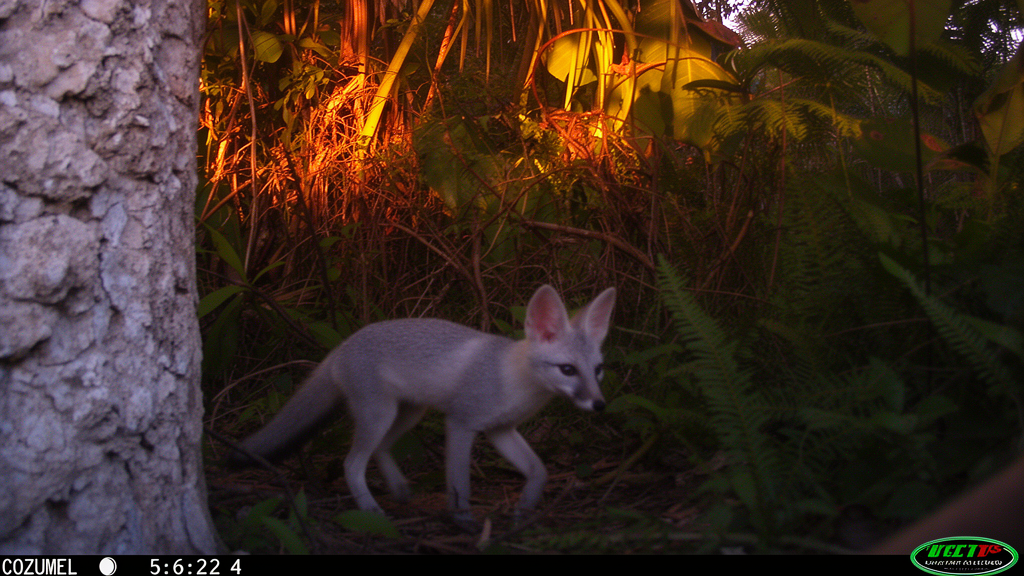
For more than two decades, the dwarf fox of Cozumel existed only as a rumor backed by bones. Scientists knew the animal from subfossil remains buried in the island’s caves and soils, from a handful of scattered eyewitness accounts, and from nothing else. No photograph had ever been taken. No specimen had ever been collected. Then, in the early morning of 14 September 2023, that changed. An adult male fox, disoriented near kilometer 29 on the island’s eastern coastal highway, was spotted by local residents, triggering a chain of phone calls and social media alerts that reached the Fundación de Parques y Museos de Cozumel. What followed was the first confirmed sighting and the first photographic record of a canid that may have been evolving in isolation on this Mexican Caribbean island for millennia.
The rescue operation, led by Rafael Chacón of the Fundación de Parques y Museos de Cozumel, located the animal at approximately 0600 hours near the coastal road. The fox was an adult male, and its capture marked a milestone in the natural history of Mexico’s largest inhabited island. Held under observation for several days, the animal was photographed in detail, providing the first visual documentation of a creature whose existence had been inferred almost entirely from archaeological deposits and secondhand reports dating back over a century.
Cozumel, an island of roughly 480 square kilometers off the Yucatán Peninsula, has long been recognized as a hotspot for insular dwarfism among its carnivores. The pygmy raccoon (Procyon pygmaeus) and the dwarf coati (Nasua nelsoni) are both formally described endemic species, recognized as distinct from their mainland relatives since the early twentieth century. The island’s fox, however, has never received the same taxonomic attention. Subfossil evidence indicates a body-size reduction of 60 to 80 percent compared to mainland gray foxes, a degree of dwarfing consistent with the well-documented pattern seen in the island fox (Urocyon littoralis) of California’s Channel Islands, where isolation drove rapid morphological, genetic, and ecological divergence over thousands of years.
The genus Urocyon currently comprises two living species: the gray fox (Urocyon cinereoargenteus), one of the most widely distributed canids in the Americas, and the island fox, endemic to six of the Channel Islands off California. The island fox is one of the best-studied examples of insular dwarfism and rapid evolution in mammals, with clear differentiation from its mainland ancestor in morphology, genetics, and ecology. The Cozumel fox, by contrast, remains a taxonomic enigma. Archaeological records suggest its presence on the island may predate early Mayan settlement, implying an isolation period of approximately 5,000 to 37,000 years. Yet no comprehensive morphological or genetic study has ever been conducted on the population, leaving its evolutionary distinctiveness and conservation status poorly understood.
After three days of observation, the fox was released on 17 September 2023 at approximately 0530 hours into suitable habitat within the Laguna Colombia State Reserve, a decision made in coordination with the Procuraduría Federal de Protección al Ambiente (PROFEPA) and the Comisión Nacional de Áreas Naturales Protegidas (CONANP). The release site was chosen because it lies farther from the road than the capture location and because it represents the type of habitat the species is believed to occupy. The reserve is characterized by a mosaic of tropical lowland forest, seasonal wetlands, and coastal dune vegetation, with two large brackish lagoons interspersed among chit palms, shrubs, mangroves, and dense understory that provides both cover and foraging opportunities for a small carnivore.
The Laguna Colombia State Reserve sits in the southern portion of Cozumel, an area that has become the focal point for all known records of the dwarf fox. Historical sightings from 1984 and 1985 cluster in this region, and the species has never been reported north of the community of El Cedral. This restricted distribution, combined with the absence of any systematic species-specific survey, means that virtually nothing is known about the population’s size, range, or demographic health. Scientists consider the Cozumel fox critically endangered by scientific consensus and likely on the brink of extinction, a designation based on the extreme rarity of observations and the mounting threats to the island’s southern habitats.
Those threats are considerable. Southern Cozumel faces increasing pressure from development, land-use change, invasive species, and natural disasters, including hurricanes that periodically batter the island. The same ecological value that makes the Laguna Colombia area important for the fox—its mix of forest, wetland, and dune vegetation—also makes it attractive for tourism infrastructure and residential expansion. The island’s other endemic carnivores, the pygmy raccoon and the dwarf coati, have already been the subject of conservation attention, but the fox has remained largely invisible to both science and policy, its existence sustained only by fragmentary evidence until now.
The photographic record from September 2023 does more than confirm the species’ continued presence; it reframes the urgency of the situation. If the fox had gone undocumented for over two decades despite intensive general biodiversity surveys on the island, its population may be extremely small, extremely cryptic, or both. The research team emphasizes that priority actions must include targeted, species-specific surveys to determine current distribution and population size, alongside morphological and genetic assessments to clarify whether the Cozumel fox represents a distinct species, a subspecies, or an insular population of the mainland gray fox. Without this taxonomic clarity, formal legal protection and conservation planning remain impossible.
The researchers point to the southern end of Cozumel, particularly the Laguna Colombia State Reserve and the area around El Cedral, as the geographic focus for these efforts, consistent with both historical and recent sighting records. Conservation measures should include protection of remaining suitable habitat and strategies to minimize human-wildlife conflict, particularly given the fox’s apparent proximity to roads and human settlements. Improved documentation and formal description of this insular canid will be critical for informing effective management, protective policies, and long-term conservation strategies.
The story of the Cozumel fox echoes that of the Channel Island fox, which was rescued from the brink of extinction through intensive conservation action after its decline was documented in the 1990s. Whether Cozumel’s dwarf fox can follow a similar trajectory depends on whether the window for action remains open. The 2023 photograph is a reminder that even in well-studied regions, species can persist undetected for decades, and that a single image can transform a ghost from subfossil legend into a living subject of urgent conservation concern. For now, the fox of Cozumel remains one of the Western Hemisphere’s most enigmatic mammals, captured at last in a photograph but still waiting to be understood.
Subject of Research: First photographic evidence and conservation status of the insular dwarf fox (Urocyon sp.) on Cozumel Island, Mexico
Article Title: First photographic evidence of an insular dwarf fox ( Urocyon sp.) on the island of Cozumel, Mexico
Article References: Bayer, T. D., McGreal, M. A., & Chacón D., A. R. (2026). First photographic evidence of an insular dwarf fox (Urocyon sp.) on the island of Cozumel, Mexico. Neotropical Biology and Conservation, 21(2), 123-129. https://doi.org/10.3897/neotropical.21.e187967
Image Credits: AI Generated
DOI: 10.3897/neotropical.21.e187967
Keywords: Cozumel, dwarf fox, Urocyon, insular dwarfism, Mexico, endangered species, island biogeography, carnivore conservation, Laguna Colombia State Reserve, gray fox, wildlife photography, taxonomic assessment
Cite Scienmag News
Margaret Porter. (October 16, 2026). Camera Captures Ghost Fox of Cozumel After 22 Years of Silence. Scienmag. https://scienmag.com/camera-captures-ghost-fox-of-cozumel-after-22-years-of-silence/
Margaret Porter. "Camera Captures Ghost Fox of Cozumel After 22 Years of Silence." Scienmag, 16 October 2026, https://scienmag.com/camera-captures-ghost-fox-of-cozumel-after-22-years-of-silence/. Accessed 16 October 2026.
Margaret Porter. "Camera Captures Ghost Fox of Cozumel After 22 Years of Silence." Scienmag. October 16, 2026. https://scienmag.com/camera-captures-ghost-fox-of-cozumel-after-22-years-of-silence/


