


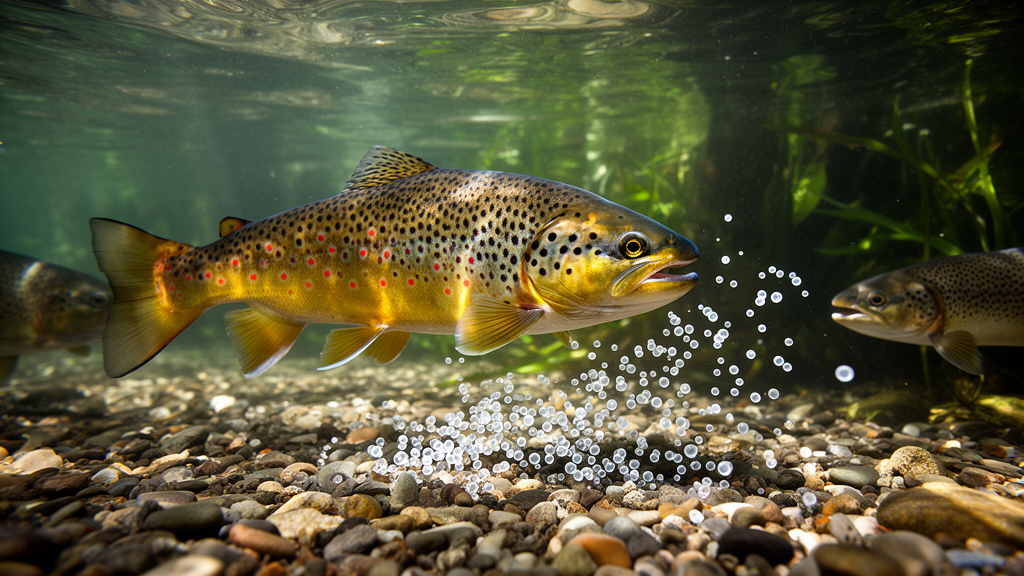
Microplastics have now been found in virtually every freshwater habitat on Earth, from urban streams to remote mountain rivers, and fish are swallowing them with their food. But a new modelling study suggests that not every trout in a stream faces the same risk. The boldest, most dominant individuals—the fish that feed most aggressively and hold the best territories—may be quietly accumulating the largest doses of plastic, and paying the biggest price in body size.
Researchers adapted a well-established individual-based model of stream trout, called inSTREAM 7.3, to simulate a population of rainbow trout (Oncorhynchus mykiss) living in a 184-metre river reach over ten years, roughly five to six generations. Every fish in the simulation was an autonomous agent that chose where to feed, when to hide, and how to balance the risk of predation against the risk of starvation. Crucially, each fish was randomly assigned two personality traits at emergence: dominance, represented by the size of its foraging territory, and boldness or shyness, represented by how effectively hiding reduces its predation risk. All nine combinations of the two traits were represented, from dominant-and-bold to subordinate-and-shy.
The team then tested three increasingly severe scenarios of how microplastics might harm fish behaviour. In the mildest scenario, plastic particles simply displaced real food, so fish eating plastic gained less nutrition. In the second scenario, fish that crossed weekly consumption thresholds also suffered permanent reductions in maximum swimming speed—15 percent after the first threshold and 30 percent after the second—based on laboratory findings in African freshwater catfish. In the harshest scenario, foraging efficiency in fast water was also impaired, forcing fish into slower habitats where prey is scarcer. Each scenario was run at microplastic concentrations of 0 percent, 1 percent, and 3 percent of the drift food in the water column, with the 1 percent level representing current environmental conditions and 3 percent a plausible future scenario.
The model was carefully validated against real-world patterns before any predictions were made. Simulated populations reproduced known behaviours: survival varied among personality types over time, higher predation selected for bold-and-dominant fish, abundant food weakened the shy-bold risk-reward trade-off, and competition favoured dominant individuals. The model also matched three empirical patterns of microplastic consumption: larger fish ingest more plastic than smaller fish of the same age, consumption rises with environmental concentration, and fish eat proportionally more plastic when food is scarce.
The results revealed a striking asymmetry. Across all scenarios, adult trout consumed far more microplastics than fry or juveniles, and dominant adults—regardless of whether they were bold or shy—consumed disproportionately more than any other personality type, especially at the 3 percent concentration. Because dominant fish command larger foraging territories and capture more prey, they inevitably ingest more of the plastic suspended alongside it. Subordinate, shy fish, which forage less and often feed at night in the sediments, consumed the least.
Yet the fish that ate the most plastic were not always the ones that suffered most. When microplastics merely reduced food intake, dominant and bold adults grew smaller at the 3 percent concentration. When swimming speed was impaired, however, it was subordinate and shy adults that lost body size—apparently because their already modest foraging success left them unable to compensate for the lost energy. When foraging efficiency itself was degraded, all dominant adults shrank, and dominant, bold fry also became less abundant. In effect, each behavioural type was vulnerable to a different kind of damage, and the personality type that enjoys the greatest adaptive advantage in a plastic-free stream is the one most penalised when plastic arrives.
Perhaps the most reassuring finding is what did not happen. Overall trout abundance barely responded to microplastics across all scenarios and concentrations, and effects on body size appeared only at the 3 percent level—above current environmental concentrations. The authors conclude that microplastic ingestion, at realistic present-day levels, is unlikely to pose a significant threat to healthy stream salmonid populations over five to six generations. The damage, where it occurred, was concentrated in the body size of specific behavioural types rather than in population numbers.
A sensitivity analysis reinforced this picture. Population biomass was most strongly influenced by reaction distance—the proxy for territory size and dominance—followed by maximum sustainable swimming speed and prey capture efficiency, all of which drive drift foraging. Microplastic concentration itself had only a moderate negative effect, and the hiding factors associated with shyness and boldness mattered even less. In other words, if microplastics undermine foraging ability, salmonid populations could suffer at lower concentrations; if foraging is only weakly affected, even substantial plastic loads may have negligible population consequences.
The study also uncovered a negative feedback loop: in the two harsher scenarios, adult microplastic consumption declined over time, because impaired swimming and foraging reduced the very activity that delivers plastic into the fish. Dominant trout lost their characteristic foraging advantage, which could, the authors speculate, shift selection toward less competitive behavioural types and increase personality variability within populations—though this hypothesis remains untested.
The model has limits. It did not consider the neurotoxic effects of microplastics, their potential to alter personality itself, or the many other stressors—climate change, habitat destruction, invasive species, disease—that already burden wild salmonid populations. The authors stress that microplastics should be viewed as an additional stressor that may interact with these pressures, and they call for salmonid-specific empirical data on how plastic ingestion affects swimming, station-holding ability, and foraging efficiency. Their broader message to ecologists is clear: to predict the effects of pollution, researchers must characterise the behavioural types within a population, because the fate of a fish in a contaminated stream may depend less on how much plastic is in the water than on who the fish is.
Subject of Research: Modelling how personality traits shape the population-level response of stream-dwelling rainbow trout to microplastics consumption
Article Title: Influence of personality traits on the response of a modelled population of stream-dwelling rainbow trout ( Oncorhynchus mykiss ) to microplastics consumption
Article References: Church, K. D. W., Railsback, S. F., & Semeniuk, C. A. D. (2025). Influence of personality traits on the response of a modelled population of stream-dwelling rainbow trout (Oncorhynchus mykiss) to microplastics consumption. Individual-based Ecology, 1, Article e137398. https://doi.org/10.3897/ibe.1.e137398
Image Credits: AI Generated
Keywords: microplastics, rainbow trout, personality traits, agent-based model, freshwater ecology, salmonids, foraging behaviour, dominance, boldness, inSTREAM, stream ecosystems, population modelling
Cite Scienmag News
Drew Townsend. (October 16, 2026). Bold Trout Eat More Plastic: Personality Shapes Microplastic Risk in Stream Fish. Scienmag. https://scienmag.com/bold-trout-eat-more-plastic-personality-shapes-microplastic-risk-in-stream-fish/
Drew Townsend. "Bold Trout Eat More Plastic: Personality Shapes Microplastic Risk in Stream Fish." Scienmag, 16 October 2026, https://scienmag.com/bold-trout-eat-more-plastic-personality-shapes-microplastic-risk-in-stream-fish/. Accessed 16 October 2026.
Drew Townsend. "Bold Trout Eat More Plastic: Personality Shapes Microplastic Risk in Stream Fish." Scienmag. October 16, 2026. https://scienmag.com/bold-trout-eat-more-plastic-personality-shapes-microplastic-risk-in-stream-fish/


