


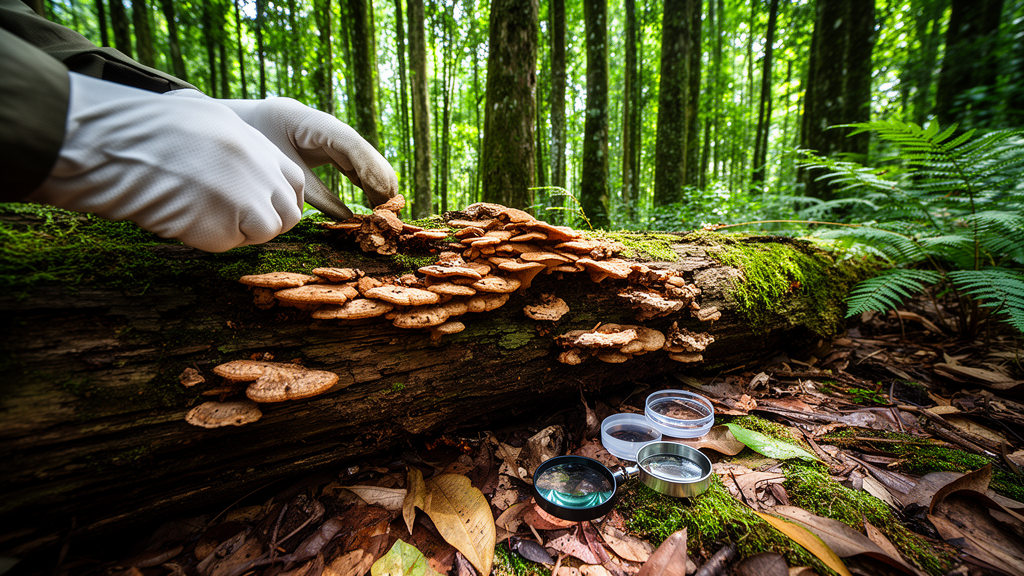
Deep in the mountain forests of southwestern China, some of the world’s most inconspicuous fungi have been hiding in plain sight. A new study published in IMA Fungus describes nine previously unknown species of Basidiodendron, a genus of wood-inhabiting fungi so small and thin that most people would walk past them without a second glance. The discovery, based on years of fieldwork across Yunnan Province, nearly doubles the number of known species in this enigmatic group and reshapes how scientists understand its evolutionary history.
Wood-inhabiting fungi are the unsung heroes of forest ecosystems. As primary decomposers of lignocellulose, the tough structural material that makes up wood, they drive the recycling of carbon, nitrogen, and phosphorus that keeps forests functioning. Without them, fallen branches and dead trees would accumulate indefinitely, and the nutrients locked inside would remain inaccessible to living plants. The order Auriculariales, to which Basidiodendron belongs, encompasses a remarkable diversity of these decomposers, ranging from the familiar gelatinous wood ears to crust-like resupinate fungi that spread thinly across the surfaces of decaying logs.
Basidiodendron itself is a genus of resupinate fungi, meaning its fruiting bodies lie flat against the wood substrate rather than standing upright. These annual basidiomata are typically membranous, waxy, or farinaceous in texture, and their hymenial surfaces, the spore-bearing layer, may be smooth, warted, or net-like depending on the species. Under the microscope, the genus is characterized by a monomitic hyphal system, meaning only one type of hypha is present, with clamp connections that ensure genetic continuity between cells. Most distinctive of all are the basidia, the spore-producing cells, which are longitudinally septate and four-celled, often surrounded by an involucre, a protective sheath of wound hyphae that gives the genus its characteristic appearance.
Despite these recognizable features, the generic boundaries and species diversity of Basidiodendron have long remained incompletely resolved. Early taxonomic frameworks relied heavily on basidial morphology, classifying fungi by whether their basidia were transversely, longitudinally, or obliquely septate, or entirely non-septate. Later work incorporating ultrastructural characteristics such as spindle pole body and septal pore architecture refined these groupings, and the advent of molecular phylogenetics triggered extensive realignments. Today, only two families within Auriculariales are widely recognized, Auriculariaceae and Hyaloriaceae, while genera like Basidiodendron remain incertae sedis, their family-level placement uncertain.
To untangle this complexity, researchers led by Q. Yuan and C.L. Zhao from Southwest Forestry University in Kunming conducted an integrative study combining detailed morphological examination with multigene phylogenetic analysis. Specimens were collected from forests across Yunnan Province, photographed in situ, dried at 40 degrees Celsius, and deposited in the university herbarium. Microscopic structures were observed at 1000x magnification using oil immersion, with sections mounted in potassium hydroxide and phloxine B stain. At least 30 basidiospores from each specimen were measured to capture size variation, and all new species were registered in the MycoBank database with unique identifiers.
The phylogenetic component of the study was equally rigorous. Genomic DNA was extracted from dried specimens, and five gene regions were amplified and sequenced: the internal transcribed spacer region of ribosomal DNA, the nuclear ribosomal large subunit, and three protein-coding genes, RPB1, RPB2, and TEF1, which encode subunits of RNA polymerase II and translation elongation factor 1-alpha respectively. The combined dataset included sequences from 103 fungal specimens representing 87 species, with an aligned length of 4694 characters. Maximum likelihood and Bayesian inference analyses produced trees with similar topologies, revealing that the nine new species nest securely within the core Basidiodendron clade, each forming a distinct, well-supported lineage.
The nine new species, Basidiodendron album, B. arachnoideum, B. dehongense, B. fragilissimum, B. odontoideum, B. rigidum, B. ruiliense, B. tenissimum, and B. zhaotongense, were each distinguished by unique combinations of macroscopic and microscopic characters. B. album, named for its white basidiomata, produces spiny globose basidiospores measuring 7 to 9 micrometers, a rare feature in the order. B. arachnoideum, with its spider-web-like hymenial surface, presents a fascinating evolutionary puzzle: its mature basidia lack the longitudinal septa traditionally considered diagnostic for the genus, yet molecular evidence firmly places it within Basidiodendron, suggesting that this structural feature may have been secondarily lost during the group’s evolutionary radiation.
Other species show equally distinctive traits. B. rigidum forms hard, leathery basidiomata with brown to grayish brown hymenial surfaces, while B. fragilissimum, collected on dead bamboo, produces fragile fruiting bodies with olivaceous surfaces. B. zhaotongense is characterized by a reticulate hymenial surface, and B. odontoideum bears tooth-like projections on its hymenium. Each species was compared against known relatives to confirm its uniqueness, with differences in spore dimensions, cystidia shape, and hymenial texture providing the morphological evidence that complements the molecular data.
Beyond simply adding names to a list, the study reveals important patterns in fungal evolution. The researchers found that both spore ornamentation and involucre-like basidia are homoplastic traits, meaning they have evolved independently in multiple distantly related species within the genus. This evolutionary plasticity underscores the limitations of relying solely on morphological features for species delimitation. Similarly, macroscopic traits such as gelatinous versus coriaceous basidiomata, long used to classify Auriculariales, prove to be highly labile across the phylogeny, representing convergent ecological adaptations rather than reliable indicators of shared ancestry. Gelatinous fruiting bodies enable moisture absorption and prevent desiccation, while leathery ones enhance structural longevity, but these functional strategies can arise independently in unrelated lineages.
With the addition of these nine species, Basidiodendron now comprises 47 accepted species worldwide. All nine new species were found on the Yunnan-Guizhou Plateau, a globally recognized biodiversity hotspot whose complex topography and diverse forest ecosystems, ranging from tropical rainforests to subtropical monsoon forests, provide ideal conditions for geographic isolation and speciation. The study’s multilocus taxonomic framework provides a robust foundation for future fine-scale generic revisions and ecological research within Auriculariales, while also highlighting how much fungal diversity remains to be discovered in the world’s mountain forests. As molecular tools continue to reveal hidden lineages, the true scale of fungal diversity on Earth may prove far greater than current estimates suggest.
Subject of Research: Taxonomy and phylogenetics of wood-inhabiting fungi in the genus Basidiodendron within the order Auriculariales
Article Title: Morphological and phylogenetic analyses in Auriculariales ( Basidiomycota , Agaricomycetes ) reveal nine new species in Basidiodendron
Article References: Morphological and phylogenetic analyses in Auriculariales ( Basidiomycota , Agaricomycetes ) reveal nine new species in Basidiodendron. (n.d.). https://doi.org/10.3897/imafungus.17.204252
Image Credits: AI Generated
DOI: 10.3897/imafungus.17.204252
Keywords: Basidiodendron, Auriculariales, wood-inhabiting fungi, new species, phylogenetics, taxonomy, Yunnan, biodiversity, mycology, Basidiomycota, resupinate fungi, species delimitation
Cite Scienmag News
Roger Howard. (October 16, 2026). Nine New Wood-Inhabiting Fungal Species Unveiled in Yunnan’s Forests. Scienmag. https://scienmag.com/nine-new-wood-inhabiting-fungal-species-unveiled-in-yunnans-forests/
Roger Howard. "Nine New Wood-Inhabiting Fungal Species Unveiled in Yunnan’s Forests." Scienmag, 16 October 2026, https://scienmag.com/nine-new-wood-inhabiting-fungal-species-unveiled-in-yunnans-forests/. Accessed 16 October 2026.
Roger Howard. "Nine New Wood-Inhabiting Fungal Species Unveiled in Yunnan’s Forests." Scienmag. October 16, 2026. https://scienmag.com/nine-new-wood-inhabiting-fungal-species-unveiled-in-yunnans-forests/


