


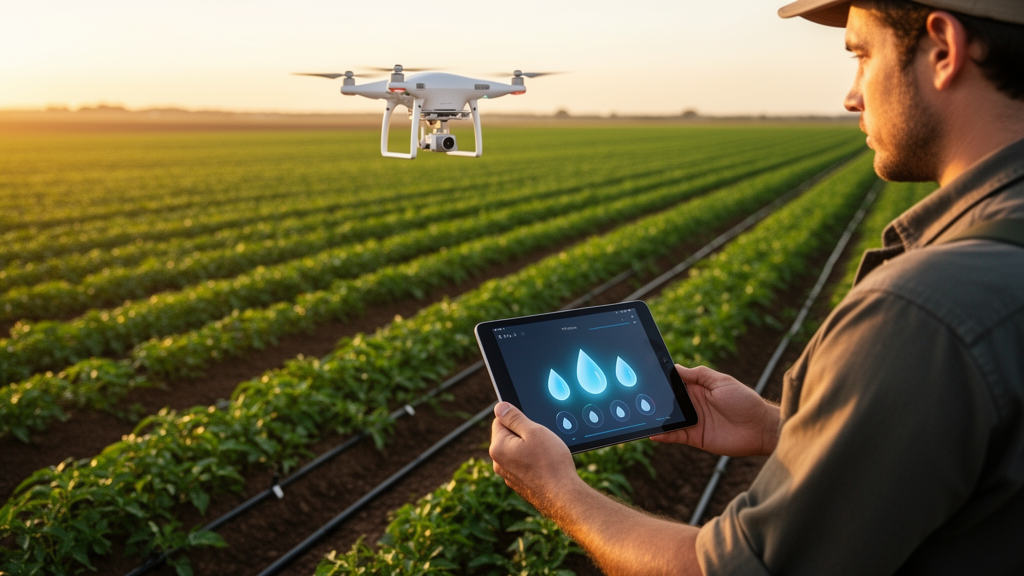
Only 0.01 percent of the water on Earth is fresh and available for human consumption, and agriculture consumes the lion’s share of it. Against that backdrop, a team of computer scientists in West Bengal, India, has built and field-tested an irrigation decision system that pairs ultra-low-power soil sensors with cloud-based ensemble machine learning, achieving at least 99 percent prediction accuracy across its own dataset and publicly available benchmarks. The system, described in a new paper in Frontiers in the Internet of Things, is called ECIID, short for Edge-Cloud-based Intelligent Irrigation Decision System, and it tackles three chronic weaknesses of smart irrigation at once: privacy, energy, and cost.
The framework rests on a three-tier architecture that moves data from the field to the farmer’s phone. At the bottom sits an ultra-low-power sensor node built around the MSP430G2553, a 16-bit microcontroller chosen specifically for its frugal energy appetite. The node carries a DS18B20 soil temperature sensor and a capacitive soil moisture sensor, both connected over the I2C protocol and inserted 10 centimeters into the soil. A Li-Ion battery powers the node, recharged by a solar panel through a TP4056 charger, which makes the data collection process self-sustaining in the field. An M95 GSM modem links the node to the internet, and readings are stored in the microcontroller’s EPROM before being transmitted to the next tier every 30 minutes over Wi-Fi.
The middle tier is where the system departs from conventional designs. Instead of shipping raw sensor data straight to a remote cloud, a Raspberry Pi edge device with 16 GB of RAM performs the first round of processing locally. A Python script converts the raw microcontroller data into a csv file stamped with date and time, replaces missing values with the mean of the respective attribute, removes outliers, and generates a cleaned dataset. Then comes the privacy step: before anything leaves the farm, the edge device adds Gaussian noise to the pre-processed data, a technique known as Gaussian differential privacy, or GDP. The noisy csv file, along with metadata about the soil type, whether sandy, loamy, or clayey, is uploaded to the cloud just once per day.
Gaussian differential privacy is the system’s answer to a growing anxiety in agricultural data science. Sending raw field data to a third-party cloud server exposes farmers to potential surveillance and misuse, but full encryption adds computational overhead that small edge devices can ill afford. GDP offers a lightweight middle path: by injecting calibrated Gaussian noise scaled to the sensitivity of the data, it mathematically limits what any observer can infer about individual records while preserving the overall statistical pattern of the dataset. The researchers added noise within a scale of (0, 1) and found that the correlation between soil moisture and soil temperature remained essentially unchanged, closely matching the correlation computed on the original, un-noised data. The trade-off is real but modest: accuracy on the GDP-protected dataset dropped only slightly, from 99.5 percent on raw data to 99 percent, and latency rose by fractions of a second.
Once the privacy-protected data reaches the cloud, hosted on Google Cloud Platform and connected through a NodeJS client using the Message Queuing Telemetry Transport protocol, the analytical heavy lifting begins. The team chose ensemble learning over single-classifier machine learning, exploiting all three of its major flavors. Bagging trains models independently on random subsets of the data and combines their outputs by voting or averaging, implemented here with random forest. Boosting trains weak learners sequentially, each correcting the errors of its predecessor, implemented with extreme gradient boosting, or XGBoost. Stacking trains different model types and feeds their predictions into a meta model, in this case logistic regression, which learns the optimal combination of the base models’ outputs.
The experimental results are striking. Using a dataset of 10,000 samples split 80-20 into training and test sets, and validated with 5-fold cross-validation, all three ensemble models achieved 99 percent accuracy, precision, recall, and F1-score. Boosting with XGBoost matched the latency and energy consumption of single classifiers like KNN and decision tree, at 0.45 seconds and 315 joules, while bagging with random forest came in at 1.77 seconds and 1,250 joules. Stacking was the most expensive of the three at 9.21 seconds and 6,450 joules. The deep learning baselines, LSTM and GRU networks, matched the 99 percent accuracy but at a punishing cost: 12.38 seconds and 8,700 joules for LSTM, and 10.33 seconds and 7,240 joules for GRU. In other words, the ensemble approach delivered deep-learning-level accuracy with a fraction of the computational burden, a decisive advantage for deployment in resource-constrained rural settings.
The system also anticipates failure. Sensors in agricultural fields break, get damaged by weather, or simply are not installed in the first place, and in developing regions buying multiple sensor types may not be economically feasible for farmers. To cope, the researchers built regression models that predict soil temperature from soil moisture data and vice versa, so that irrigation decisions can proceed even when only one sensor is working. Again the ensemble methods outperformed the KNN and decision tree baselines: for soil temperature prediction, stacking achieved the lowest mean absolute error at 0.81 and the best coefficient of determination at 0.48, while for soil moisture prediction stacking again led with an MAE of 7.91 and an R-squared of 0.45. Interestingly, soil temperature could be predicted more accurately from moisture data than the reverse.
Robustness was tested beyond the team’s own fields. The framework was evaluated on two publicly available datasets, one with 3,000 samples covering soil moisture, air temperature, and air humidity labeled with motor on/off decisions, and another with 200 samples covering crop type, moisture, and temperature labeled with pump on/off decisions. After applying the same Gaussian noise, the ensemble models again reached 99 to 99.5 percent accuracy, with XGBoost once more combining top-tier accuracy with the lowest latency and energy consumption, 0.16 seconds and 192 joules on the larger dataset. Compared against published irrigation systems, which reported accuracies ranging from 87.5 percent for SVM-based approaches to 99.96 percent for a standalone XGBoost model, ECIID’s 99 percent figure stands out for being achieved while simultaneously incorporating edge processing, latency measurement, soil temperature prediction, and privacy protection, features the authors’ comparison table shows no prior system combined.
The researchers also subjected their framework to A/B testing, reporting Z-scores above 2.58 and P-values of 0 for all three ensemble models on their dataset, which they interpret as evidence of statistical robustness and high confidence. Data collection ran for 90 days across three regions with different soil types, and the labeling rules were soil-specific: for loamy soil, irrigation is triggered when temperature falls to a threshold and moisture reaches 40 percent; for sandy soil, which drains faster, the moisture threshold is 50 percent; for clayey soil, which retains water, the trigger is above a temperature threshold with 40 percent moisture. These rules reflect the agronomic reality that different seasons and soil textures demand different moisture levels for optimal crop growth.
The final piece is practical: an Android app that lets farmers log in, view real-time soil temperature and moisture data, check the irrigation decision, and download collected and predicted data as a csv file, all from anywhere. Because GDP is applied before transmission, the app shows data that preserves the pattern of the original dataset but not the exact values, a limitation the authors acknowledge openly. Looking ahead, the team plans to address scenarios where both sensors fail simultaneously or extreme weather disrupts monitoring, and to develop a split learning-based irrigation model for precision agriculture. For now, ECIID offers a template for how edge computing, differential privacy, and ensemble learning can converge to make every drop of irrigation water count, and to count it without giving away the farm’s data.
Subject of Research: IoT and edge computing-based soil moisture monitoring with ensemble learning for sustainable irrigation decision making
Article Title: Ensemble learning-based soil moisture monitoring and sustainable irrigation management for Internet of Agricultural Things
Article References: Bera, S., Dey, T., Sengupta, A., Mukherjee, A., & De, D. (2026). Ensemble learning-based soil moisture monitoring and sustainable irrigation management for Internet of Agricultural Things. Frontiers in The Internet of Things, 5, Article 1870523. https://doi.org/10.3389/friot.2026.1870523
Image Credits: AI Generated
DOI: 10.3389/friot.2026.1870523
Keywords: smart irrigation, soil moisture, ensemble learning, Internet of Things, edge computing, Gaussian differential privacy, XGBoost, random forest, precision agriculture, machine learning, data privacy, sustainable farming
Cite Scienmag News
Alan Morgan. (October 16, 2026). Smart Farming Breakthrough: Ensemble AI Delivers 99% Accurate, Privacy-Safe Irrigation Decisions. Scienmag. https://scienmag.com/smart-farming-breakthrough-ensemble-ai-delivers-99-accurate-privacy-safe-irrigation-decisions/
Alan Morgan. "Smart Farming Breakthrough: Ensemble AI Delivers 99% Accurate, Privacy-Safe Irrigation Decisions." Scienmag, 16 October 2026, https://scienmag.com/smart-farming-breakthrough-ensemble-ai-delivers-99-accurate-privacy-safe-irrigation-decisions/. Accessed 16 October 2026.
Alan Morgan. "Smart Farming Breakthrough: Ensemble AI Delivers 99% Accurate, Privacy-Safe Irrigation Decisions." Scienmag. October 16, 2026. https://scienmag.com/smart-farming-breakthrough-ensemble-ai-delivers-99-accurate-privacy-safe-irrigation-decisions/


