


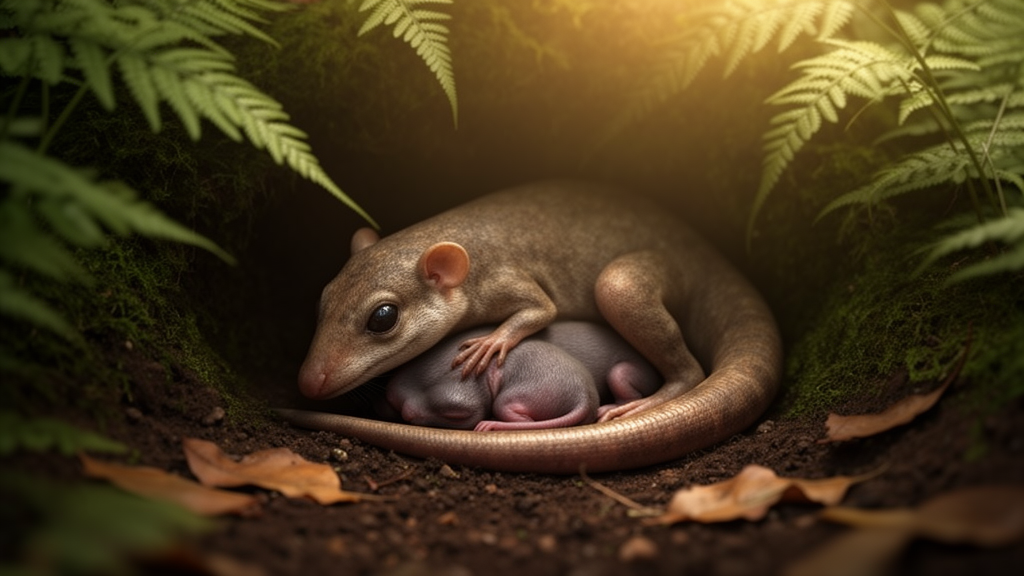
For more than a century, textbooks have told a tidy story about how live birth came to define the mammals. Egg laying was the ancestral vertebrate condition, monotremes such as the platypus kept it, and viviparity — the completion of embryonic development inside the female body — arose once, at the base of Theria, the clade uniting marsupials and placental mammals. A new palaeohistological study now upends that narrative. By identifying a birth-related growth line in the bones of a Late Triassic cynodont from Argentina, researchers argue that viviparity was already established among non-mammalian synapsids roughly 236 million years ago, pushing back its recognition in the mammalian lineage by approximately 90 to 95 million years.
The study, published in Frontiers in Mammal Science, centers on Chiniquodon theotonicus, an early probainognathian cynodont recovered from the Chañares Formation in north-western Argentina. Specimen CRILAR-PV109, a partially articulated adult skeleton with a basal skull length of 160 millimeters, was buried in tuffaceous siltstones deposited on a low-energy littoral mudflat during the Carnian stage of the early Late Triassic. More than 50 specimens of the species are known from the unit, spanning skull lengths from about 50 to 160 millimeters, which allowed the team to place the studied individual confidently at the large end of the adult size range. Strong cranial sutures, fully erupted teeth, and a completely ossified postcranial skeleton, including carpal and tarsal bones, supported this interpretation.
The decisive evidence came from thin sections of the right ulna and left femur, prepared at the Museo Carlos Ameghino in Cipolletti and examined under a polarizing petrographic microscope. Both cortices are composed almost entirely of densely vascularized fibrolamellar bone, a composite primary tissue in which a woven fibered periosteal matrix is lined by lamellar bone of intracortical origin around vascular spaces. Vascularization is dominated by radially oriented canals, with longitudinal and circumferential canals present at lower density. Crucially, the medullary cavities are of exceptionally small diameter and secondary remodeling is minimal, so the innermost embryonic bone tissue was preserved rather than reabsorbed — a rarity, since medullary expansion usually destroys perinatal bone shortly after birth.
Within that preserved innermost cortex, the researchers found an abrupt change in histological pattern. The perimedullary region contains fewer vascular canals, mostly longitudinally oriented, with noticeably reduced internal diameters, and its fibrolamellar matrix shows a higher proportion of concentrically arranged fibers, a modification most pronounced in the ulna. This non-cyclical growth mark coincides in timing and characteristics with a neonatal line, the structure that records the moment of birth in extant amniotes. In living placentals, the neonatal line reflects an abrupt acceleration in bone deposition rate, with shifts in fibrillar organization and in the arrangement and size of vascular canals, tied to the new biomechanical demands of weight-bearing and locomotion immediately after birth. Histologically, a neonatal line cannot be distinguished from a hatching line, so the reproductive mode must be inferred from body-mass comparisons.
That inference relied on regression equations originally proposed for extant carnivorans, felids, and canids, linking femoral circumference at midshaft to body mass. Measuring the neonatal line at 17.3 millimeters and the external bone surface at 35.81 millimeters, the team estimated an average body mass of 11.99 kilograms at death and 1.68 kilograms at birth, meaning the newborn represented 14.04 percent of the maximum weight reached. A skull-length-based equation for carnivorans produced congruent results, predicting a neonatal skull length between 40 and 50 millimeters — remarkably similar to the smallest Chiniquodon theotonicus skulls known, specimens MCZ 4296 and PVL 4675, which the authors now propose represent perinates based on tooth number, skull proportions, and bone morphology.
To test whether Chiniquodon theotonicus reproduced more like placental mammals than like any other amniote, the researchers compiled neonate, hatchling, and adult body masses for 1869 mammals, 2619 non-avian reptiles, and 782 birds. The neonate-to-adult body-mass proportion estimated for Chiniquodon, between 10 and 20 percent, falls squarely within the range of placentals across a broad phylogenetic spectrum. Monotremes and marsupials, by contrast, are extraordinarily small at birth, most below 0.15 percent of adult mass. Lepidosaurs and crocodiles above 10 kilograms produce hatchlings no heavier than 0.62 percent of the female’s weight, and large birds between 0.002 and 0.024 percent, while similarly sized placentals can give birth to young representing more than 22 percent of adult mass. A discriminant analysis and a K-nearest neighbors test, using log-transformed neonate and adult masses, grouped Chiniquodon with placentals with high probability in every case.
The team extended the same comparative framework to other extinct synapsids whose reproductive strategies have been debated. The perinate-to-adult ratio in the Early Permian Ophiacodon retroversus, between 2.62 and 7.76 percent depending on the equation, resembles some placentals, reptiles, and birds but far exceeds marsupials and monotremes of equivalent adult weight, although its hatchling mass is more comparable to non-avian reptiles, and statistical classification remained ambiguous. The dicynodont Lystrosaurus, known from an embryo found in an in ovo position — the strongest direct evidence of oviparity in early synapsids — plots at the intersection of reptile, bird, and placental fields, with a perinate-to-adult ratio between 0.2 and 1.3 percent. The authors suggest Lystrosaurus may have employed extended embryo retention, retaining the egg inside the mother, which could explain its relatively large hatchling size. The tritylodontid Kayentatherium wellesi, with a perinate-to-adult ratio of just 0.01 percent, was invariably classified as a non-avian reptile, though its minimum litter mass of 178.6 grams far exceeds what a marsupial-like strategy would predict for an animal of its size, leaving its reproductive mode undetermined.
If Chiniquodon theotonicus was indeed viviparous, the evolutionary history of live birth among synapsids demands revisiting. Mapping viviparity and oviparity onto a phylogenetic reconstruction yields two equally parsimonious scenarios. Under the traditional view, oviparity is ancestral for crown Mammalia, and viviparity in Chiniquodon represents an independent, non-homologous acquisition — yet another case among the more than 150 independent origins of viviparity documented across vertebrates — with genomic imprinting evolving separately at least twice. Under the alternative, viviparity was achieved once, early in the mammalian lineage among Triassic probainognathians, making it plesiomorphic for crown Mammalia and requiring a reversion to egg laying in monotremes. The genetic substrate for viviparity — retrotransposition and gene duplication — is best interpreted as having occurred once among synapsids, while the epigenetic mechanism of parent-of-origin gene expression, present in therians with six imprinted genes in marsupial placentas and 55 in placentals, evolved in a stepwise manner.
The finding ties in with recent work showing that other hallmark mammalian features — a motile rhinarium, maxillary vibrissae, an enlarged cerebellum, body hair, and lactation — originated at the root of Probainognathia. Viviparity now joins that list, suggesting that the suite of traits underpinning therian evolutionary success was assembled long before the first true mammals appeared. The authors caution that the evolutionary scenario for Ophiacodon, Lystrosaurus, and Kayentatherium remains highly speculative, and that the scarcely known postcranial skeleton of Chiniquodon precludes analysis of its pelvic anatomy, which could offer further comparisons with placentals that birth relatively large young. Still, the evidence from bone histology is unambiguous in its implication: the capacity to complete development inside the female body was not exclusive to therians among synapsids, and the roots of mammalian live birth reach back into the Triassic, tens of millions of years deeper than anyone had recognized.
Subject of Research: Paleontology
Article Title: Early origin of viviparity in the mammalian lineage
Article References: Gaetano, L. C., Miceli Baro, M. D. L. Á., Cerda, I. A., & Mancuso, A. C. (2026). Early origin of viviparity in the mammalian lineage. Frontiers in Mammal Science, 5, Article 1845319. https://doi.org/10.3389/fmamm.2026.1845319
Image Credits: AI Generated
DOI: 10.3389/fmamm.2026.1845319
Keywords: paleontology, evolution, Triassic, cynodonts, viviparity, Early, origin, mammalian, lineage, scientific research
Cite Scienmag News
Gavin Prescott. (October 16, 2026). Live Birth Pushed Back 90 Million Years in Mammal Ancestors. Scienmag. https://scienmag.com/live-birth-pushed-back-90-million-years-in-mammal-ancestors/
Gavin Prescott. "Live Birth Pushed Back 90 Million Years in Mammal Ancestors." Scienmag, 16 October 2026, https://scienmag.com/live-birth-pushed-back-90-million-years-in-mammal-ancestors/. Accessed 16 October 2026.
Gavin Prescott. "Live Birth Pushed Back 90 Million Years in Mammal Ancestors." Scienmag. October 16, 2026. https://scienmag.com/live-birth-pushed-back-90-million-years-in-mammal-ancestors/


