


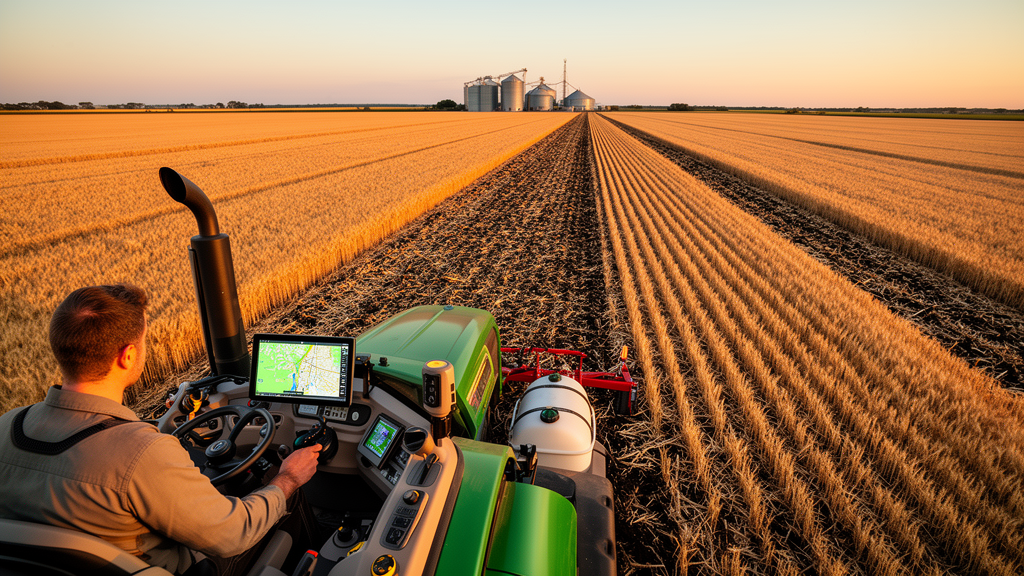
On rainfed farms in southern Spain, a quiet revolution is being measured one tractor pass at a time. A four-season field study led by researchers at the Universidad de Córdoba, together with colleagues at the Universidade de Évora in Portugal, has quantified exactly how much energy and carbon can be saved when two of modern agriculture’s most promising ideas—Conservation Agriculture and Precision Agriculture—are deployed on the same fields. The verdict, published in Frontiers in Agronomy, is striking: pairing no-tillage with GPS-based tractor guidance cut fuel consumption by around 50% and reduced greenhouse gas emissions by 12 to 26% across three annual crops, all without any significant loss of yield.
The stakes are far from trivial. Andalusia accounts for 21% of Spain’s agricultural area, and agriculture there is responsible for 7,005.07 Gg of CO2 equivalent—29.2% of the region’s diffuse-sector emissions, which include transport, agriculture and waste. Those emissions arise mainly from nitrogen fertilisers and fossil fuels, and conventional tillage, the ploughing-based system still common across the Andalusian countryside, burns more diesel than any system that minimises soil disturbance. Conventional ploughing also oxidises soil organic carbon, eroding natural fertility and fertiliser-use efficiency over time.
Conservation Agriculture rests on three interlinked principles: minimal soil disturbance, permanent soil cover with crop residues, and diversified crop rotations. Precision Agriculture, by contrast, envisages a more rational use of inputs by eliminating the overlaps between machine passes—areas where a sprayer or spreader covers ground already treated on the previous pass. The research team hypothesised that combining the two, specifically no-tillage with residue retention plus GPS guidance assistance, would outperform conventional tillage on both energy and carbon metrics. To test this, they monitored 90 hectares across three commercial farms in Córdoba, Carmona and Las Cabezas de San Juan from the 2009/10 to the 2012/13 growing seasons, following the classic Andalusian rotation of cereal, sunflower and legumes.
The instrumentation was meticulous. Three tractors—a John Deere 6420, a Fendt Vario 712 and a New Holland TM 120—were fitted with potentiometers to detect the rear-hitch position, GPS receivers to calculate task duration, worked area and overlap, and flow meters to measure instantaneous fuel consumption. A data logger recorded UTM position, heading, speed, fuel use and hydraulic-lift position every two seconds, transmitting data daily via GPRS to a remote computer. The tractors used for guidance treatments were equipped with a Trimble AgGPS EZ-Guide 500 for spraying and fertiliser application and an EZ-Steer assisted steering system for sowing. Yields were sampled in ten homogeneous 0.5-hectare grids per plot using a one-square-metre frame, giving a robust picture of production under each system.
The energy analysis followed the framework proposed by the International Federation of Institutes for Advanced Study, distinguishing direct-use energy—fuel burned in the field, converted at 36.8 MJ per litre—from indirect-use energy embedded in machinery manufacture and maintenance, seeds, fertilisers and plant protection products, calculated on a cradle-to-gate basis. Two headline indicators emerged: energy efficiency, the ratio of energy contained in the harvested grain to the energy required to produce it, and energy productivity, the kilograms of food produced per megajoule of energy supplied. Carbon emissions were derived from fuel consumption using a diesel conversion factor of 0.074 kg CO2 equivalent per MJ, with emission factors for production inputs drawn from the Spanish industrial energy mix of 2009 to 2012.
The fuel data told the clearest story. Primary tillage was the most fuel-intensive operation, with the mouldboard plough consuming 22.5 litres per hectare and the chisel 14.1 litres per hectare. Under conventional tillage, the disc harrow recorded the highest overlap at 35.1%, and a total of 136 tillage-related passes—mouldboard plough, chisel, disk harrow, semi-chisel, scarifier, cultivator, baler and roller—were conducted that no-tillage systems simply eliminate. The only notable increase under no-tillage was in sprayer passes, 29 more than under conventional tillage, because weed control shifts from mechanical cultivation to herbicides. Even so, the arithmetic was decisive: average fuel consumption fell by 53% overall, with reductions of 55.7% for legumes, 52.9% for sunflower and 51.6% for wheat, all statistically significant.
Energy consumption followed the same pattern. Wheat was the most energy-demanding crop, consuming 17.54 GJ per hectare under the combined system and 19.92 GJ per hectare under conventional tillage, largely because of its high nitrogen fertiliser requirements. Sunflower required the least energy, at 2.75 GJ per hectare under the combined system versus 3.73 GJ per hectare under conventional tillage. For wheat, the elimination of tillage accounted for 35.8% of the absolute energy saving, while the remaining 64.2% came mainly from fertiliser savings enabled by reduced overlap under guidance assistance. For sunflower and legumes, where fertiliser use was minimal, more than 90% of the saving came from suppressing tillage. The one production factor where the combined system consumed more energy was plant protection products, averaging 45% higher than conventional tillage, driven by herbicide use—though the researchers note that reduced runoff and erosion under no-tillage limits non-point pollution, and continuous no-till increases soil organic matter, enhancing herbicide degradation in soil.
Crucially, none of these savings came at the cost of production. Yields did not differ significantly between systems: wheat averaged 2.39 Mg per hectare under the combined system versus 2.24 Mg per hectare under conventional tillage, sunflower 1.08 versus 1.10, and legumes 1.06 versus 1.08. Energy efficiency and energy productivity improved under the combined system for all crops, with sunflower showing the only statistically significant gains—a 33.5% increase in energy efficiency and 34.5% in energy productivity. Sunflower was the most efficient crop overall, with efficiency and productivity values roughly twice those of legumes and three times those of wheat, despite producing less total energy than the cereal.
The carbon balance mirrored the energy results. Greenhouse gas emissions fell by 26.4% for sunflower, 18.4% for legumes and 12.0% for wheat under the combined system, all statistically significant. Carbon use efficiency and carbon use productivity—kilograms of carbon harvested per kilogram of carbon emitted, and kilograms of food produced per kilogram of CO2 equivalent emitted—were 15 to 35% higher under the combined system. The study deliberately excluded soil carbon sequestration and soil respiration, focusing solely on emissions from field operations and production inputs; the authors note that when sequestration is considered, the carbon balance becomes even more favourable to Conservation Agriculture, since minimally disturbed soils with retained residues accumulate organic carbon while conventional tillage accelerates its oxidative breakdown.
The implications reach well beyond Andalusia. Under the European Climate Law, the EU mandates a net greenhouse gas reduction of at least 55% by 2030 relative to 1990 levels and climate neutrality by 2050, and agriculture is under growing pressure to contribute. The researchers argue that their simple, replicable methodological approach—built on real, remotely monitored field data—can help farmers and trainers identify where energy is best invested in relation to production, crop by crop and system by system. In a Mediterranean region where climate change is expected to hit particularly hard, the message is clear: the plough is no longer the default. A tractor that never tills and never strays from its GPS line can grow the same food with half the fuel and a markedly lighter carbon footprint.
Subject of Research: Agricultural Science
Article Title: Improving energy efficiency and carbon balance through conservation and precision agriculture with respect to conventional agriculture: a methodological approach
Article References: Márquez-García, F., Repullo-Ruibérriz de Torres, M. Á., Basch, G., & González-Sánchez, E. J. (2026). Improving energy efficiency and carbon balance through conservation and precision agriculture with respect to conventional agriculture: a methodological approach. Frontiers in Agronomy, 8, Article 1916869. https://doi.org/10.3389/fagro.2026.1916869
Image Credits: AI Generated
DOI: 10.3389/fagro.2026.1916869
Keywords: Conservation Agriculture, Precision Agriculture, No-Tillage, Carbon Balance, Energy Efficiency, GPS Guidance, Sustainable Farming, Climate-Smart Agronomy, Improving, energy, efficiency, carbon
Cite Scienmag News
Sloane Callahan. (October 16, 2026). Half the Fuel, Same Harvest: GPS-Guided No-Till Farming Slashes Energy Use and Carbon Emissions. Scienmag. https://scienmag.com/half-the-fuel-same-harvest-gps-guided-no-till-farming-slashes-energy-use-and-carbon-emissions/
Sloane Callahan. "Half the Fuel, Same Harvest: GPS-Guided No-Till Farming Slashes Energy Use and Carbon Emissions." Scienmag, 16 October 2026, https://scienmag.com/half-the-fuel-same-harvest-gps-guided-no-till-farming-slashes-energy-use-and-carbon-emissions/. Accessed 16 October 2026.
Sloane Callahan. "Half the Fuel, Same Harvest: GPS-Guided No-Till Farming Slashes Energy Use and Carbon Emissions." Scienmag. October 16, 2026. https://scienmag.com/half-the-fuel-same-harvest-gps-guided-no-till-farming-slashes-energy-use-and-carbon-emissions/


