


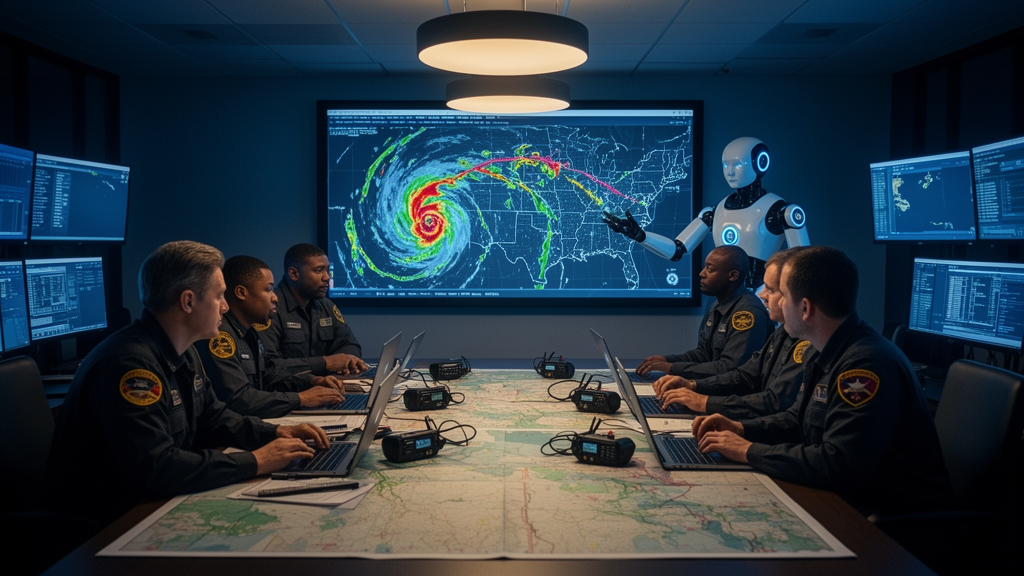
When Typhoon Doksuri swept north in July 2023 and unleashed historic rainfall over the Beijing-Tianjin-Hebei region, emergency commanders faced a brutal arithmetic: dozens of experts, four competing rescue strategies, and almost no time to reconcile them. A new study published in Frontiers in Big Data proposes a way to make that arithmetic tractable, by handing the delicate job of nudging experts toward agreement to a deep reinforcement learning agent. The method, developed by Hongyu Yu, Xuanhua Xu, and Weiwei Zhang of Hunan University of Technology and Business and Central South University, treats the messy, human process of consensus building as a sequential decision problem that a machine can learn to solve.
Large-scale group decision making, or LSGDM, is the formal discipline behind many high-stakes choices that involve twenty or more experts with different backgrounds, risk tolerances, and information. In emergencies, the stakes are extreme: hesitation or misjudgment can cost lives, yet forcing rapid agreement risks steamrolling minority opinions that may contain crucial insights. The traditional remedy is the consensus reaching process, an iterative loop in which experts whose views stray too far from the group are asked to adjust them until a preset consensus threshold is met. The trouble, the authors argue, is that the feedback parameters governing how strongly experts are pushed to compromise have historically been fixed by hand, based on experience. Too large a step and expert preferences get bulldozed; too small a step and the discussion drags on for rounds that an unfolding disaster cannot spare.
The core innovation is to model the entire consensus process as a Markov decision process and let a Deep Deterministic Policy Gradient, or DDPG, agent learn the feedback strategy. In this formulation, the state at each round captures the group’s evolving condition: the vector of opinion deviations between each expert cluster and the group center, the current group consensus level, the historical effect of previous feedback adjustments, and the trend in how quickly opinions are changing. Because these variables contain the essential statistics of the consensus environment, the next state depends only on the current state and the action taken, satisfying the Markov property that makes reinforcement learning well-posed. The action is deceptively simple: a single continuous value between zero and one, the feedback parameter that determines how far identified experts should move their opinions toward the group position.
What makes the problem genuinely hard is the reward. The authors designed a bi-objective, piecewise reward function that pays the agent for improving group consensus, penalizes it for each additional discussion round, and rewards it for preserving what they call the opinion retention degree, a measure of how much of each expert’s original judgment survives the adjustment. The result is an agent that learns to walk a narrow line: converge quickly, but not by erasing the diversity of expert judgment that makes large-group decisions robust in the first place. Sensitivity analysis over reward weight configurations confirmed the trade-off is real and tunable. A consensus-heavy weighting cut the rounds to agreement to 5.2 but dropped preference preservation to 0.6498, while a preference-oriented configuration raised preservation to 0.7235 at the cost of more rounds. The default weights of 0.5, 0.3, and 0.2 struck the best balance.
Before the learning agent ever sees a decision problem, the raw expert input must be made computable. Experts express preferences using hesitant fuzzy linguistic term sets, which allow a decision maker to offer several linguistic evaluations at once, for instance rating an alternative as both good and very good when uncertain. Conventional score functions for these sets can misjudge cases where a multi-element set and a single-element set yield identical scores. The team introduced a hesitation degree into the score function, quantifying how much uncertainty an expert’s linguistic expression carries, so that more hesitant judgments are weighted accordingly. In the case study, this refinement changed the final ranking of the middle alternatives, evidence that the hesitation information embedded in expert language genuinely matters to the outcome rather than being mathematical decoration.
Clustering twenty or more experts into manageable subgroups poses its own trap. Grouping by preference similarity alone ignores the trust relationships that determine who actually influences whom; grouping by trust alone can lump together mutually trusting experts who hold wildly divergent views. The method fuses both signals into a comprehensive relationship matrix, blending preference similarity and normalized trust values with a balance coefficient, then applies K-Means clustering with the number of clusters chosen by the silhouette coefficient. Sensitivity tests across coefficient values from 0.0 to 1.0 showed that equal weighting produced the best clustering, the fewest consensus rounds, and the highest final consensus level, while relying on either signal alone degraded performance significantly. Expert and cluster weights are then computed from network topology, in-degree and out-degree in the trust graph, and credibility, using a Hamacher t-norm to fuse scale and credibility weights.
The real-world test replayed the emergency decision scenario sparked by the 2023 rainstorm, in which 33 people died in Beijing and more than one million people across the region were evacuated. Twenty simulated experts evaluated four emergency alternatives, spanning headcounts and medical treatment, safe transfer of trapped residents, infrastructure repair, and water rescue with secondary disaster management, across four attributes including personnel search and rescue, resource allocation, public opinion management, and timeliness. The initial group consensus level came out at 0.8599, below the emergency threshold of 0.9. The DDPG agent then generated a sequence of feedback parameters, starting conservatively at 0.2195 and escalating round by round to 0.5946, reaching the threshold in six iterations with a final consensus level of 0.9043.
Notably, the attribute weights were not set by the experts themselves. The team crawled more than 50,000 Weibo posts about the rainstorm and applied the TF-IDF algorithm to extract keyword frequencies, matching terms like search and rescue, relief supplies, and rumor control to the decision attributes. Personnel search and rescue emerged as the heaviest weighted attribute at 0.3051, followed by public opinion management at 0.2542. This grounds the final ranking of alternatives in the aggregate concern of the affected public, an unusual touch of democratic signal in a mathematical procedure. The comprehensive scores ranked the fourth alternative, focused on water rescue and secondary disaster control, as optimal, and the refined score function preserved that top ranking while reshuffling the middle options compared with the original function.
Head-to-head comparisons against three benchmark paradigms, a fixed-parameter feedback method, a random small-step adjustment method without reinforcement learning, and a traditional linearly increasing consensus approach, showed the DDPG method reaching consensus in 6.2 rounds for 50 experts versus 8.4, 12.4, and 10.5 respectively, with the gap widening as groups grew to 200 experts. The random method did preserve slightly more of the experts’ original preferences, but needed roughly twice as many rounds, a cost the authors argue is unacceptable when disaster conditions are changing by the hour. Simulated experiments with 20 to 200 experts, and with uniform, normal, and multimodal preference distributions, all reached the 0.9 threshold within eight rounds, with preference preservation rates between 0.65 and 0.73, suggesting the approach generalizes beyond the showcase case.
The authors are candid about the model’s central assumption: that experts adjust their opinions gradually according to the feedback intensity the agent prescribes. Real experts accept, reject, negotiate, or partially adopt suggestions, and the team flags modeling those behaviors as the next frontier of human-machine collaborative decision making. Even so, the study marks a meaningful shift in how consensus might be engineered, from static rules tuned by intuition to a learned policy that reads the live state of a debating group and modulates its pressure in real time. If such agents mature, the quiet work of reconciling expert disagreement in the next flood, wildfire, or pandemic could begin not in a tense conference room, but inside a neural network that has already rehearsed thousands of arguments.
Subject of Research: Reinforcement learning-based adaptive feedback consensus for large-scale group emergency decision making
Article Title: Machine-assisted adaptive feedback consensus method for large-scale group decision making based on reinforcement learning
Article References: Yu, H., Xu, X., & Zhang, W. (2026). Machine-assisted adaptive feedback consensus method for large-scale group decision making based on reinforcement learning. Frontiers in Big Data, 9, Article 1921037. https://doi.org/10.3389/fdata.2026.1921037
Image Credits: AI Generated
DOI: 10.3389/fdata.2026.1921037
Keywords: reinforcement learning, DDPG, large-scale group decision making, consensus reaching, hesitant fuzzy linguistic term sets, emergency decision making, Markov decision process, social network analysis, K-Means clustering, TF-IDF, human-machine collaboration, disaster response
Cite Scienmag News
Denise Maddox. (October 16, 2026). AI Agent Learns to Steer Expert Consensus in Disaster Decisions. Scienmag. https://scienmag.com/ai-agent-learns-to-steer-expert-consensus-in-disaster-decisions/
Denise Maddox. "AI Agent Learns to Steer Expert Consensus in Disaster Decisions." Scienmag, 16 October 2026, https://scienmag.com/ai-agent-learns-to-steer-expert-consensus-in-disaster-decisions/. Accessed 16 October 2026.
Denise Maddox. "AI Agent Learns to Steer Expert Consensus in Disaster Decisions." Scienmag. October 16, 2026. https://scienmag.com/ai-agent-learns-to-steer-expert-consensus-in-disaster-decisions/


