


Every time a caterpillar chews through a leaf, the plant under attack does something remarkable: it starts releasing a chemical distress signal that drifts across the field. Predatory beetles, lacewings, and parasitic wasps can read these plumes like signposts, following them to find prey or hosts hidden in the foliage. This invisible conversation between plants, herbivores, and their enemies is the domain of chemical ecology, and over the past decade it has become increasingly woven into conservation biological control, a pest management strategy that enhances resident populations of natural enemies through habitat manipulation rather than releasing laboratory-reared insects. A new review published in Frontiers in Ecology and Evolution by Stefano Colazza of the University of Palermo takes stock of this rapidly evolving field and delivers a sobering message: the science of chemical communication has matured enormously, but translating laboratory discoveries into reliable, field-scale pest control remains the discipline’s greatest challenge.
Conservation biological control, or CBC, differs fundamentally from other biological control approaches. Rather than importing exotic natural enemies or repeatedly augmenting crops with mass-reared insects, CBC seeks to strengthen the communities of predators and parasitoids already present in and around agricultural landscapes. Farmers practicing CBC might plant flower strips, diversify their crops, reduce tillage intensity, or maintain semi-natural habitats at field margins. The goal is to provide the resources and refuges that allow beneficial arthropods to survive, reproduce, and attack pests more effectively. Since the foundational framework of habitat management was formulated decades ago, the field has increasingly recognized CBC not merely as a farm-scale tactic but as a landscape-dependent ecological process in which resource continuity, habitat configuration, and farming intensity jointly determine outcomes. Chemical ecology enters this picture because nearly every interaction among plants, herbivores, predators, parasitoids, and even higher trophic levels such as hyperparasitoids is mediated by semiochemicals, the chemical cues that convey information between living organisms.
The mechanistic basis of CBC through chemical ecology is remarkably rich. When herbivores feed or oviposit on plants, the plants respond by emitting herbivore-induced plant volatiles, or HIPVs, which natural enemies exploit as long- to medium-range cues for locating prey or hosts. These volatile blends are chemically complex, comprising green leaf volatiles, terpenoids, and benzenoid or phenylpropanoid compounds, and they can encode information about herbivore identity, attack intensity, and the physiological state of the plant. Beyond attracting natural enemies, these same volatiles can prime the defenses of neighboring plants, creating a wider information network that extends well beyond a single plant-herbivore interaction. Belowground, herbivore-damaged roots release volatiles that recruit entomopathogenic nematodes, as famously demonstrated for the compound (E)-beta-caryophyllene in maize. Natural enemies also exploit herbivore-derived cues, including pheromones, frass, honeydew, exuviae, chemical footprints, and cuticular hydrocarbons, which become increasingly important as the search process narrows from habitat finding to host recognition and acceptance.
Adult natural enemies also depend on chemical information to locate nutritional resources. Predators and parasitoids require carbohydrate-rich foods such as floral nectar and honeydew to sustain flight, longevity, and reproduction, and recent research has revealed that flowering plants function not only as nutritional resources but also as olfactory resources in CBC. Floral volatiles can guide parasitoids to food, helping explain why certain flowering plants attract parasitoids into crop habitats and increase host-egg parasitism under field conditions. Yet even this seemingly straightforward relationship harbors hidden complexity. Nectar-inhabiting microorganisms can modify volatile blends and nectar nutrient composition, making floral resources attractive, neutral, or even repellent to specific parasitoid species. In one striking example, nectar sugar and amino acid composition combined with yeast identity altered volatile emissions in ways that made fermented nectar attractive, neutral, or repellent to the endophagous parasitoid Aphidius ervi. In another case, filamentous fungi changed nectar chemistry in ways that reduced the longevity of the egg parasitoid Trissolcus basalis while leaving another species, Ooencyrtus telenomicida, unaffected, demonstrating species-specific consequences that complicate any simple prescription for habitat management.
The central obstacle to deploying chemical ecology tools in CBC is not a shortage of behaviorally active cues but the difficulty of maintaining their reliability under real field conditions. Laboratory assays typically isolate one emitter and one receiver in a controlled airspace, whereas agroecosystems are variable in space and time. Synthetic odor sources generally release relatively constant blends, but plants and their surrounding habitats are highly dynamic, with volatile composition and emission rates changing markedly over the course of the day. Background odors from crops, weeds, flowering plants, and non-host vegetation can mask resource-indicating cues or, in some cases, improve contrast and facilitate orientation. The odors of Brassica rapa flowers, for instance, can reduce the attractiveness of herbivore-infested plants to parasitoids, and this disruption increased with floral odor concentration for at least one parasitoid species tested. Weather conditions add another layer of uncertainty: successful upwind host finding by parasitoids in one field study occurred only at wind speeds below three meters per second, and overall recapture patterns depended on interactions among humidity, wind speed, temperature, and barometric pressure changes.
Emerging evidence suggests that climate change and air pollution may disrupt chemical signaling even earlier in the process. Abiotic stress-induced plant volatiles may function as misleading cues, while atmospheric pollutants can degrade herbivore-induced volatiles at different rates and impair their perception by reducing olfactory receptor sensitivity or physically occluding insect sensilla. This means that semiochemical reliability depends not only on biological specificity but also on atmospheric chemistry and weather conditions that are simply not represented in laboratory bioassays. The gap between controlled experiments and field reality is further illustrated by large-scale studies of methyl salicylate, an herbivore-induced plant elicitor used to attract natural enemies. Across 50 field sites, methyl salicylate increased the abundance and diversity of several natural enemy taxa, but its effect varied with field management and surrounding landscape composition. Wetlands within 1,500 meters strengthened the attraction of dagger flies, yet the increased recruitment of natural enemies did not translate into higher predation rates.
A review of 111 field trials involving methyl salicylate and related semiochemical applications revealed a troubling pattern: most studies quantified natural enemy abundance near the semiochemical source, whereas direct measurements of herbivore population reduction or crop protection were uncommon. Moreover, surrounding landscape context was not reported in 59 percent of the trials, making it difficult to determine where recruited natural enemies originated. The authors caution that, in the absence of nearby source populations, semiochemicals may simply redistribute the limited number of natural enemies already present within a field rather than genuinely increasing biological control. This concern is echoed by an evidence map compiled from field studies published since 2011: of 33 studies included, nearly 70 percent assessed only natural enemy attraction or recruitment, about 21 percent evaluated realized biological control without measuring an agronomic endpoint, and fewer than 10 percent reported crop damage, yield, or another agronomic outcome. Attraction, in other words, is an intermediate behavioral response that by itself does not demonstrate effective crop protection.
Beyond the laboratory-to-field gap, chemical ecology in CBC faces significant multitrophic complications. Semiochemicals designed to recruit natural enemies circulate through food webs and may also be detected by herbivores, competitors, and hyperparasitoids. Herbivore-induced plant volatiles, often treated as indirect plant defenses, can inadvertently benefit fourth trophic level organisms. In a field study, hyperparasitoids exploited HIPVs to locate primary parasitoid hosts developing inside caterpillars, and the primary parasitoid species that most strongly altered the induced volatile blend experienced higher levels of hyperparasitism. Comparable information leakage occurs in aphid systems, where aphid parasitism alters induced plant responses and allows hyperparasitoids to locate concealed parasitoid hosts. Flower strips within multitrophic communities may not benefit natural enemies uniformly; one field study of wildflower plantings revealed increases in some natural enemy groups but also in some herbivores, without a corresponding increase in stink bug egg parasitism. A recent meta-analysis found that flower strips in crops clearly increased natural enemy abundance, whereas their effects on herbivore populations were more variable and showed no significant overall trend, highlighting the risk of attraction-reward mismatch and potential ecological traps.
The path forward, according to the review, requires moving beyond chemical cue discovery and laboratory demonstrations of attraction. Future research should assess semiochemical reliability across sites and seasons using multifactorial experiments that vary crop genotype, herbivore community, natural enemy guild, and environmental context. Rather than searching for a universal attractant, the next phase of CBC research should focus on designing agroecosystem-specific chemical information environments that integrate attract functions with appropriate habitat and food resources. Important research frontiers include selecting crop genotypes with effective indirect-defense traits, exploring genetic engineering to enhance targeted recruitment of natural enemies, and paying greater attention to nectar-inhabiting microorganisms as hidden drivers of CBC. Ultimately, chemical ecology will contribute most effectively to conservation biological control when embedded within the broader design of integrated pest management systems, creating agroecosystems in which chemical information remains reliable, recruitment is matched by accessible and nutritionally suitable rewards, and biodiversity-based herbivore control becomes more effective, resilient, and cost-effective than the synthetic pesticide paradigm it seeks to replace.
Subject of Research: Chemical ecology and semiochemical-mediated interactions in conservation biological control of agricultural pests
Article Title: Chemical ecology in conservation biological control: status and emerging challenges
Article References: Chemical ecology in conservation biological control: status and emerging challenges. (n.d.). https://doi.org/10.3389/fevo.2026.1966653
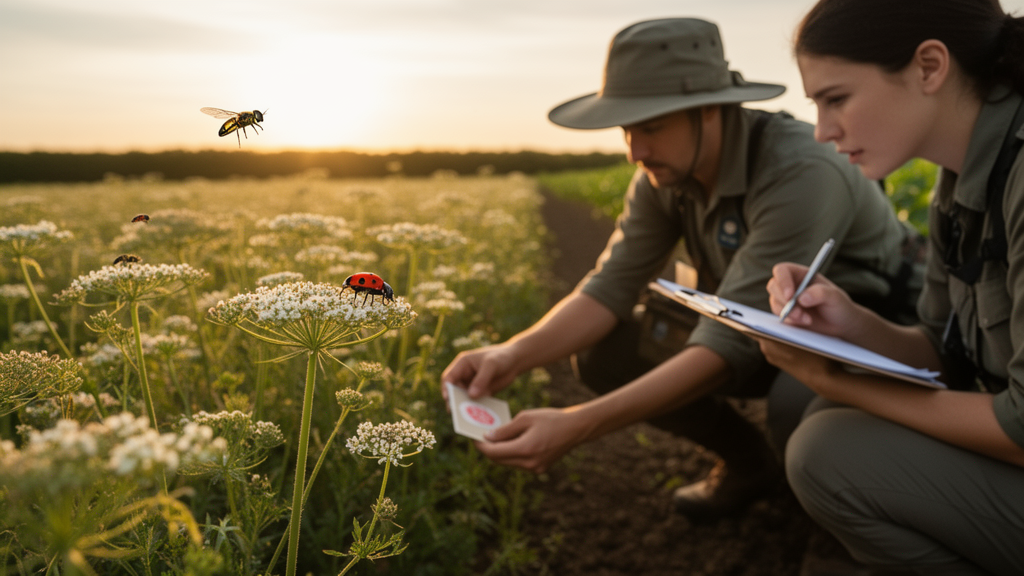
Image Credits: AI Generated
DOI: 10.3389/fevo.2026.1966653
Keywords: chemical ecology, conservation biological control, semiochemicals, herbivore-induced plant volatiles, natural enemies, parasitoids, hyperparasitoids, habitat management, integrated pest management, floral resources, multitrophic interactions, agroecosystems
Cite Scienmag News
Gavin Prescott. (October 16, 2026). Chemical Ecology Faces a Field Reality Check in Conservation Biological Control. Scienmag. https://scienmag.com/chemical-ecology-faces-a-field-reality-check-in-conservation-biological-control/
Gavin Prescott. "Chemical Ecology Faces a Field Reality Check in Conservation Biological Control." Scienmag, 16 October 2026, https://scienmag.com/chemical-ecology-faces-a-field-reality-check-in-conservation-biological-control/. Accessed 16 October 2026.
Gavin Prescott. "Chemical Ecology Faces a Field Reality Check in Conservation Biological Control." Scienmag. October 16, 2026. https://scienmag.com/chemical-ecology-faces-a-field-reality-check-in-conservation-biological-control/


