


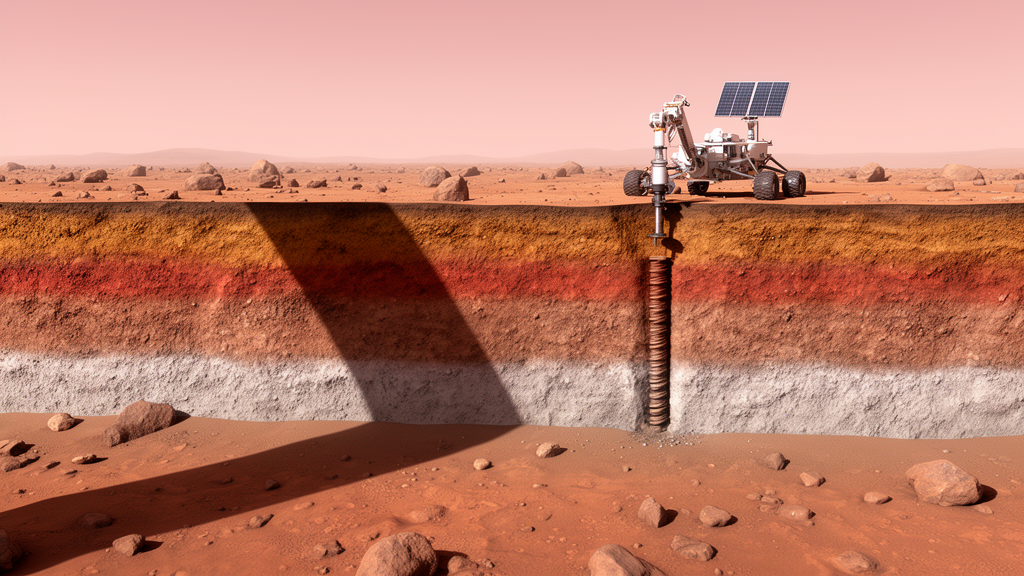
A PhD candidate at the University of Sydney has produced the first comprehensive classification system and global map of Martian soils, a development that could shape how scientists choose landing sites, plan habitats and eventually grow food on the Red Planet. Daniel Irving, who works at the Sydney Institute of Agriculture within the Faculty of Science, led the research, which has been published in the peer-reviewed soil science journal Catena. The study introduces a brand-new vocabulary for the loose surface material that covers most of Mars: instead of calling it simply Martian regolith or dirt, the researchers propose the term areths, derived from Ares, the ancient Greek name for Mars. With this single act of naming, a field that has long belonged to geologists and planetary scientists acquires something it has never really had before, a soil science of its own, complete with taxonomy, hierarchy and a map that covers almost the entire planet.
The scale of the achievement is considerable. Using orbital observations and quantitative models, Irving and his colleagues classified nearly 800 million individual locations across Mars into a hierarchy of 2000 distinct soil classes, then rendered that classification as a global map covering 92 percent of the Martian surface. This is the first time a classification system of this scale has been developed for Martian soils, and it fills a conspicuous gap in planetary science. Researchers have previously mapped the geology, mineralogy and surface chemistry of Mars in impressive detail, but those maps each describe a separate property of the landscape. What has been missing is a single integrated framework that brings multiple properties together, allowing scientists to understand how different Martian soils relate to one another and where each type actually occurs. That is precisely what the new system delivers.
The framework is formally known as the Provisional Polythetic Areth Classification System, or PPACS, and its architecture will be familiar to anyone who has studied soil taxonomy on Earth. Martian soils are grouped into 10 major realms, which are subdivided into 100 assemblages, which in turn split into 2000 detailed forms. The assignment of any given location to a class rests on measurable soil properties, including particle texture, mineralogy, pH and profile thickness. The word polythetic in the system’s name signals that membership in a class is determined by a combination of properties rather than a single diagnostic criterion, an approach borrowed from Earth-based soil classification that makes the system more robust when individual measurements are uncertain. Because the classification is provisional by design, it can be revised as new data arrive from orbiters, rovers and eventual sample returns, which the researchers regard as an essential feature rather than a weakness.
Why does a planet with no agriculture need a soil map? Professor Alex McBratney, Irving’s supervisor and a leading figure in soil science, offers a practical answer: a future greenhouse on Mars would need more than air, water and light. Its builders would also need to know what lies beneath in order to identify better starting points for growing plants. The prospect of cultivating crops on Mars has captured the public imagination for decades, most famously in the film The Martian, in which astronaut Mark Watney, played by Matt Damon, survives on the planet by growing potatoes in Martian soil treated with improvised fertiliser. While a real Martian greenhouse remains firmly in the future, the new research supplies a scientific starting point for working out which of the planet’s thousands of soil types might be best suited to supporting plant growth under controlled conditions, long before anyone loads a seed packet onto an interplanetary spacecraft.
As a proof of concept, the researchers assessed all 2000 soil classes for characteristics that matter to plant production, including water-holding capacity, pH, profile thickness, clay content and gravel content. Each class received a score on a zero-to-one grading scale, and a clear winner emerged: a soil class known as Nohibareth, which achieved a score of 0.93, the highest of any form in the system. The modelled average profile of Nohibareth soil is remarkably benign by Martian standards. It carries a pH of 6.8, which is close to neutral and near ideal for many crops, contains 72 percent clay, has minimal sand or gravel, and offers an estimated water-holding capacity of 202 millimetres per metre. In other words, if any soil on Mars could hold onto moisture the way a good agricultural soil on Earth does, Nohibareth is the leading candidate.
The global map gives that statistical result a geographic dimension. Nohibareth soils are concentrated in the mid-latitudes of Mars, with notable occurrences around the volcanic province of Tharsis, in central Arabia Terra and across Elysium Planitia, the latter a region already familiar to mission planners because of its relatively flat, safe terrain. Even so, these soils are rare by planetary standards, covering just 0.14 percent of the Martian surface, an area that is small on a global scale but still vast in absolute terms. The researchers are careful to stress what these locations are and are not: they are candidates for closer investigation, not selected greenhouse sites. The assessment also showed which properties constrain the rest of the planet. Among the properties evaluated, water-holding capacity was the limiting factor in 73 percent of the soil forms studied, and classes in the Fareth to Mareth realms all scored below 0.3 in this initial test, reflecting unfavourable combinations of the characteristics considered.
Nobody involved in the research suggests that crops could simply be planted in Martian soil and left to grow. Future habitats would still require fully controlled environments, along with water supplies, added nutrients and treatment of potentially harmful substances before any growing medium could be considered safe. The map is a screening tool, a way of narrowing an entire planet down to a handful of promising regions and soil types worth studying in depth. That kind of triage matters enormously for mission planning, because every kilogram of equipment and every hour of astronaut or rover time on Mars is precious, and knowing where the most workable soils lie could inform the placement of landing sites decades before the first greenhouse is assembled.
The next steps, appropriately, will happen on Earth. The researchers envision creating or obtaining Mars-like substrate mixtures that represent the mapped soil classes, then testing those simulants in controlled growing spaces with real crops, added nutrients and managed water regimes. Such experiments could compare plant growth rates, water use efficiency and the chemical treatment each mixture would need to become safe for cultivation. In time, rover measurements and physical samples returned from Mars could verify whether the promising mapped classes are actually present where the models place them, closing the loop between orbital inference and ground truth. The researchers acknowledge the current map’s limitations directly: it does not yet account for factors such as perchlorate toxicity, nitrogen availability or the full depth profiles of the soils, and many of its input properties are inferred from orbital data and relationships established on Earth. The classification will therefore need revision as direct measurements improve, a process the framework’s provisional design is built to accommodate.
There is an unexpected twist in this story of Martian agriculture, because the research may also illuminate some of the most challenging soils on our own planet. Martian soils contain no organic matter at all, yet Professor McBratney points out that people often wrongly assume soil needs abundant organic matter to function. Soil types on Earth, particularly in arid regions such as the Atacama Desert, the Pilbara region of Western Australia and various polar regions, contain very little organic matter while still supporting genuine soil processes. These results from Mars, he argues, make soil scientists think more deeply about this kind of soil on Earth and what might be done with it, whether for understanding desert ecosystems, managing degraded land or modelling how soils respond in the driest environments. The comparison between planets thus runs in both directions: Mars benefits from Earth’s long tradition of soil survey and classification, and Earth gains a new perspective from studying a planet stripped of biology.
Underlying the whole project is a conviction about how science should handle the flood of data coming back from Mars. Every rover mission collects valuable information, but scientists need consistent ways to organise and compare that knowledge across missions, instruments and years, Irving notes, and the classification system provides a framework that can grow and evolve as new data becomes available. In that sense, PPACS does for Martian soils what earlier taxonomies did for Earth’s soils: it converts scattered observations into a shared language that researchers everywhere can use. Whether the first Martian greenhouse ever takes root in a patch of Nohibareth remains to be seen, but the planet now has a soil map, a naming system and a shortlist of the most promising ground. For a world that has never known a farmer, that is a quietly revolutionary beginning.
Subject of Research: A hierarchical classification system and global map of Martian soils
Article Title: Sydney student creates first map of Martian soils
Article References: Sydney student creates first map of Martian soils. (n.d.). Original publication
Image Credits: AI Generated
DOI: Not provided
Keywords: Mars, soil classification, areths, PPACS, Nohibareth, planetary science, astro agriculture, University of Sydney, Catena, Tharsis, Elysium Planitia, regolith
Cite Scienmag News
Grant Pearson. (October 16, 2026). First Global Soil Map of Mars Could Point the Way to Red Planet Farming. Scienmag. https://scienmag.com/first-global-soil-map-of-mars-could-point-the-way-to-red-planet-farming/
Grant Pearson. "First Global Soil Map of Mars Could Point the Way to Red Planet Farming." Scienmag, 16 October 2026, https://scienmag.com/first-global-soil-map-of-mars-could-point-the-way-to-red-planet-farming/. Accessed 16 October 2026.
Grant Pearson. "First Global Soil Map of Mars Could Point the Way to Red Planet Farming." Scienmag. October 16, 2026. https://scienmag.com/first-global-soil-map-of-mars-could-point-the-way-to-red-planet-farming/


