


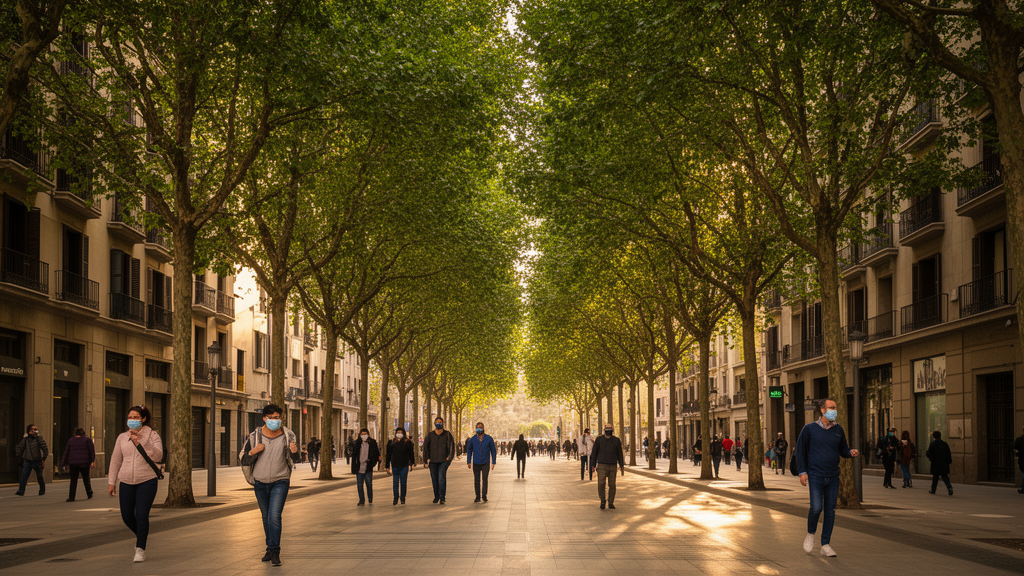
When the COVID-19 pandemic reshaped daily life in 2020, parks and open spaces became lifelines for millions of people confined to their neighbourhoods. But not all green spaces behaved the same way. A new population-based study of more than half a million residents of Northern Ireland suggests that the type of greenery outside your front door may have subtly shaped your odds of catching the virus. People living in neighbourhoods with abundant woodland cover were slightly less likely to test positive for COVID-19, while those surrounded by open grassland were slightly more likely to do so — and both effects were strongest in the most deprived communities.
The study, published in the International Journal of Public Health by a team at Queen’s University Belfast led by Ruoyu Wang, is among the first to examine the green space–COVID-19 link at the individual level rather than by comparing whole districts. Earlier research had produced contradictory results: some ecological studies in the United States found that more forest cover coincided with lower infection rates, while analyses in London suggested that greener areas could actually harbour more transmission, perhaps because they attracted crowds for outdoor socialising. By linking health records, property data, satellite-derived land cover maps and deprivation indices for 519,005 individuals, the Northern Ireland team sought to cut through that ambiguity.
The data came from the National Health Application and Infrastructure Services system, which covers nearly the entire population of Northern Ireland because the region’s health service is free at the point of use and more than 98 percent of residents are registered with a general practitioner. The researchers drew on 6.4 million individual COVID-19 test records collected between 29 March 2020 and 31 December 2021, spanning both hospital-based Pillar 1 testing and community-based Pillar 2 testing. After restricting the sample to community-dwelling residents with complete demographic and testing information, they were left with 519,005 unique individuals. Of these, 318,198 — or 61.31 percent — had at least one positive COVID-19 test during the first two pandemic years.
Green space exposure was measured using the UK Centre for Ecology and Hydrology’s Land Cover Map 2020, derived from satellite imagery. The researchers separated green space into two categories that previous work suggested could have very different health effects: grassland, including improved, neutral, calcareous, acid and heather grassland, and woodland, comprising broadleaved and coniferous stands. Each resident’s address in January 2020 was matched to a Super Output Area, the primary administrative unit in Northern Ireland containing between 2,000 and 6,000 households. Within each of these neighbourhoods, the proportion of grassland and woodland was calculated and then divided into quintiles, from the least green fifth to the most green fifth, allowing the team to detect non-linear patterns while satisfying privacy protection rules.
The statistical machinery was a two-level multilevel logistic regression model, with a random intercept for each Super Output Area to account for the clustering of residents within the same neighbourhoods. The models adjusted for sex, age, the income domain of the Northern Ireland Multiple Deprivation Measure, urbanity based on settlement population bands, and the capital value of each resident’s house, graded from under £100,000 to £400,000 and above. A variance inflation factor of 1.79 confirmed that multicollinearity among predictors was not a concern, and supplementary analyses using log-binomial and Poisson regression produced broadly consistent estimates.
The results revealed a striking divergence between the two types of greenery. Compared with residents of neighbourhoods in the lowest woodland quintile, those in the second, third and fifth woodland quintiles had lower odds of a positive COVID-19 test, with the most wooded areas showing an odds ratio of 0.939 — a 95 percent confidence interval of 0.894 to 0.987. Grassland told the opposite story: residents of neighbourhoods in the third, fourth and fifth grassland quintiles had higher odds of testing positive relative to those in the least grassy areas, reaching an odds ratio of 1.062 in the greenest quintile. Socioeconomic deprivation itself mattered, too. Individuals in the least deprived three quintiles of the deprivation measure had significantly lower odds of infection than those in the most deprived fifth, and people living in the most expensive housing grade also faced reduced odds, while those in the second-cheapest grade faced elevated odds.
Perhaps the most compelling finding emerged when the researchers stratified their analysis by socioeconomic status. The protective effect of woodland was significantly stronger in the most deprived neighbourhoods and among people in the lower housing value grades — an effect modification confirmed by statistically significant interaction terms. For residents of the most deprived fifth of neighbourhoods, higher woodland cover was consistently associated with lower odds of infection, whereas no such benefit appeared among those in the least deprived areas. This pattern echoes the equigenesis hypothesis, which holds that deprived groups, lacking private gardens, safe jobs that can be done from home and other health-promoting resources, may derive disproportionately large benefits from freely accessible public amenities. Deprived residents were also less able to work from home during lockdowns and more likely to depend on public green spaces for exercise and respite, making the character of those spaces matter more for their infection risk.
Why would woodland and grassland pull in opposite directions? The authors propose several mechanisms rooted in how people behave in each setting. Woodland, with its canopy and shade, tends to invite solitary, movement-based activities such as walking, in which individuals keep traveling from place to place and naturally maintain distance from one another. Open grassland, by contrast, provides expansive flat terrain that encourages gathering, sport and prolonged social contact — precisely the conditions that favour respiratory transmission. There is also the hygiene hypothesis to consider: contact with the diverse microbial antigens found in wooded environments may bolster immune function, potentially adding a physiological layer of protection on top of the behavioural one. Intriguingly, the sex-stratified analyses hinted at behavioural differences behind the numbers, with the woodland effect stronger among men, who tend to use green space for physical activity, and the grassland effect stronger among women, who were more likely to use green space for social contact during the pandemic.
Other patterns added texture to the picture. The protective woodland association was stronger in rural areas, where lower population densities and lighter restrictions on outdoor activity meant people could use green spaces with less fear of crowding. The effect of deprivation on infection was weaker among minors, consistent with evidence that children’s more robust immune function partially insulates them regardless of family circumstances, while the green space effect was muted among older adults, whose reduced mobility during the pandemic likely limited their exposure to neighbourhood greenery. Sensitivity analyses bolstered confidence in the core findings: substituting the overall deprivation measure, using 2019 land cover data to test for lagged effects, excluding residents who moved between neighbourhoods, and running separate models for 2020 and 2021 to account for the vaccine rollout’s confounding influence all left the conclusions intact.
The authors are careful to note the study’s limits. Its cross-sectional design precludes causal inference, and exposure was measured at the neighbourhood rather than the household level, introducing the well-known Modifiable Areal Unit Problem: quintile assignments could shift under different geographic boundaries. Asymptomatic infections went uncounted, vaccination and occupational exposure data were unavailable, and the study could not observe how individuals actually used green spaces, leaving the proposed mechanisms as well-grounded inference rather than demonstrated fact. Even so, the implications are tangible. The findings suggest that public health strategy during future respiratory pandemics should not treat all outdoor activity as equivalent risk, and that governments should work with urban planners to expand tree-rich green space — particularly in deprived neighbourhoods — as a component of pandemic preparedness. In the arithmetic of the study, even a modest odds ratio, applied across an entire population, translates into thousands of infections prevented.
Subject of Research: The association between neighbourhood woodland and grassland cover, socioeconomic deprivation, and COVID-19 infection in Northern Ireland
Article Title: The association between green space, socioeconomic deprivation, and COVID-19 infection: a population-based cross-sectional study
Article References: Wang, R., Patterson, L., Maguire, A., & Hunter, R. F. (2026). The association between green space, socioeconomic deprivation, and COVID-19 infection: a population-based cross-sectional study. International Journal of Public Health, 71, Article 1609558. https://doi.org/10.3389/ijph.2026.1609558
Image Credits: AI Generated
DOI: 10.3389/ijph.2026.1609558
Keywords: COVID-19, green space, woodland, grassland, socioeconomic deprivation, Northern Ireland, epidemiology, public health, cross-sectional study, equigenesis, pandemic preparedness, urban planning
Cite Scienmag News
Kristina Jarvis. (October 16, 2026). Trees May Have Shielded Neighbours From COVID-19 in Landmark Study of Half a Million People. Scienmag. https://scienmag.com/trees-may-have-shielded-neighbours-from-covid-19-in-landmark-study-of-half-a-million-people/
Kristina Jarvis. "Trees May Have Shielded Neighbours From COVID-19 in Landmark Study of Half a Million People." Scienmag, 16 October 2026, https://scienmag.com/trees-may-have-shielded-neighbours-from-covid-19-in-landmark-study-of-half-a-million-people/. Accessed 16 October 2026.
Kristina Jarvis. "Trees May Have Shielded Neighbours From COVID-19 in Landmark Study of Half a Million People." Scienmag. October 16, 2026. https://scienmag.com/trees-may-have-shielded-neighbours-from-covid-19-in-landmark-study-of-half-a-million-people/


