


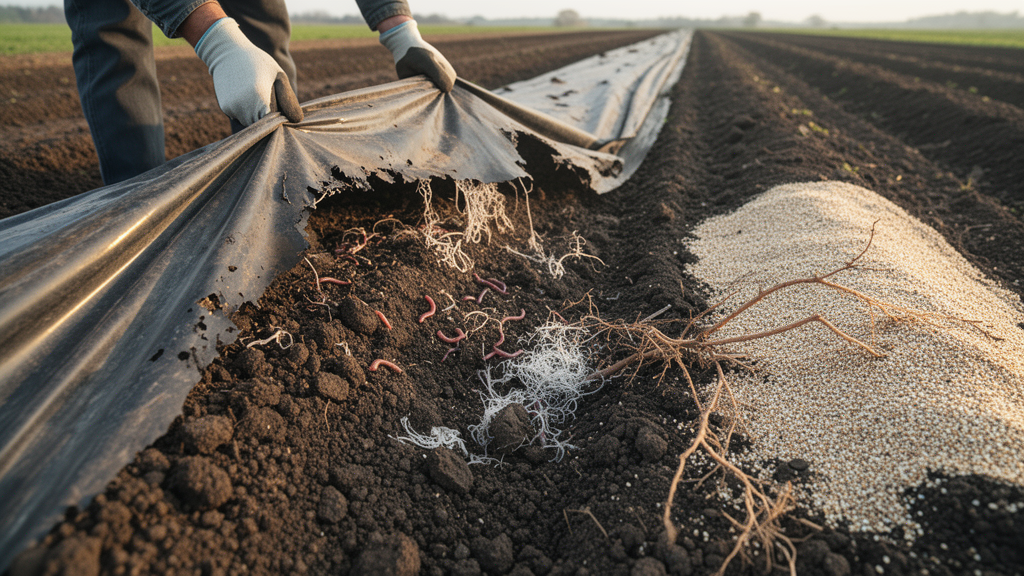
Biodegradable plastic mulches have been heralded as a greener alternative to the conventional polyethylene films that blanket vegetable fields around the world. Unlike traditional plastic, which must be painstakingly peeled off the soil at the end of each season and often ends up fragmenting into persistent microplastics, soil-biodegradable plastics are designed to be tilled straight into the ground, where microbes should eventually dismantle them. But that promise comes with a hidden twist: as these films break down, they release an entirely new source of carbon into the soil, and nobody fully understands what that influx does to the invisible ecosystems and physical architecture beneath our feet. A new year-long laboratory study from the University of Bologna, published in Frontiers in Soil Science, now offers one of the most detailed pictures yet, and its central finding is striking: the same biodegradable plastic can leave two very different fingerprints depending on whether it lands in a loamy or a sandy soil.
The research team, led by Paola Gioacchini and Martina Mazzon, took two contrasting agricultural soils, a loamy Cambisol rich in silt and clay and a sandy Arenosol dominated by coarse particles, and mixed in fragments of a commercial biodegradable mulch film made of Mater-Bi, a starch-based polymer produced by Novamont. The fragments, sized between two and five millimeters, were added at three concentrations: 100, 1,000 and 10,000 milligrams per kilogram of dry soil, corresponding to 0.01, 0.1 and 1 percent by weight. The lowest dose mirrors the estimated annual input of biodegradable mulch material in a realistic agronomic setting, while the highest matches the loading rate recommended by the European standard EN 17033 for testing biodegradability. The soils were then incubated at 23 degrees Celsius, held at 60 percent of their water-holding capacity, for a full twelve months, with microbial measurements taken at the start, at six months and at the end of the experiment.
The clearest signal emerged at the highest dose, and it was dramatic. After one year, microbial biomass carbon, a measure of the living microbial community, was 69 percent higher in the loamy soil and 25 percent higher in the sandy soil compared with untreated controls. Because the biodegradable plastic contains roughly 60 percent carbon and no nitrogen, the highest dose delivered a hefty 6,000 milligrams of carbon per kilogram of soil, essentially a feast for soil microbes. At the six-month mark, the effect was already visible, with microbial biomass reaching approximately 583 milligrams per kilogram in the loamy soil and 238 in the sandy soil. Even though microbial biomass declined in all treatments between six and twelve months, the highest-dose treatment remained significantly elevated above both the control and the lower doses, suggesting that a large pulse of plastic-derived carbon can sustain microbial growth for a remarkably long time.
Quantitative PCR of bacterial 16S rRNA genes and fungal target genes revealed a more nuanced, and partly surprising, story. In the sandy soil, the intermediate dose of 1,000 milligrams per kilogram produced the highest bacterial and fungal gene abundance across the two sampling times, outperforming even the highest dose. The researchers suspect this counterintuitive result relates to carbon losses measured in a companion study: at the highest dose, the sandy soil had released extremely large amounts of carbon dioxide early in the incubation, meaning much of the available carbon may have escaped as gas rather than being converted into microbial cells. In the loamy soil, by contrast, microbial responses were strongly time-dependent, with the highest dose producing peak fungal abundance at six months. The prominence of fungi fits with earlier work showing that fungi are key colonizers and degraders of biodegradable plastics, thanks in part to their ability to produce cutinases, enzymes that accelerate polymer breakdown and carbon release.
Beyond the microbes, the plastic fragments physically restructured both soils. At the end of the year, the researchers used wet sieving to separate each soil into three size classes: macroaggregates larger than 250 micrometers, microaggregates between 250 and 50 micrometers, and the free silt-clay fraction below 50 micrometers. The highest plastic dose increased macroaggregate abundance by 32 percent in the loamy soil and 11 percent in the sandy soil, while sharply reducing the free silt-clay fraction, which fell to just 8.9 percent of the loamy soil’s mass compared with 28.5 percent in the untreated control. The likely mechanism is twofold: the plastic fragments can act as nuclei around which mineral particles, microbial biomass and organic matter coalesce into larger aggregates, and the surge in microbial growth supplies the sticky residues and extracellular substances that bind those particles together.
Crucially, the researchers corrected aggregate weights for sand content, since the sandy soil’s aggregates were up to 90 percent sand by weight, allowing a fair comparison between the two textures. This revealed that the loamy soil inherently holds far more real aggregate material, with 78 percent more macroaggregates and 71 percent more microaggregates than the sandy soil. The lower plastic doses produced weaker and more soil-specific effects: in the loamy soil, the two lower doses increased the recovery of microaggregates to about 50 percent of the soil mass, possibly because macroaggregates formed early in the incubation broke down and freed microaggregates previously locked inside them. In the sandy soil, only the highest dose shifted aggregate composition at all, underscoring how coarse-textured soils resist structural change unless the input is large.
The redistribution of aggregates carried carbon and nitrogen with it. The highest plastic dose increased carbon and nitrogen contents in macroaggregates in both soils, and also in the sandy soil’s microaggregates, while the free silt-clay fraction lost both elements. According to the classic aggregate-turnover model of Six and colleagues, this occlusion of fine particles within macroaggregates may actually protect carbon and nitrogen from microbial attack and mineralization, since physical barriers inside aggregates limit oxygen diffusion and enzyme access. The carbon-to-nitrogen ratio narrowed steadily from macroaggregates down to the silt-clay fraction in both soils, a signature of the predominantly microbial origin of organic matter in the finest fractions, where nitrogen-rich microbial residues accumulate and bind chemically to mineral surfaces.
Stable isotopes added a final layer of insight, and an unexpected one. Nitrogen isotope values, expressed as δ15N, rose progressively from macroaggregates to the finest fractions in both soils, indicating extensive microbial recycling of nitrogen in the smaller fractions, although the plastic itself had no effect on this pattern in the loamy soil and only a modest one in the sandy soil. Carbon isotopes told a different story in each soil: in the loamy soil, the silt-clay fraction was enriched in carbon-13, consistent with repeated microbial processing leaving heavier isotopes behind, while in the sandy soil the finest fraction was actually depleted in carbon-13, possibly reflecting rapid mineralization in which microbes preferentially consumed the lighter, labile compounds and left recalcitrant, carbon-13-depleted molecules stabilized on mineral surfaces. These isotopic shifts were driven by soil texture rather than by the plastic, showing that the soil itself, not the added carbon, governs the pathways of transformation and stabilization.
The authors are careful to note the caveats. The strongest responses occurred at 1 percent plastic by weight, an order of magnitude above realistic annual inputs, and the closed incubation system prevented nitrate leaching, which may have masked some nitrogen isotope effects. Yet the fact that even the lowest, field-realistic dose produced detectable changes in microaggregate recovery and associated carbon and nitrogen is a warning worth heeding. As biodegradable mulches are tilled into fields season after season, their residues will accumulate, and whether the effects documented here persist, amplify or fade over years of repeated incorporation remains an open question. The researchers argue that long-term field studies with repeated applications, focused on realistic doses, are now essential before the soil-biodegradable plastic revolution can be declared truly benign for the ground it is meant to protect.
Subject of Research: Effects of biodegradable plastic mulch residues on soil microbial biomass, aggregation, and carbon and nitrogen stabilization in loamy and sandy soils
Article Title: Contrasting responses of loamy and sandy soils to biodegradable plastic residues: microbial biomass, aggregation, and aggregate-associated carbon and nitrogen
Article References: Contrasting responses of loamy and sandy soils to biodegradable plastic residues: microbial biomass, aggregation, and aggregate-associated carbon and nitrogen. (n.d.). https://doi.org/10.3389/fsoil.2026.1950823
Image Credits: AI Generated
DOI: 10.3389/fsoil.2026.1950823
Keywords: biodegradable plastic mulch, soil aggregates, microbial biomass carbon, soil organic carbon, nitrogen cycling, stable isotopes, soil texture, microplastics, soil biogeochemistry, Mater-Bi, qPCR, carbon sequestration
Cite Scienmag News
Alan Morgan. (October 16, 2026). Biodegradable Plastic Mulch Residues Reshape Soil Life Differently in Loamy and Sandy Soils. Scienmag. https://scienmag.com/biodegradable-plastic-mulch-residues-reshape-soil-life-differently-in-loamy-and-sandy-soils/
Alan Morgan. "Biodegradable Plastic Mulch Residues Reshape Soil Life Differently in Loamy and Sandy Soils." Scienmag, 16 October 2026, https://scienmag.com/biodegradable-plastic-mulch-residues-reshape-soil-life-differently-in-loamy-and-sandy-soils/. Accessed 16 October 2026.
Alan Morgan. "Biodegradable Plastic Mulch Residues Reshape Soil Life Differently in Loamy and Sandy Soils." Scienmag. October 16, 2026. https://scienmag.com/biodegradable-plastic-mulch-residues-reshape-soil-life-differently-in-loamy-and-sandy-soils/


